
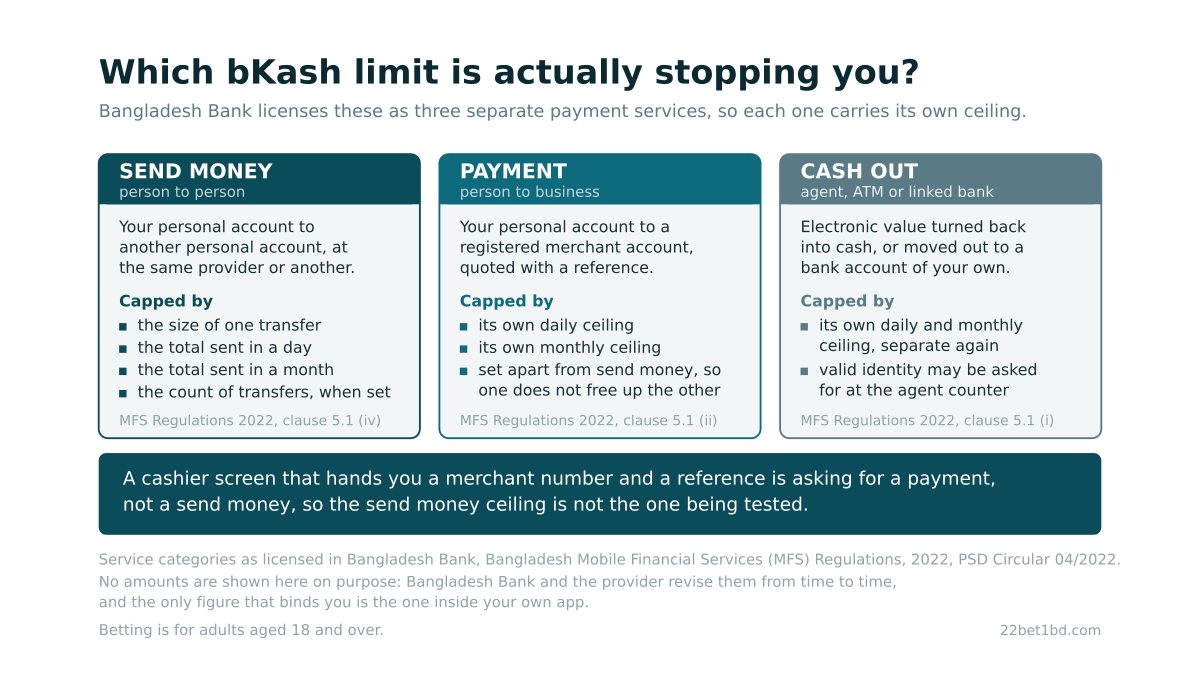
The bKash send money limit is not a single figure. It is a set of ceilings that apply at the same time to one specific service, person to person transfer, and a transfer can be refused by any one of them while your balance is untouched. That is the part people miss, and it is why a transfer that worked last week fails today: the money was fine, the cap that bound was a different one.
What is the bKash send money limit, and why is it not one number?
Send money is a licensed service category before it is a button in an app. Bangladesh Bank sets out what a mobile financial services provider is permitted to offer, and it lists person to person payments separately from merchant payments, from cash in, and from cash out. The regulator's own definition of the person to person category is narrow: one personal account to another personal account, at the same provider or a different one, plus movements between an account and a bank account. You can read the categories in clause 5.1 of the Bangladesh Mobile Financial Services Regulations 2022, issued by the Payment Systems Department as PSD Circular 04/2022.
The consequence is structural. A ceiling does not belong to your account as a whole. It belongs to a service, and there are several services inside the same app. Room left in one does not release room in another, which is the single most useful thing to understand before you go looking for a number.
Numbers are the part that will not hold still. The regulations say providers follow the rules, regulations, guidelines and instructions issued by Bangladesh Bank from time to time, at clause 16.2, and news coverage of one such revision is a large part of what a search on this question returns. Any figure written on a page like this one has a shelf life measured in months, so what follows describes the structure and tells you where the live figure lives.
How do the per day, per month and per transaction caps stack up?
Four separate measurements can be applied to the same service, and they are checked together:
- Per transaction. The largest amount that may move in one instruction.
- Per day. The total across every send money transfer inside the provider's day, which starts and ends on the provider's clock rather than yours.
- Per month. The total across the month. This is the one that surprises people, because it accumulates quietly while each individual transfer looks small.
- Count of transfers. Some caps are counted in transfers rather than in money. Whether one of these is in force, and at what level, is set by instruction rather than fixed in the regulations, so it is not something to assume from an older page.
Whichever is nearest is the one that binds. A refusal therefore carries very little diagnostic information on its own: it tells you a ceiling was reached, not which. Late in the month, with a comfortable balance and a modest amount, the monthly total is the usual answer. Early in the month, on a large single transfer, it is the per transaction cap.
This is also why splitting an amount into smaller pieces often does not help. Smaller pieces still add into the daily and monthly totals, and if a count cap is active they consume it faster. The only cap that splitting addresses is the per transaction one.
How do you check your own bKash send money limit rather than read it somewhere?
Inside the app, on the limit screen, where it is shown per service and for your account rather than for accounts in general. That is the figure that will be applied to you.
It is worth being blunt about why third party pages disagree with each other on this. They copy one another, and a copy taken before a revision stays online afterwards looking exactly as confident as it did the day it was true. The pattern is not confined to payment blogs. This site does not publish deposit minimums or maximums either, and for the same reason: a cashier screen takes ten seconds to read and is the only figure that binds you.
How do you increase a bKash send money limit?
Through account status, and there is no other lever. The regulations tie the opening of accounts to full observance of know your customer and customer due diligence procedures as prescribed by the competent authority, at clause 7.4, and make the provider responsible for keeping those records current under instructions from the Bangladesh Financial Intelligence Unit, at clause 11.2. An account sitting on a lower ceiling usually has an incomplete or outdated record behind it, and completing verification is the documented route.
What is not a route is using someone else's account. The same regulations state at clause 10.1 that any transfer transaction involving third party accounts at the sending or the receiving end is prohibited, and that providers must monitor transaction patterns to identify unauthorised or suspicious activity. Providers are also bound by the Money Laundering Prevention Act and by instructions issued by the Financial Intelligence Unit, at clause 11.1. A wallet is a monitored record rather than a private one, and arrangements that route around a ceiling are precisely the pattern that monitoring exists to notice.
Why is the cash out limit in bKash a separate cap?
Because it is a separate service. The regulations define cash in as the exchange of cash for electronic value and cash out as the exchange of electronic value for cash, and they are listed in a different sub category from person to person transfer. Each carries its own ceiling.
That separation has a practical edge. Unused send money allowance does not become cash out allowance at the agent counter, and the reverse is equally true. The regulator also notes that customers may be asked to show valid identity to an agent to complete a cash in or a cash out, which is a step that does not arise in an app to app transfer.
Bangladesh Bank publishes a monthly comparative summary of the whole sector and breaks it down by product, with person to person transfer, cash out and merchant payment reported as separate lines. The mobile financial services statistics are worth a look if you want to see that these are genuinely different products in the regulator's accounting rather than three names for one thing.
Which limit applies when the money is heading toward a betting account?
Usually not the send money one, and that is the most common source of confusion in this topic.
A deposit at an operator cashier is normally a merchant payment. You are shown a merchant number and a reference, and you pay to that number quoting the reference. Under the regulator's categories that is a person to business payment, a different service from person to person transfer, with its own ceiling. So a send money limit you looked up carefully may have nothing to do with the refusal you are troubleshooting. 22Bet is the operator this site covers, and the page on how deposits and withdrawals work from Bangladesh sets out its cashier flow for each local wallet alongside the three failure modes that account for most missing payments.
There is a second structural point that rarely appears in articles on this query. Clause 7.6 of the regulations states that no outward or cross border payment transaction may be undertaken by a mobile financial services provider, since those can only be handled by the authorised dealer branches of scheduled banks. Foreign inward remittance reaches a wallet only through a bank and is paid out in local currency. A wallet is a domestic rail by design, whatever sits at the other end of the transaction.
Whether any of this activity is permitted for you is a separate question with a separate answer, and it is not settled by an operator holding a licence issued abroad. That question is covered in what the law in Bangladesh actually says, and the FAQ collects the ones that come up most. Betting is for adults aged 18 and over, money placed on an uncertain outcome should be money you had already decided you could lose, and a transfer ceiling is a limit set by a regulator rather than a budget set by you.
Frequently asked questions
Does a bKash to bank transfer come out of the send money allowance?
In the regulator's categories it sits in the same person to person group, which also covers payments from an account to a bank account and back. Providers nevertheless present it as its own service in the app with its own ceiling, so the two do not necessarily share a pot. The limit screen is the place that resolves it, and the answer can differ between providers. The regulations separately state at clause 7.8 that account holders are free to move their balance to their own deposit account and that providers must act immediately on such a request.
Is the send money limit different on a merchant account?
A merchant account is a different account type, opened under its own due diligence requirements, and it sits on the receiving side of a person to business payment rather than the sending side of a personal transfer. The personal send money ceiling is not the cap that governs it. If you are looking at a merchant account, you are looking at the wrong row of the limit table.
If a transfer is refused for exceeding a limit, has anything been deducted?
A refused instruction is not a partial transfer. The point of the check is that the instruction does not execute, so nothing moves and nothing is charged. If money has left your balance and not arrived, that is a different problem from a limit, and the transaction identifier is the first thing any support conversation will ask for. Keep it before you start chasing.