
Not reliably, no. Is cricket betting profitable is a question with an arithmetic answer rather than an opinion, and the arithmetic is public: every price a bookmaker publishes has a margin folded into it, so the prices in a single market add up to more than one whole. That gap is charged before a ball is bowled and it stays in the book whichever side wins. Anyone telling you otherwise is describing a good run, or selling something.
What is cricket betting, and what is a bookmaker doing in it?
Cricket betting is an agreement about an uncertain outcome at a fixed price. You stake an amount on a stated result, the price is agreed the moment the bet is accepted, and the match decides whether the bet returns anything.
The bookmaker is not the other player in a contest of prediction, which is how most people picture it. It is the counterparty that publishes prices and accepts stakes on every side of the same market. Its business is not being right about who wins, it is setting prices so that the money taken across the whole market leaves it ahead no matter which result arrives. That distinction answers the profitability question and almost every other question underneath it.
What happens on the field is governed elsewhere. The Laws of Cricket are written and maintained by MCC, which publishes each edition in full. The bookmaker prices what those rules produce and settles against them.
What are odds in cricket betting, and what do they imply?
A decimal price is a multiplier on the stake, and it is also a statement of probability wearing different clothes. To read the probability, divide one by the price.
A price of 2.00 implies one chance in two. A price of 1.25 implies four chances in five. A price of 5.00 implies one in five. That division is the entire conversion and it works on any price on any screen.
Prices move because the two inputs behind them move. The sporting picture changes with the toss, the surface, the forecast and who is actually named in the eleven, and in cricket the toss carries more weight than in most sports because it can decide who bats on a surface that will not behave the same way twice. The money changes too: if stakes pile up on one side, that price shortens, because the book has to balance regardless of who looks the better team. A price is not a forecast handed down from someone who knows. It is the number at which the book balances.
Is cricket betting profitable once the margin is counted?
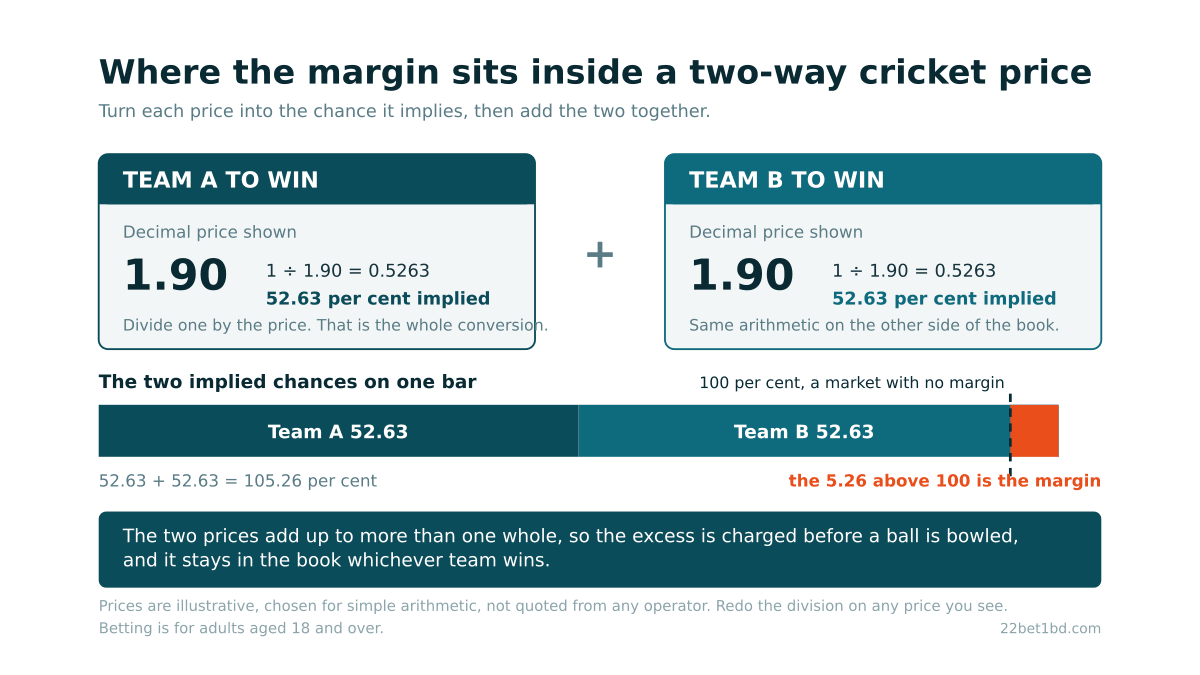
Do the conversion on both sides of a two-way market, then add the two implied chances together. The total does not come to one whole. It comes to more.
Take two sides priced identically at 1.90, a figure used here because it divides cleanly and not because it is quoted from anywhere. One divided by 1.90 is 0.5263, which is 52.63 per cent, and the same on the other side. Together they total 105.26 per cent. A market describing nothing more than two possible outcomes would total 100. The excess is the margin, also called the overround or the vig, and it is not a fee deducted afterwards from winnings. It is already inside the price you accepted. How wide that excess runs varies by book and by market, which is why the division is worth doing on the prices in front of you rather than assuming a figure.
This is what makes the honest answer no. To break even over time you would have to be more accurate than the published price by at least the margin, on average, across every bet you place, over a sample long enough that luck has stopped deciding the total. The margin applies to the bets you win as much as the ones you lose, because it was priced into both.
Short-run results say almost nothing about this. A run of winning bets is compatible with a losing method, and a run of losses with a sound one. That is variance rather than evidence, and it is why the arithmetic has to be read from the price rather than from last month's results.
What are match handicap and over/under markets for?
A match handicap gives one side a notional head start, expressed in cricket as runs or wickets depending on the market, and settles on the result after that adjustment. Its purpose is structural: a lopsided contest produces one very short price and one very long one, and a handicap turns it back into a market with two prices near each other that people will bet on both ways.
An over/under market, sometimes called a total, prices a number rather than a winner. Total runs in an innings, total runs in the opening overs, total wickets in a session. You are not backing a team, you are taking a position on whether a quantity lands above or below a line the bookmaker set to divide the money rather than to predict the score.
Both carry the same margin structure as the match winner market. A less obvious market is not a softer one: the overround is the same mechanism asking a different question.
What is virtual cricket betting, and why is it a different question?
Virtual cricket betting is a bet on a simulated match produced by software, not on eleven people playing. There is no toss, no pitch, no injury news and no crowd, because there is no match. The result comes from a random number generator, and the animation on screen is a rendering of a number that has already been drawn.
This matters more than it first appears. In a real match there is at least something to analyse, even if the price has already absorbed most of it. In a virtual round there is nothing, because each round is generated independently of the last one. No sequence, no staking pattern and no reading of previous rounds changes the chance of the next result, and any system claiming otherwise is describing a pattern in numbers drawn without memory. That is a difference in kind rather than degree, even though virtuals and real cricket sit in the same account.
What happens when the match does not produce a clean result?
Cricket produces unclear endings more often than most sports, and rain, bad light and interruptions are handled by the playing conditions rather than by the bookmaker. The ICC publishes the playing conditions for Tests, ODIs and T20Is, and the Duckworth Lewis Stern method that sets revised targets in shortened matches is published in the same rules and regulations section. A match cut short can still produce an official result under that method, and a match abandoned before the minimum play required can produce no result at all. Those are two different outcomes and bets are treated differently in each.
Then there is the dead heat, which most people meet for the first time when it happens to them. If two selections finish level in a market that expects one winner, such as top run scorer, the usual mechanism is to divide the stake between the tied selections and settle only the divided part at the original price. The bet is neither lost nor paid in full.
Where a site draws each of these lines is in its own settlement rules and the detail varies, which is why that page is worth opening before the bet rather than after a disputed one. 22Bet is the operator this site covers, and how its cricket markets are organised is set out in the 22Bet review.
So what would have to be true for a bettor to come out ahead?
Being more accurate than the price by more than the margin, consistently, over a sample long enough to mean anything. No staking plan changes that condition. Adjusting how much you bet changes the shape of the swings, not the expected result of each individual bet, and a plan that raises stakes after losses changes the size of the eventual loss rather than its likelihood.
Betting is for adults aged 18 and over, and the arithmetic above runs against the bettor by default, which is the sense in which it is a cost rather than an income. If a session stops being something you would choose to pay for, that is the point to stop, and a run of losses is not a reason to continue. Whether any of this is permitted where you are is a separate question with its own answer, covered in what the law in Bangladesh actually says, and an operator's foreign licence does not settle it.
Frequently asked questions
What is online cricket betting, as opposed to betting through someone locally?
Pricing is published and updated continuously rather than quoted to you by a person, and every stake and settlement sits in an account record you can read back. That record is the part people underestimate: it exists whether or not you look at it, and it is why identity verification tends to appear at the withdrawal stage rather than at signup.
Does the bookmaker lose money when a heavy favourite wins?
On that single market it can. The margin guarantees a profit only across a book where the money is spread roughly in line with the prices, and that rarely happens perfectly on one match. The business works across many markets over a long period, not match by match.
What happens to a bet if a named player does not take the field?
That depends on the market rather than the match. A match winner bet normally stands, because the market was about the team. A market on an individual, such as runs scored by a particular batsman, is normally void with the stake returned, since the question it asked can no longer be answered. Confirm it in the operator's rules, because the definition of taking part varies.
Does a cricket betting app work differently from the site?
Prices, markets and settlement are the same, since both reach the same account. The difference is installation: on Android, an app distributed outside the Play Store requires you to allow installs from an unknown source, which means turning off a security check that exists for a reason. That trade off, and the iPhone situation, is covered on the app page, and the questions that come up most often are collected in the FAQ.