
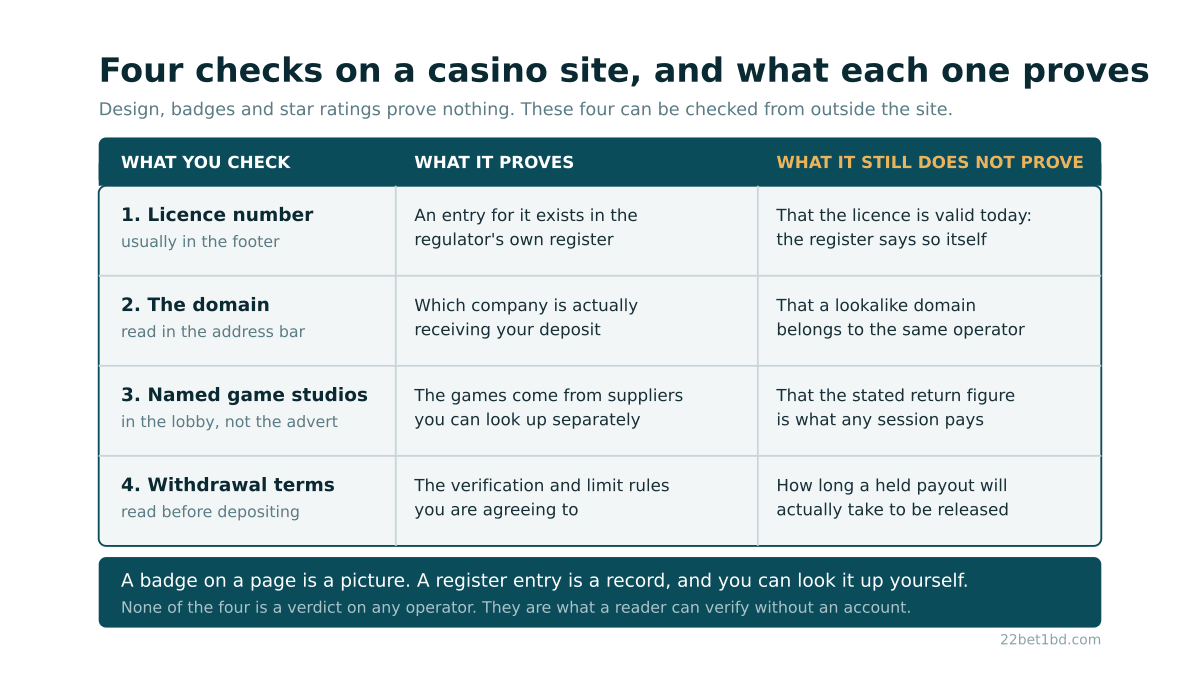
Some are. Is online casino fake is a question people usually type after something specific has happened: a payout that has not arrived, an app that asked for permissions it had no reason to need, a licence badge in a footer that links nowhere. The useful answer is that a small number of casino sites are outright clones or unlicensed shells, most are real companies registered somewhere, and neither of those facts tells you anything about the one in front of you. What does tell you something is a short set of checks you can run from outside, before you have an account, none of which requires believing the site's own description of itself.
Is an online casino fake, or real but unaccountable?
These are two different problems and they need different checks, which is why "is it a scam" so often gets a useless answer.
The first problem is a clone. Someone copies the design, the logo and often the exact page text of a known operator, registers a domain one character away from the real one, and takes deposits. Nothing behind it is real, including the games. This is rare, it is uncovered by looking at the domain rather than the page, and it is the only case where the word "fake" is literally accurate.
The second problem is far more common and gets called fake by people who lost money to it: a site that genuinely exists, genuinely holds a licence somewhere, and is still nearly impossible to hold to anything. Your deposit arrives, your account works, and then a withdrawal enters a review that has no stated end. The company is real. Your recourse is what is thin.
Almost everything written about spotting a fake casino is written about the first problem. Most readers actually meet the second.
How do you check a licence instead of trusting the badge?
A licence badge in a footer is an image file. Anyone can put one there, and a clone site copies it along with everything else, so its presence proves nothing at all. What the badge should carry is a licence number and the name of the authority that issued it, and those two things are checkable somewhere that is not the casino's own website.
Many operators reachable from Bangladesh are licensed in Curacao, and the authority there publishes its register of licensed entities. You can look up an entity yourself, which is the whole point of a public register. Read the caveat printed at the top of that page as well: the authority says the overviews do not guarantee that a listed licence is currently valid, because status changes over time. That is worth knowing, because "it appears in the register" and "it is licensed today" are not the same claim.
The same authority publishes public warning notices naming brands it says are offering games without a valid licence. A regulator naming a site is a much stronger signal than any review page, and it takes a minute to search.
Then check the thing a clone cannot copy: the domain in your address bar. Compare it, character by character, against the domain named wherever you first found the operator. A site can imitate every pixel of another site and still cannot be that other site's domain.
Do online slots pay real money, and what decides whether yours does?
They pay real money in both directions, and the number people cite when they ask this does not mean what it appears to mean.
A slot's stated return is a property of the game's design calculated across an enormous number of rounds, closer to a manufacturer's specification than a forecast. It describes the game, not your session. The complementary part of that figure, the margin, is built into the rules before anyone presses anything, and it does not switch off during a winning run or accumulate during a losing one.
That has one consequence worth stating plainly, because it is where most "is this rigged" questions actually come from. When a session goes badly, nothing needs to have gone wrong for that to happen. A game with a fixed margin and random outcomes produces long losing runs as ordinary output, and no system, staking pattern or timing changes the odds of the next round. Games with random outcomes are for adults aged 18 and over, and over any meaningful period they cost money rather than make it.
What is genuinely checkable is the supply chain. Look at whether the lobby names the studios that built the games and whether those studios exist independently of the casino. A site running unbranded games nobody else carries is a different proposition from one running software licensed from companies with their own reputations to lose.
Can online casinos ban you for winning?
Accounts do get closed and limited, and the mechanism is duller than the question suggests: it is a clause in the terms, written long before you won anything.
Read the section on account closure and limitation before depositing rather than after. Operators generally reserve the right to limit stakes, restrict markets or close an account, and the grounds listed tend to be duplicate accounts, verification that cannot be completed, or use of the service in ways the terms exclude. Which grounds a given site wrote down matters, because that document is what any dispute is decided against.
In games with a fixed built-in margin, a winning player is not a structural problem for the operator in the way a consistently winning sports bettor can be, since the margin does the work over time. Where accounts more often run into trouble is verification, which brings up the question people really mean.
Why does a withdrawal sit pending, and when is that the warning sign?
Most held withdrawals are held for reasons that are boring and resolvable. Identity checks are frequently only triggered on the first withdrawal rather than at signup, so the paperwork lands exactly when someone is waiting for money. A mismatch between the name on the betting account and the name on the payment wallet will stop a payout at nearly any operator. Many sites also require withdrawals to return to the method that funded the account, which is a rule about tracing money rather than a delaying tactic, and it is why depositing through someone else's wallet creates a problem you cannot fix later. How these routes work in practice is set out on the deposits page.
The signs that separate an ordinary hold from a real problem are these. A held payout with a stated reason, a document list that does not change, and a support channel that answers is a process. A hold where the requested documents change each time you satisfy them, where no reason is given, or where support stops replying once the amount is above a certain size is a different thing.
One red flag is worth naming on its own because it turns up in this market specifically. If a cashier, an agent or a support chat asks you to send a deposit to an individual person's mobile wallet number instead of through the site's own cashier, stop there. That transfer is a personal payment to a stranger, it sits outside whatever the operator's terms say about your balance, and a completed wallet transfer has no reversal route comparable to a card chargeback. Whatever the site is, that particular arrangement leaves you with nothing to point at.
Does any of this make the casino lawful for you in Bangladesh?
No, and the two questions get merged constantly, usually by pages that benefit from merging them.
A licence is issued to a company by the authority of the place that company is registered in. It sets obligations the operator owes and gives you somewhere to complain, which is a real reason to prefer a licensed site to an unlicensed one. It does not grant a permission that travels to the player, and it has no effect on Bangladeshi law, where the Gambling Prevention Act 2026 has been in force since 1 July 2026. That position is set out in full in what the law actually says, and the questions that come up most often are collected on the FAQ page.
This site carries affiliate links, including to 22Bet, and earns a commission when someone opens an account through one, which is a reason to apply the checks above to anything recommended here rather than fewer of them. What one operator does and does not publish about itself is gone through on the 22Bet review page. The checks in this article are not a verdict on any operator, including that one: they are what a reader can verify without an account.
Frequently asked questions
Does an app store listing prove a casino app is genuine?
It proves a developer account passed a store's review, which is a check on the app's behaviour and not on the operator's licence. The two are unrelated, and a store listing does not tell you the licence exists. When an app is installed from a file outside a store instead, even that limited check is skipped, along with the store's ability to remove it later. What sideloading actually trades away is covered on the app page.
If I paid a site that turned out to be a clone, can the transfer be reversed?
Not by you: there is no chargeback route to invoke on a completed wallet transfer. What is worth doing immediately instead is keeping the transaction ID and reporting the receiving number to the wallet provider, since a number collecting from many people is something the provider can act on even when your individual transfer cannot be pulled back.
Are user reviews useful evidence about a casino?
Praise is close to worthless, because review pages are cheap to seed and many are run by sites earning commission on the operators they rate. Complaints are more informative, not because complainers are more honest, but because nobody has a commercial reason to invent a withdrawal problem. Read them for the specific mechanism described, a document request that kept changing, a payout that stopped at a threshold, and ignore the star rating.