
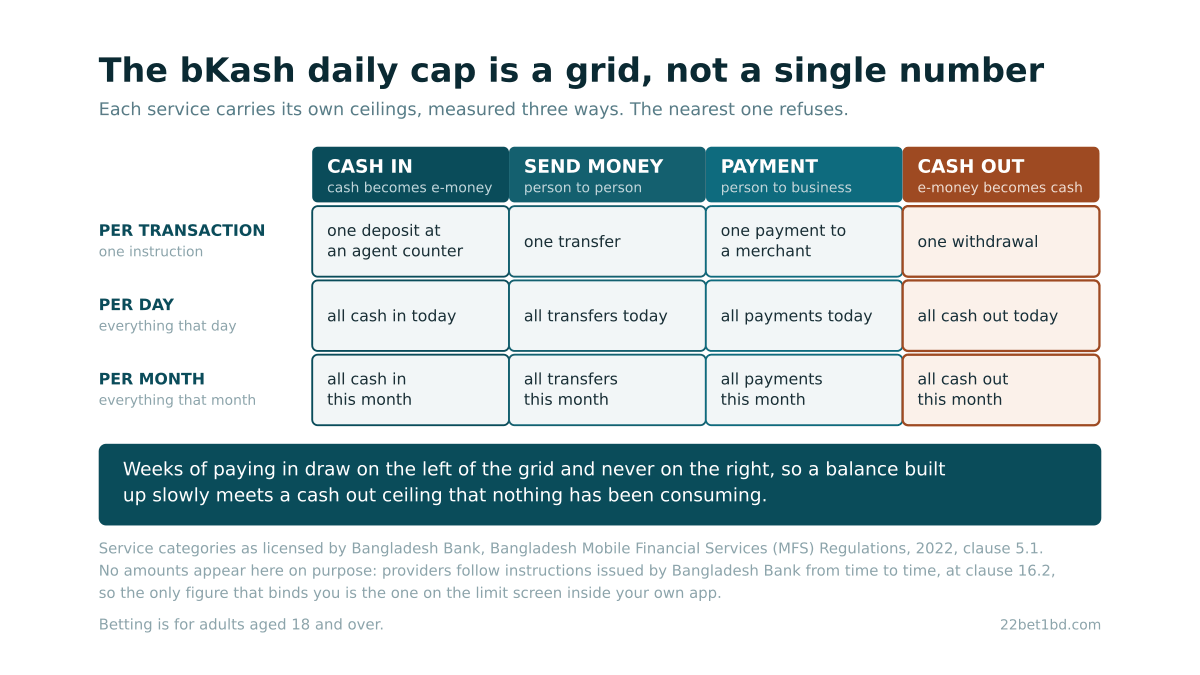
The bKash limit per day is not one number. It is a set of ceilings attached to services rather than to your account, so cash in, sending money, paying a merchant and taking cash out each carry their own daily total, and using up one of them does not release room in another. That is why a wallet which handled weeks of small payments without complaint can refuse a single larger instruction, and why the ceiling that strands money on the way out is usually not the one anyone looked up on the way in.
What is the bKash limit per day, and why is it never one number?
Because a wallet is not one product. Bangladesh Bank permits a provider to deliver several categories of payment service, and the Bangladesh Mobile Financial Services (MFS) Regulations, 2022 list them separately at clause 5.1. Three of those categories are the ones a wallet holder meets constantly: cash in to and cash out from an account, at agent locations, bank branches, ATMs, cards, linked bank accounts and other methods the regulator approves; person to business payments, which is where merchant payments sit; and person to person transfers, one personal account to another at the same provider or a different one. Separate categories, each with a ceiling of its own.
Then each of those services is measured in more than one way at the same time. There is a size for a single instruction, a total for the day, and a total for the month. The useful picture is therefore a grid rather than a list: services across the top, measures down the side, and every cell holding a ceiling of its own. Whichever cell is nearest is the one that refuses you.
This is what makes a refusal so uninformative. It names no cell. You are told that a ceiling was reached and left to work out which of twelve was nearest, and the shortlist depends on where you stand in the month and on how the amount compares with what you usually move. Reading a refusal that way inside the send money column in particular, including what changes when a cap is counted in transfers rather than in money, is set out in how the send money caps are structured.
Why is the bKash cash out limit per day the one that strands money?
Because of which direction the previous month ran in. Money arriving in a wallet draws on the cash in cell or on somebody else's send money allowance. Money paid out to a cashier draws on the payment cell. None of that touches the cash out column at all, so its allowance sits full and unexamined for as long as you are only paying in.
The day that changes is the day you want a larger sum back as cash. A balance that accumulated over several weeks in small movements has to leave through a ceiling measured in a single day, and there is no credit for the weeks in which you did not use it. Unused allowance does not carry forward. That is the structural reason a withdrawal often has to be taken across more than one day while the balance itself is perfectly fine, and it is the part of this topic that pages listing figures never explain.
There is a second thing about that column. Cash out happens at an agent counter or a machine rather than inside the app alone, and the regulations note at clause 10.1 that customers may need to show valid identity to an agent in order to complete a cash in or a cash out. The same clause limits agents to cash in, cash out and other transactions approved by Bangladesh Bank, so a counter is not a general purpose branch and cannot lift anything for you.
Does the bKash cash in limit per day apply to a deposit at a betting cashier?
No, and this is the most common mix-up in the whole subject. Cash in means physical money being exchanged for electronic value, normally at an agent. Paying an operator from a balance you already hold is not that. It is a person to business payment, category (ii) of clause 5.1, the same family as a utility bill or a merchant payment, and it draws on the payment column of the grid.
The practical consequence is that a deposit can be refused while your cash in allowance is completely untouched, and a cash in at an agent can go through on a day when a payment will not. Two different cells, checked independently. 22Bet is the operator this site covers, and the page on how deposits and withdrawals work from Bangladesh sets out which wallet appears at which step of its cashier, which is where you can see whether you are being asked for a payment or a transfer.
Is the daily limit different for personal, merchant and agent accounts?
Yes, and the difference starts earlier than the limit table. These are different account types, opened under different requirements. Clause 7.4 states that opening accounts in the names of individuals, businesses and other entities requires complete observance of know your customer and customer due diligence drills as prescribed by the competent authority. An account admitted on a different basis is governed on a different basis.
What each type does inside the grid also differs. A personal account sends person to person transfers and makes payments. A merchant account mostly sits on the receiving end of those payments, which is a different side of the same transaction. An agent account exists to perform cash in and cash out for other people, under clause 10.1, and is not a personal wallet with bigger numbers.
So the query "maximum transaction limit in bKash" has no single answer, and any page that gives one has quietly picked a row, a column and an account type without telling you which. A figure copied from a merchant page describes a service your personal account does not perform.
How do you read the daily and monthly limit that applies to you?
On the limit screen inside the app, and the useful part is that it arrives broken down by service. What you are looking at there is the grid itself, calculated for your account rather than for accounts in general, so read down the column you are about to use rather than the one you used last week.
Two things follow from that. Clause 16.2 of the regulations requires providers to follow rules, regulations, guidelines and instructions issued by Bangladesh Bank from time to time, so the figures move by instruction, and a page that was accurate before a revision goes on looking accurate afterwards. And the columns really are counted apart: Bangladesh Bank's own monthly statistics on mobile financial services report cash in, cash out, person to person transfer and merchant payment as separate product lines, which is the regulator confirming in its own accounting that these are four services and not four names for one pot.
This site publishes no operator minimum or maximum for the same reason, and the cashier screen is the only figure that actually binds you.
What does not raise a bKash daily limit?
Splitting an amount moves one cell only, the per transaction one. The pieces still add into the daily and the monthly totals, so a split aimed at the wrong cell reaches the same wall a few minutes later.
Using someone else's wallet is not a way around it either. Clause 10.1 prohibits transfer transactions involving third party accounts at the sending or the receiving end, and requires providers to monitor transaction patterns for possible unauthorised or suspicious activity, which makes that arrangement the shape the monitoring is watching for rather than a route past it.
The documented route runs through account status: completing the verification your provider asks for, through the provider itself. None of this speaks to whether the activity behind the payment is permitted for you, which a licence an operator holds abroad does not settle either way; that question is taken up in what the law in Bangladesh actually says, and the FAQ gathers the ones asked most often. Betting is for adults aged 18 and over, money placed on an uncertain outcome should be money you had already decided you could lose, and a ceiling set by a regulator is a limit on the wallet, not a budget for the week.
Frequently asked questions
If a cash out is refused at an agent counter, was it my limit or the agent's?
It can be either, and the counter rarely says. Agents are a separate account type performing cash in and cash out for many customers under clause 10.1, so their own capacity is consumed by everyone who came in before you, particularly late in the day. The way to tell them apart is that your own remaining allowance is visible in your app, and the agent's is not: if the app shows room and the counter still refuses, the constraint is on their side, and another agent is a reasonable next attempt.
Does a transfer to an account at Nagad or another provider come out of the same daily total?
It sits in the same person to person column regardless of where it lands. Clause 5.1 defines that category as covering personal accounts at the same provider or a different one, and clause 13.2 requires providers to build fund transfer in a completely interoperable way. Crossing to another provider changes the destination, not the service, so it does not open a fresh allowance.
Does the daily limit reset at midnight?
Treat that as an assumption rather than a fact, because the day being measured is the provider's accounting day and it is defined by them rather than by your clock. The reliable move is to read the remaining allowance on the limit screen instead of waiting for an hour you have guessed at. A transaction attempted on the assumption that the counter has already rolled over is one of the easier ways to burn an attempt for nothing.