
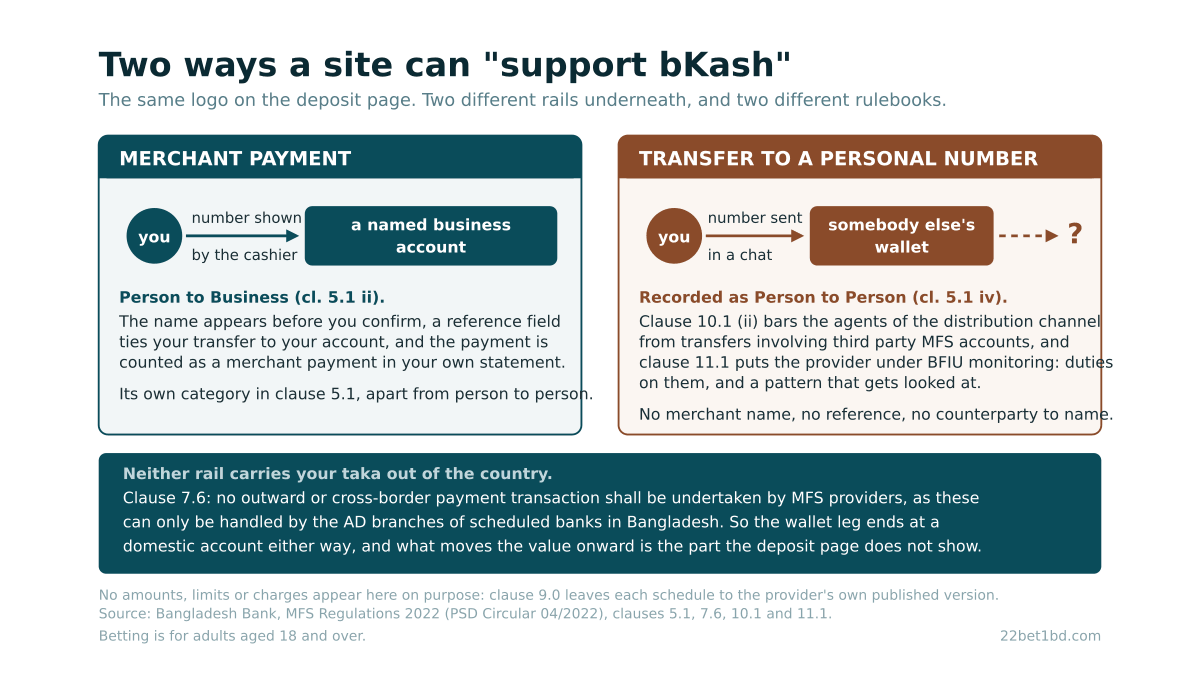
Nobody can hand you the best betting site in Bangladesh with bKash, and every page on the first results screen that tries is ranking payment arrangements it has no way to audit. What you can check yourself, in about a minute, is the thing those rankings skip: whether a site takes bKash as a merchant payment or as a transfer to a number somebody sends you in a chat. Those are two different transactions under two different rules, and the difference decides what record exists when money goes missing.
What does "supports bKash" actually mean on a betting site?
It means one of two things, and a deposit page almost never says which one.
Bangladesh Bank sorts every wallet movement into categories. Clause 5.1 of the Bangladesh Mobile Financial Services (MFS) Regulations, 2022 lists them one by one. Person to Business payments, category (ii), gather merchant payments alongside utility bills, educational institution fees, mobile top up and insurance premiums. Person to Person payments, category (iv), cover one MFS personal account paying another, at the same provider or a different one. Online and e-commerce payments get a heading of their own again at category (vi).
A cashier that generates a number for you and asks for a reference is running the first of those. A site that has an agent send you a number in a chat window and asks for a screenshot is producing the second, whatever the logo on the deposit page says. The wallet app itself tells you which one you are in before you confirm: a merchant payment names the counterparty on the confirmation screen, and a send money shows a number and, at most, a person's name.
That separation is not a technicality invented by the provider. Bangladesh Bank's monthly statistics on mobile financial services report merchant payment and P2P transaction as separate rows of the same product table, so the two survive as different things all the way up into how the country counts its own payments.
Why does money paid with bKash never leave Bangladesh?
Because the rail is domestic by construction, and clause 7.6 says so in one sentence: no outward or cross-border payment transactions shall be undertaken by MFS providers, as these can only be handled by the AD branches of scheduled banks in Bangladesh. The same clause handles the other direction, allowing foreign inward remittances only where they arrive through credits in Nostro accounts of scheduled commercial banks and are paid out to wallets only in taka.
Read that against a betting operator incorporated somewhere else and the picture rearranges itself. Your wallet is not paying a foreign company. It is paying something domestic, and whatever carries the value onward from there runs on a rail you never see and that your app never records. So the honest content of the phrase "supports bKash" is narrow: a domestic leg exists. Whose account terminates that leg, and what sits behind it, is the actual question, and it is the one no ranking answers.
It also explains a delay people blame on the wrong party. Money coming back has to re-enter the domestic rail from that same far side before your wallet can see it, so a withdrawal is not the deposit run backwards through one system. It is a second arrangement, and it can be slower, or be routed somewhere else entirely, without anything being broken.
What is wrong with a betting site in Bangladesh that gives you a personal bKash number?
It records your money as a person to person transfer between two personal wallets, not as a payment to a business. The regulations treat your side of that as an ordinary service, but they are pointed about a wallet that collects payments on somebody else's behalf. Clause 10.1 (ii) governs the agents of the distribution channel and bars them from any transfer transaction involving third party MFS accounts at the sending or receiving end. The same clause requires providers to sensitise agents about the money laundering and terrorist financing risks inherent in those transactions, and to monitor transaction patterns carefully towards identifying possible unauthorised or suspicious transaction activities. Clause 11.1 keeps the provider inside the Money Laundering Prevention Act, the Anti Terrorism Act and the instructions issued by the Bangladesh Financial Intelligence Unit, so that monitoring is an obligation rather than a policy the provider may relax. Those duties fall on the agent and on the provider rather than on you, and that is precisely why they matter to you: a personal number taking in deposits from people it has never met is the pattern the monitoring is built to surface, and the account on the far side of your transfer can stop working without warning.
Three practical consequences follow for the person making the transfer, and none of them depend on anyone's intentions:
- Your statement records a send money to a person. That line is the whole of what you can show afterwards, to anyone, about where the money went.
- Nothing matches the payment to your betting account automatically. A person reads a screenshot and credits you, which is why these flows ask for one.
- The receiving number changes. When it does, the previous one stopped working, and that is information about the arrangement rather than an administrative detail.
A cashier-generated merchant payment removes all three problems at once, which is the reason the distinction is worth a minute of anyone's attention before the first deposit rather than after a disputed one.
Why is a deposit page listing bKash not proof that a withdrawal comes back the same way?
Because the two directions are separate services, admitted separately. The payment you make going in sits in category (ii) as a person to business payment. Money paid out to a player is a Business to Person payment, category (iii), which clause 5.1 lists apart, with salary disbursements and refund payments. A cashier can accept a wallet on one side and settle on the other side through something else, and no rule obliges the two lists to match.
So the check worth doing is unglamorous and takes less time than reading a review: open the withdrawal screen before the first deposit, not after the first win, and see whether the same wallet appears there as a destination. Then check the name. The name registered on the wallet has to match the name on the betting account, because identity verification tends to arrive at the withdrawal stage rather than at signup, and a mismatch found then is found at the worst possible moment. The step by step mechanics of each method are set out on how deposits and withdrawals work from Bangladesh, and why the ceilings differ between a personal and a business wallet is covered in what a bKash merchant account limit is measuring.
Why do so many bKash betting site searches turn out to be login problems?
Because access trouble usually shows up at the moment identity gets tied to a wallet, and that feels like a login fault while being a verification one. A password that worked yesterday and fails today, an account that opens but will not release a withdrawal, a deposit that lands in a balance that then freezes: these cluster around the same step rather than around the choice of site. Changing site does not solve them, and re-registering with a second account on the same site tends to make the mismatch worse, because now two records point at one wallet. The FAQ takes up the verification sequence directly.
What can you check before deciding a site's bKash support is real?
Six things, all observable from your own screen, and none of them requiring you to trust a ranking:
- Does the cashier produce the number, or does a person? A number generated inside your logged-in session belongs to an arrangement. A number pasted into a chat belongs to whoever is holding the phone.
- Does a counterparty name appear in your wallet app before you confirm? A merchant payment shows one. A send money does not, and that absence is the entire difference in evidence.
- Is there a reference or transaction ID field on the deposit form? That field is what ties an anonymous transfer to your account without a human in the middle.
- Does the withdrawal screen list the same wallet? Accepting a method and paying out by it are two separate claims, and only one of them is usually advertised.
- Is the receiving number the same on a second deposit as on the first? A number that rotates is the clearest signal available from outside that the domestic leg is improvised.
- Does the licence claim survive a check on the regulator's own site? A badge in a footer is an image. The authority that issued a licence publishes its own register, and the Curacao Gaming Authority also maintains a list of public warnings about operators it has not authorised, which is worth reading before a licence number is taken at face value.
On the wallet leg you also have a documented complaint route, which is more than most payment disputes give you. Clause 17.3 requires the MFS provider to maintain a call centre receiving and processing disputes 24 hours a day by telephone, SMS, IVR and mail, with each dispute resolved within ten working days. Its limit is worth knowing in advance: that route can establish whether a transfer happened and where it went, not whether a betting account was credited. The two ledgers belong to two companies, and the transaction ID is the only object that appears in both.
22Bet is the operator this site covers, and how its cashier handles the local wallets, along with what the platform does not do well, is set out in the 22Bet review. Betting is for adults aged 18 and over, money staked on an uncertain outcome should be money already written off, and an operator's foreign licence governs that operator rather than settling what is permitted for a player here, a question answered in what the law in Bangladesh actually says.
Frequently asked questions
Does paying a merchant number prove the betting site itself is registered with bKash?
No, and this is the part the check does not reach. A merchant payment proves that a properly opened business account is receiving the money and that its name was shown to you before you confirmed. It does not prove that the name belongs to the operator, and often it will not, because a payment processor standing between the two is a normal arrangement rather than a suspicious one. What you gain is a named counterparty and a merchant record, which is exactly what the alternative denies you.
If a deposit does not arrive, which side do I complain to first?
The wallet side, because that is the side with a clock on it. Clause 17.3 gives the provider ten working days from the dispute, and it can tell you whether the transfer completed and to what account. Start there only to establish the fact, then take the transaction ID to the operator, since the wallet provider has no view of a betting balance and the operator has no way to search for a transfer you cannot identify. Keep the ID either way. It is the single object both sides recognise.
Is a site listing more payment methods a safer choice than one listing fewer?
The number of logos measures marketing rather than plumbing. Each logo is a claim about accepting money, not about returning it, and a long row of them can sit on one improvised domestic arrangement just as easily as a short one. A site accepting two wallets that both appear on the withdrawal screen is better wired than a site accepting six that appear only on the deposit screen.
Can I deposit from a friend's or relative's bKash account?
It is the fastest way to have a withdrawal stopped later. Nothing in the wallet rules stops one personal account from paying another, which is exactly why it looks harmless on the way in: clause 5.1 lists person to person payments as an ordinary service. The obstacle sits on the betting side, where the name registered on the wallet is checked against the name on the account when verification runs, and paying money out to a third party is the thing that check exists to prevent. A deposit that worked is not evidence that it was accepted, because the check happens at the other end of the relationship, when you ask for the money back.