
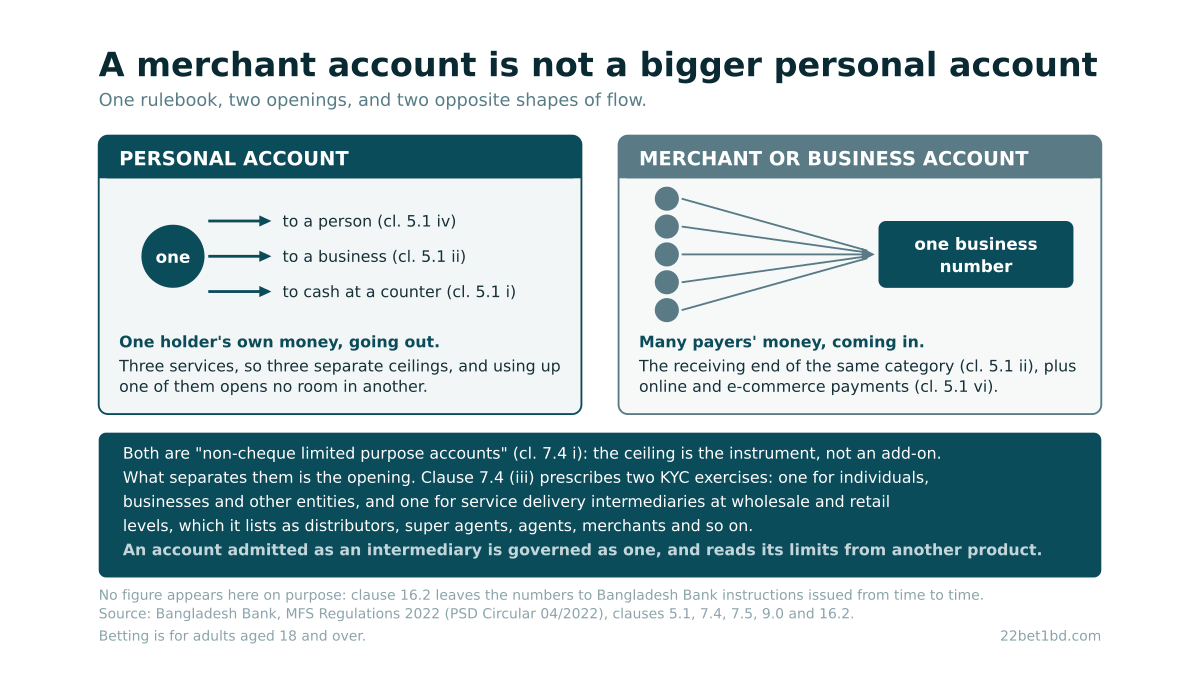
A bKash merchant account limit is not a personal limit with more room in it. The two accounts are admitted to the system through two separately prescribed openings, and they sit on opposite ends of the same transaction: a personal account mainly sends one holder's own money out, while a merchant account mainly receives money in from people the holder has never met. Almost everything that looks arbitrary about the caps, the charges and the checks follows from that single difference, which is also why a merchant figure looked up to plan a personal transfer describes a service your account does not perform.
What is a bKash merchant account limit, and why is it not just a bigger personal limit?
Because the two accounts are opened as different things, and the ceiling belongs to the opening rather than to the customer. Bangladesh Bank's Bangladesh Mobile Financial Services (MFS) Regulations, 2022 start from a definition that settles most of this argument before limits are mentioned at all. Clause 7.4 (i) states that transactions in mobile financial services will be conducted only through non-cheque limited purpose accounts termed MFS Accounts. Limited purpose is not a warning about the product, it is the product. A wallet with no ceiling would be a different instrument under a different licence.
Then comes the split that people looking for a merchant figure are actually standing on. Clause 7.4 (iii) prescribes two separate exercises. Opening accounts in the names of individuals, businesses and other entities requires complete observance of know your customer and customer due diligence drills as prescribed by the competent authority. Opening accounts in the names of a service delivery intermediary at wholesale and retail levels, which the clause lists as distributors, super agents, agents, merchants and so on, likewise requires complete observance of those drills. Two admissions, written separately, with merchants named in the second one.
So a merchant account is not a personal wallet with the numbers raised. It is an account admitted as part of the service delivery chain, and it is governed, priced and capped as one. That is why no arithmetic converts one into the other.
Why does the bKash merchant payment limit sit in a different column from send money?
Because the regulator counts them as different services, not as two uses of one allowance. Clause 5.1 lists the permitted categories one by one. Person to business payments, category (ii), gathers utility bill payments, educational institution fees, merchant payments, mobile top up, deposits into savings schemes, loan repayments and insurance premiums. Person to person payments, category (iv), covers one MFS personal account to another at the same provider or a different one, plus movements between an MFS account and a bank account. Online and e-commerce payments get a heading of their own again at category (vi).
Three headings, defined separately, and a business number sits at the receiving end of two of them: the merchant payments inside category (ii) and the online and e-commerce payments of category (vi). Separate services are also how a provider's limit screen is divided, which is why room left in one column says nothing about the room left in another. Which of those ceilings tends to be the one that actually stops a transaction is a question about your own account rather than the merchant's, and it is set out in which bKash ceiling stops a transaction.
The regulator keeps the separation in its bookkeeping and not only in its rules. Bangladesh Bank's monthly statistics on mobile financial services report cash in, cash out, person to person transaction and merchant payment as separate rows of one product table, so the distinction survives all the way into how the activity is counted.
Why is a merchant account measured by what it receives rather than what it spends?
Because the exposure it creates points inward, and the system behind the balance is built to be watched from that side. Clause 7.5 (i) requires the aggregate of e-money balances in all MFS accounts of a provider to agree at the end of every day with, or be less than, the real cash held in nominated trust cum settlement accounts with scheduled commercial banks, plus the amount invested in government securities. Providers monitor that daily and must report any shortfall immediately to the Payment Systems Department.
Read that clause and the shape of a merchant account stops being a policy choice. A balance in a wallet is a claim on a ring-fenced fund, and an account that collects payments from many different people concentrates many strangers' claims in one place. Clause 7.7 closes the other door by prohibiting providers strictly from taking deposits and lending from their own funds, so nothing in the arrangement behaves like a bank deposit that could absorb the difference.
The second reason is the compliance load that arrives with the receiving end. Clause 11.1 requires providers to comply with the Money Laundering Prevention Act, the Anti Terrorism Act and the instructions and guidelines issued by the Bangladesh Financial Intelligence Unit, and clause 11.2 keeps them responsible for the authenticity and timely updating of know your customer records. A many to one pattern of incoming payments is precisely the pattern those obligations exist to examine, so the account that produces it is admitted with more checks and capped on its own terms.
Why can no page publish a bKash merchant account limit per day that stays true?
Because nothing in the regulations fixes a figure, and two clauses keep it moving. Clause 16.2 requires providers to follow rules, regulations, guidelines and instructions issued by Bangladesh Bank from time to time, which is the door a revision comes through. Clause 9.0, headed Schedule of Charges, leaves the rate of charges realisable from the various financial services to be set in a competitive, non-collusive manner, and then says where the binding version lives: displayed prominently at all retail agent outlets, and available with information about all products in customer care centres and on the provider's own website.
The phrase worth stopping on is all products. A merchant account is one product and a personal account is another, each with a published schedule of its own. A figure copied from a personal limit page onto a merchant question is therefore not merely out of date. It describes a different product, and it will keep looking plausible for as long as nobody notices which page it came from. The same logic explains why the charge for taking money out varies by the counter you are standing at, which is why the cash out charge is a percentage.
What does a personal retail account change about the limit?
It changes which of the two openings you were admitted under, and that is the thing the ceiling hangs on. Providers do offer products aimed at small retailers who receive payments while also being one individual, and whatever a given provider calls that product, the question that decides its limits is the one clause 7.4 (iii) asks: was this account opened as an individual account, or as a service delivery intermediary account. A retail-facing product sits on the intermediary side of that sentence even when a single person runs the shop.
Bangladesh Bank's monthly table, the one already cited above, keeps that separation visible without naming any provider's product. It counts merchants apart from registered customers and splits them into two rows, regular merchants and a row labelled PRA, and it splits the cash out line the same way, customer cash out on one line and merchant plus PRA cash out on another. A product counted on the merchant side of the national statistics is not being treated as a personal account anywhere along the chain.
Two consequences follow, and both are the opposite of what the search phrasing assumes. A retail or merchant product is not a personal account with a raise, so its ceilings cannot be read off a personal limit screen. And there is no self-service route to a higher cap, because a cap is attached to standing rather than to a setting: standing is established at opening and changes through the provider, under the same know your customer obligations that clause 11.2 requires to be kept current.
Does any of this change what happens when you pay a business number?
It changes whose ceilings apply at each end, not which ones apply to you. Paying any business number out of a balance you already hold is a person to business payment under category (ii), so it draws on your payment allowance and leaves your send money and cash out allowances untouched. The account on the other side is somebody else's, with its own standing, its own schedule of charges and its own ceilings, and none of that is visible from your app.
That asymmetry has a practical edge. A refusal names no cell and no side, so a payment stopped for a reason that lives on the receiving end looks identical to one stopped by a limit of yours, and the reflex of retrying a smaller amount tests only your own side of the transaction.
22Bet is the operator this site covers, and the page on how deposits and withdrawals work from Bangladesh sets out which wallet appears at which step of its cashier, which is where you can see whether a screen is asking you for a payment or a transfer. Betting is for adults aged 18 and over, money placed on an uncertain outcome should be money already written off, and a licence an operator holds abroad governs that operator rather than settling what is permitted for a player in Bangladesh, a question the FAQ takes up directly.
What does not move a merchant account limit?
Breaking a total into pieces, which is the reflex, and which on a receiving account can cut the wrong way. What a merchant account produces is the many to one pattern itself, so the same total arriving in more transactions from more payers gives the obligations of clauses 11.1 and 11.2 more to examine rather than less. Splitting is a technique aimed at a per transaction ceiling, and a per transaction ceiling is a measure inside a column rather than a way out of it.
Routing the money through an account belonging to somebody else is named in the rules rather than merely inefficient. Clause 10.1 (ii), which sets out what an agent in the distribution channel is allowed to handle, closes with a sentence that reaches both ends of the transfer: any transfer transactions involving third party MFS accounts at the sending or receiving end are prohibited. The same clause requires providers to sensitise their agents to the money laundering and terrorist financing risks inherent in those transactions, and to monitor transaction patterns carefully to identify possible unauthorised or suspicious activity. A pattern assembled to work around a ceiling is therefore the thing being looked for, not a way past it.
Nor does the ceiling bend for distance. Clause 7.6 states that no outward or cross-border payment transaction shall be undertaken by MFS providers, because those can only be handled by the authorised dealer branches of scheduled banks, and that inward remittances are paid out to wallets only in taka. A wallet is a domestic rail by construction, which is a different kind of constraint from a ceiling and one reason a bKash to bank transfer is three variables rather than one.
Frequently asked questions
Does a merchant account pay a lower charge than a personal one?
The comparison does not hold, because the two are priced as separate products rather than as two tiers of one. Clause 9.0 leaves each rate to be set competitively and requires information about all products, with the schedule of charges, to be available in customer care centres and on the provider's website. So there is a published schedule for each product and no fixed relationship between them. The answerable question is which product the transaction you are about to make runs through, not which account type is cheaper in the abstract.
Can a business account send money to a personal account the way a personal account can?
Not under the same heading. Clause 5.1 lists business to person payments, salary disbursements and dividend, refund or discount payments among them, as category (iii), separate from the person to person transfers of category (iv). The money moves, but it moves as a different service, admitted and counted on its own, which is why a business account holder cannot read outward capacity off a send money limit.
If a payment to a business number is refused, was it my ceiling or theirs?
It can be either, and the message will not say. Your own remaining allowance per service is visible on your limit screen, while the receiving account's standing and ceilings are not, so the sequence that saves attempts is to read your payment column first and stop treating the refusal as yours once it shows room. Clause 17.3 requires the provider to run a call centre 24 hours a day by telephone, SMS, interactive voice response and mail, and to resolve each dispute within ten working days, which is the documented route once retrying has told you nothing.