
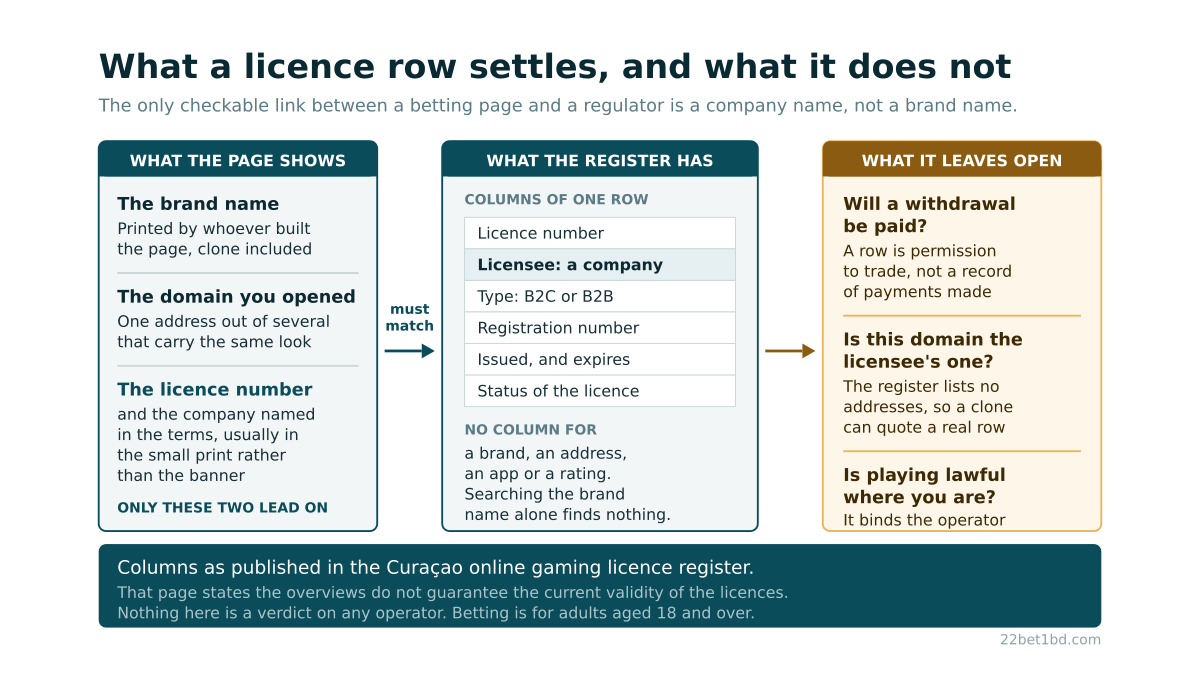
Is 22Bet legit? Nothing on the first page of that search answers it in a way you can verify yourself. The results are star ratings, a forum thread, a video verdict and review scores written by sites that earn a commission, this one included. What can be settled, for free and from outside, is narrower and more useful: whether the licence number printed on the page belongs to a company that appears in the register the regulator publishes, and what that entry does and does not promise.
Is 22Bet legit, and which part of that question can be checked?
"Legit" collapses three questions with three different kinds of answer, which is why pages answer it with a score instead of a method. Whether a real, authorised company stands behind the site is a records question, and records can be looked up. Whether that company will pay a withdrawal is a prediction about future behaviour: a licence entry is permission to trade, not a receipt. Whether you are allowed to play is decided by the law where you are sitting, not by the operator's paperwork.
Only the first is checkable from outside, and it is the one every page-one result skips.
What does the Curacao licence register actually show?
Operators serving this market are usually licensed in Curacao, and the authority there publishes its register of licensed entities, with the online gaming licences in a dated list of their own.
Open it and the shape of the check becomes obvious. Each row carries a licence number, the licensee, which is a company name, the company type, a company registration number, the date the licence was issued, the date it expires, and a status. There is no column for a brand, no column for a website address, no column for an app and no column for a rating.
That is the detail the review pages leave out, and it is why the check fails for most people on the first try. Typing a betting brand into that list finds nothing, because brands are not what is registered. The name you need is the company named in the site's own terms and conditions, usually in the small print at the bottom of the page rather than the banner at the top, with the licence number next to it. Those two strings are the only things on a betting page that lead anywhere outside it.
The dates on the row matter too, and they are what a screenshotted badge destroys. A licence has an issue date and an expiry date, so an entry describes a window of time rather than a permanent condition, and the status column exists because licences change state: some rows in the published list read as revoked. The register page says as much itself: the overviews do not guarantee the current validity of the licences, and no rights can be derived from them.
The same authority also publishes public warning notices naming brands it says are operating without authorisation, each with a date. A brand named there is a regulator's finding. A brand missing from there is not a clearance, only an absence.
The operator covered on this site is 22Bet, and the licence claim on its pages is worth putting through exactly this check before reading anything else about it, including the detailed review here. A review that asks you to trust its conclusion is worth less than a register row you looked up yourself.
Why is there a 22Bet eu address as well as the main one?
Operators in this sector rarely run one address. There are country-specific sites, mirrors that appear when a network blocks the main domain, separate pages hosting the Android file because the app is not in the Play Store, and older addresses that still resolve. Finding more than one address carrying the same brand is normal, and by itself proves nothing either way.
The difficulty is that a clone is also normal, and a clone copies the page. Logo, layout, licence badge, even the licence number: all of it is text and images anybody can duplicate in an afternoon. Appearance cannot separate a mirror from a fake, because appearance is the one thing the fake gets right. What a clone cannot copy without exposing itself is who it says it is in writing: a genuine address names the licensee company in its terms, and the payment details it then gives you belong to that same company.
What this article cannot do is certify which addresses are the operator's. A third-party list of "official mirrors" is another page making a claim, this one included. The route that depends on nobody's claim is an address you typed yourself, or one sent to the email address on your own account, rather than one that arrived in a message or an advert.
What is worth checking before a 22Bet com login?
The login page is where a cloned site pays off, which is why clones put their effort there. A fake deposit page takes one payment. A fake login form takes the credentials that open the real account, and in this market it sits next to the mobile wallet number the account is tied to.
Three checks cost nothing. Read the address bar character by character before typing anything, because a swapped letter or an extra word is the whole trick. Notice whether your browser or password manager offers the saved entry: those match on the exact domain, so silence on a page that looks familiar is worth stopping for. And never reuse a password that opens an email account, because a harvested pair gets tried everywhere else.
One confusion gets mistaken for a stolen account. Opening a different address of the same operator can show you signed out, with the saved login no longer filling in, because a browser keeps sessions and stored passwords per domain and neither carries from one address to another. That is domain behaviour, not a disappearance, and going back to the address where the account was opened settles it.
If a site turns out to be a clone, the report goes to BGD e-GOV CIRT, the government team that handles cyber incidents in Bangladesh, which takes incident reports naming the domain involved. An unlicensed brand can also be reported to the regulator whose licence it is displaying.
Why would a 22Bet withdrawal problem happen on a licensed site?
Because a licence regulates conduct, not speed, and most stalled withdrawals are caused by things the licence actually requires.
Identity checks are the usual cause. The framework that issues the licence, the National Ordinance on Games of Chance in force since 24 December 2024, carries anti-money-laundering obligations with it, so an operator has to know who is withdrawing: the account holder and the wallet receiving the money have to be the same person. A withdrawal to a relative's wallet, or from an account whose documents were never completed, stops there.
The payment route is the second. Deposits from local mobile wallets often reach an operator through intermediaries rather than directly, and the way back is not always the mirror image of the way in. When the two differ, the request sits in a queue that belongs to neither party alone.
The third is a promotional balance, which carries its own published conditions about when funds can be taken out. Those conditions change without notice and are only worth reading in the cashier, on the day, which is why no page other than the operator's own should be telling you what they say.
None of that proves good faith, and a delay is not evidence of fraud. What separates a process from a pattern is repetition across many accounts over time, which is why a single complaint thread settles nothing: it is an allegation, usually from someone mid-dispute and without the other side. The formal route runs through the operator's own complaints process first, then the separate dispute-resolution providers the regulator licenses for that purpose, and that second step exists only if the company behind the site really is the licensee it claims to be. Which is why the register row is worth looking up before a deposit rather than after, and also why ranked "trusted site" lists are not a test.
Does a licence make any of this lawful for a player in Bangladesh?
No, and this is where most pages on this query mislead by omission. A Curacao licence binds the company that holds it. It says nothing about the person placing the bet, and a foreign regulator has no authority over what is permitted in Bangladesh.
The Gambling Prevention Act 2026 has been in force since 1 July 2026 and covers participation as well as operation, and it is the law that applies to someone sitting in Bangladesh regardless of where the operator is licensed. That question is treated on its own terms in what the law actually says, and the site FAQ answers the short version.
So the honest summary of the whole check: it can tell you whether an authorised company stands behind an address, and it cannot tell you that betting is safe, profitable or allowed. Betting is for adults aged 18 and over, losing is the ordinary outcome rather than the exception, and money staked on an outcome should be money whose loss changes nothing. If stopping has started to feel difficult, that is the part no register addresses.
Frequently asked questions
Is 22Bet a scam?
That word covers two accusations checked in two different ways. One is that no authorised company stands behind the site, which the register and the warnings list answer. The other is that a real company is not paying, which records cannot answer and which a resolved complaint thread argues against rather than for, since a resolution means a dispute route existed and worked. Separate them or the question stays unanswerable.
Is 22Bet casino legit if the sportsbook is?
They can sit under different entries. The register's company type column separates B2C licences, held by operators that take bets from the public, from B2B licences held by suppliers. Casino games are usually built by studios that hold their own entries, so a casino section is typically several licensed parties working together rather than one. If only the casino side concerns you, the company to look up is still the one named in the terms of the site taking your deposit.
What if the terms name a company that is nowhere in the register?
Then the licensing claim rests on the site's own word, which is the position the check exists to detect, and it is worth separating from the duller explanation: company names change after restructuring, and an old name on a page can lag a new one on a row. Either way the gap is the operator's to explain, and a support reply naming the current licensee can be taken back to the register and matched there.