
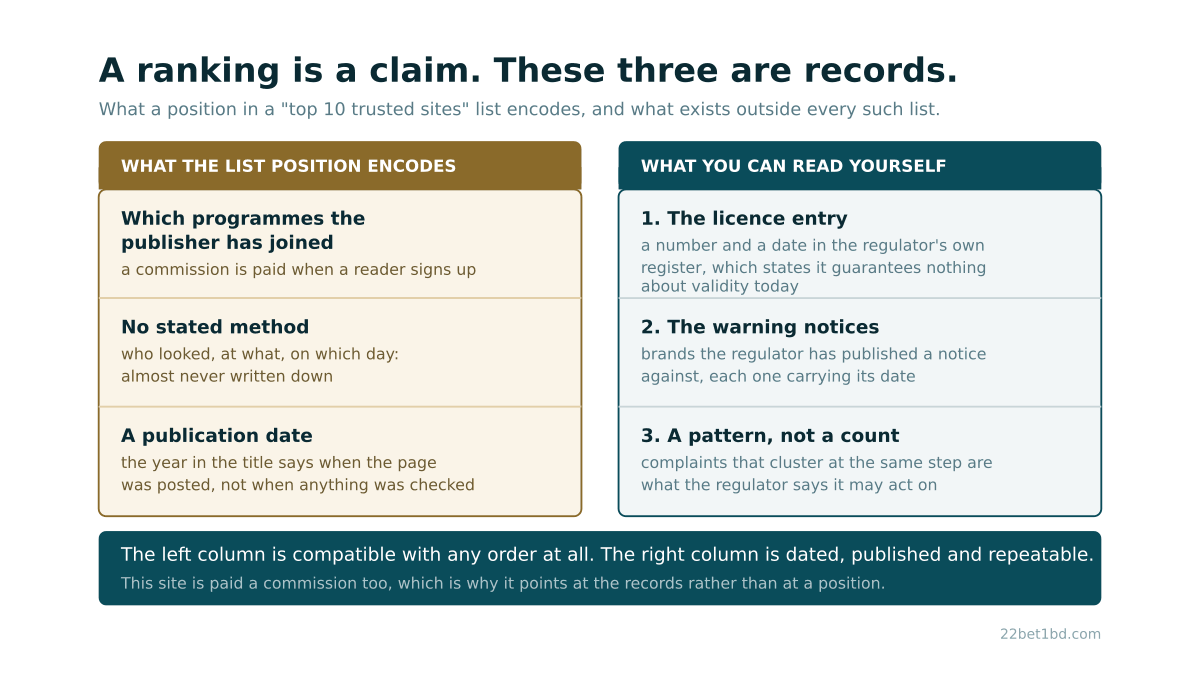
Searching for a trusted betting site in Bangladesh returns a first page made almost entirely of ranked lists, and a ranked list cannot establish the thing its title claims. Those pages are affiliate marketing: the publisher is paid when a reader opens an account through its link, and that applies to this site as much as to the others. It does not make any of them dishonest, but it does mean the word "trusted" is sitting there with no stated test behind it. Three records about an operator exist outside every such list, they carry dates, and anyone can read them without an account. That is what this page is about.
Why is every page about a trusted betting site in Bangladesh a top ten list?
Because the format fits how the page earns, and the query is commercial enough to be worth the effort.
An affiliate publisher joins an operator's programme and receives a tagged link. When a reader follows it and registers, the operator can see who sent them, and the publisher is paid. A single operator on a page looks like an advert, so the page names several, and the ordering turns the advert into something that reads as a comparison. The structural point is easy to miss: a publisher is usually in the programmes of most of the names on its own list, so almost any order is compatible with being paid by everyone ranked.
What those pages leave out is the method. Who looked, at what, on which day, whether an account was ever opened, and which observations produced position two rather than position five. The year in the title does not fill that gap either, because it records when the page was published or edited, not when anything was examined. At least one domain holding the first page for this query is a direct competitor of this site, which is a reason to be careful with what you read here as well.
What would a test of "trusted" actually have to measure?
Three separate questions, which the single word hides and an ordinal number cannot carry.
The first is identity: whether the site in front of you is the operator it appears to be, rather than a lookalike domain one character away. The second is conduct: whether money that goes in can come back out, and what happens when a withdrawal is held. The third is your own legal position, which is about you rather than about the operator, and which no licence anywhere settles.
A list position answers none of the three. It cannot, because a number in a sequence has nowhere to store a date, a document, or a condition. The identity question has its own step by step sequence, covered in the piece on how to check a betting site before you trust it, and it is worth running before anything below. The rest of this page is about the second question, which is the one the lists gesture at with the word "trusted" and then never examine.
What does a Curacao licence entry settle, and what does it leave open?
It settles that an entry exists, under a regime that changed recently enough to matter, and it leaves the current validity of that entry explicitly open.
When the authority named in a footer is Curacao's, the date matters more than the word, because Curacao rewrote its rules in the middle of the period these lists cover. The authority's own page on the current online gaming legislation states that the Landsverordening op de kansspelen, the National Ordinance on Games of Chance, came into effect on 24 December 2024, replacing a regime that had run under the earlier offshore ordinance, and that the earlier ordinance remains relevant through transitional provisions based on Article 15.1 of the new one. So "licensed in Curacao" is not one claim with one meaning. It is a claim that needs a number and a date attached before it says anything.
The register itself is blunter about its limits than any list is. The authority publishes overviews of the entities it has licensed, with online gaming listed separately from land based casinos, and states in the same breath that the overviews "do not guarantee the current validity of the licenses, as the licensing status of the entities may vary over time", and that no rights can be derived from them.
Two consequences follow. A licence claim with no number printed next to it encodes nothing at all, and a register hit proves an entry, not a licence in force this morning. Both are smaller claims than "trusted", and both are the ones that are actually true.
Why is a pattern of withdrawal complaints worth more than a count of them?
Because a pattern is the thing a regulator says it can act on, and a count mostly measures how many customers an operator has.
The same authority is explicit about the limit of its role. It states that it "does not handle individual complaints against gaming providers", that resolving disputes between players and operators "is not within our mandate", and that it has no authority to mediate or arbitrate. Then it says what does matter: a complaint may indicate a possible breach, and if "a complaint or a pattern of complaints indicates a possible violation of the law", it may take action against the operator.
Read that as a reader rather than as a lawyer and it tells you what to look for. One angry forum post is not evidence about an operator, and an operator large enough to be ranked will always have some. A pattern is different, and it has a shape: complaints that cluster at the same step. Identity documents demanded only after a first sizeable withdrawal rather than at signup. A wallet whose registered name does not match the account holder, discovered at payout rather than at deposit. A dormant account rule applied to a balance that sat untouched. When many accounts describe the same step, the step is a policy, not an accident.
The published counterpart to all of this is the notice list. The authority maintains public warning notices naming specific brands, each entry dated. A name appearing there is a record rather than an opinion, and a name absent from it has simply not been the subject of a notice, which is a weaker statement than a clean bill of health.
How long has the brand operated under the same licence holder?
Longer is not automatically safer, but continuity is checkable, and a position in a list is not.
The operating company and the licence number usually sit in the footer of the operator's own site, and both can change without the brand name changing at all. A brand can be operated by different companies in different markets, and a licence can be surrendered, reissued, or replaced under a new ordinance while the logo stays put. Archived snapshots of the same footer from previous years, through a web archive, show whether the company and the number stayed the same. A change is not proof of anything wrong. It is a question worth asking, and it is precisely the sort of question a ranking has no room for.
Where does that leave a site that carries one operator?
Unable to be a comparison, which is worth saying plainly.
This site carries affiliate links to a single operator, 22Bet, so it has nothing to rank and no ordering to defend. What it can do is apply the checks above to that one name and show the working, which is what the operator review sets out: what is known about 22Bet from records outside its own pages, and what cannot be settled from here. A reader who runs the same steps on any other name is doing exactly what this page recommends, and the results do not belong to whoever published the list.
What can no list, and no check, settle?
Four things, and they outlast every verification step above.
Your legal position is the first. A licence issued abroad regulates the operator that holds it, not the person placing a bet, and Bangladesh has its own framework that is covered on its own terms in what the law says about betting here. The second is the margin: odds are priced so the book holds the edge across many bets, and no amount of checking moves that arithmetic. The third is the payment rail. Mobile wallet transfers are push payments with no chargeback behind them, which is why how deposits and withdrawals actually move matters more here than the identity of the site receiving them. The fourth is harm. Betting is for adults aged 18 and over, gambling is habit forming, and a fully licensed operator can host exactly the same problem as an unlicensed one.
Frequently asked questions
Does using an app instead of the website change any of this?
No, and it adds a question of its own. The licence, the notices and the complaint pattern belong to the operator, not to the delivery format. What changes is how the software reached the phone: betting apps in Bangladesh usually arrive as a downloaded file rather than through a store, which means a security setting has to be switched off to install one. That install route, and what it costs, is covered in what makes a betting app safe to install.
Which betting sites should be avoided?
The only names anyone can point to with a record behind them are the ones a regulator has published a notice against, and those lists are short, dated and public. Beyond that, the avoidable cases mostly identify themselves by shape rather than by name: a domain spelled one character away from a brand you know, a licence badge that is an image with no number, a site that first mentions its verification rules after a withdrawal is requested. A roster of bad names compiled by a publisher that earns from the good ones is not a record.
Is betting illegal in Bangladesh?
That question is about the person placing the bet, not about the operator, and the two get mixed up constantly in pages that answer it quickly. A foreign licence describes what the company holding it must do in the jurisdiction that issued it, and it makes no statement about a reader in Dhaka. Bangladesh legislated on this subject recently and the position deserves more than a line here, so it is treated in full in the separate article linked above.