
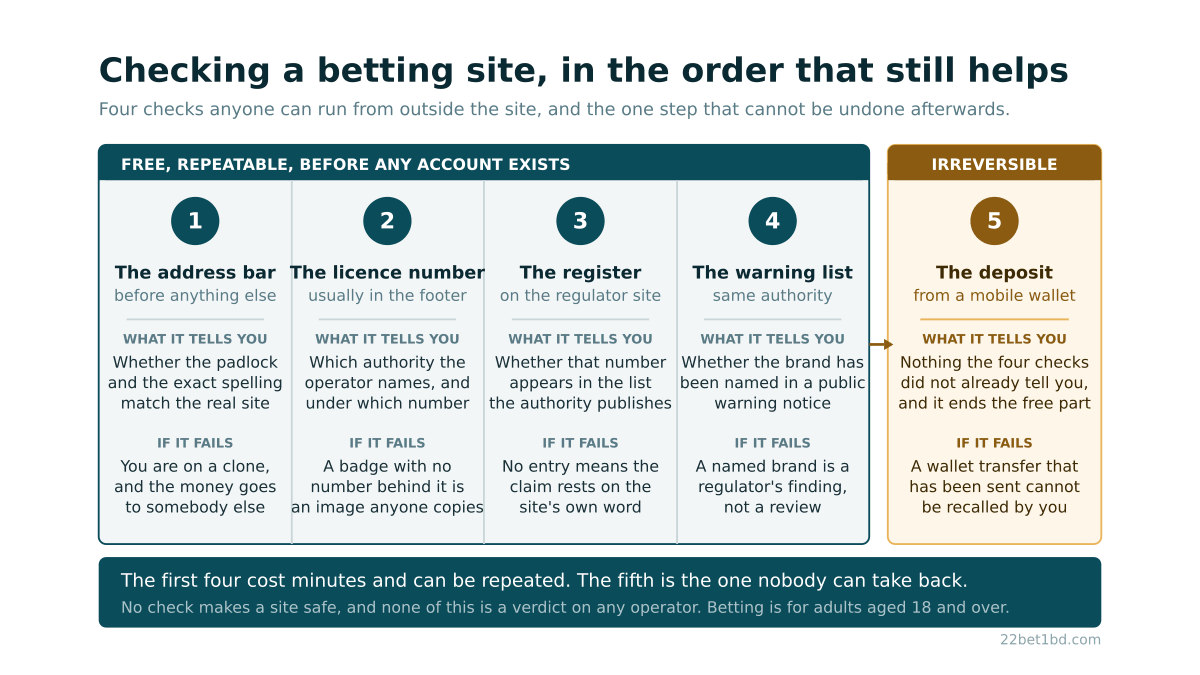
Asked as a yes or no question, is online betting safe has no honest answer. Safety is not a property that online betting has or lacks in general. It is a set of claims about one specific site, on one specific day, and four of those claims can be checked in a few minutes by anyone, without an account and without spending anything. What follows is how to run those checks, what each one proves, and why the order they happen in matters more than most pages admit.
Is online betting safe, or is that the wrong question?
It is the wrong question, and the wrong question produces a useless answer either way.
Pages that answer "yes" mean that licensed operators exist. Pages that answer "no" mean that fraudulent sites exist. Both are true and neither helps the person about to type a wallet PIN, because that person is not deciding about online betting. They are deciding about one domain name.
Broken into claims about that domain, the question becomes answerable:
- Is this the site it appears to be, or a lookalike?
- Does it name a regulator and a licence number at all?
- Does that number appear in the regulator's own published list?
- Has the brand been named in a public warning notice by that regulator?
All four are free and repeatable. The step that comes after them, the deposit, is neither, and that asymmetry is the whole reason to run them in this order.
How do you check if a betting site is legit?
Start in the address bar, because every later check is worthless if the site is a clone.
The padlock means the connection between your phone and that server is encrypted, so nobody on the network in between can read it. It does not mean the operator is honest. Certificates are issued to whoever controls the domain, which is a fact about domain control and not about character. A cloned betting site with a slightly different spelling can hold a perfectly valid certificate and show the same padlock. Read the domain character by character before reading anything else on the page.
Next, look for a licence number, usually in the site footer. What matters is a number and a named authority, not a badge. A badge is an image file, and an image file can be copied onto any page in a few seconds.
Then take that number to the authority instead of trusting the page that showed it to you. When the authority named is Curacao, it publishes its own register of licensed entities. A claimed number that produces no entry there is a claim the site is making about itself.
The register is also explicit about its own limits. It states plainly that the overviews "do not guarantee the current validity of the licenses, as the licensing status of the entities may vary over time". So a register hit tells you an entry exists, not that the licence is in force today. That is a smaller claim than "licensed and safe", and it is the accurate one.
The fourth check is separate from the third, and an entry in the register does not cover it. The same regulator publishes warning notices about unlicensed operators, naming specific brands with the date each notice was issued. A brand appearing there is not an opinion or a bad review. It is the regulator recording that something is operating outside the licence it claims or holds none.
Those four are the same shape as the checks that separate a real casino lobby from a fabricated one, covered in more detail in the piece on how to spot a fake online casino.
What does a gambling licence actually prove about fairness?
It proves that somebody has written down what the operator must do, and that a body exists to enforce it. It does not prove that any individual result was fair, and it is not a promise about your outcome.
One regulator has written down what "fair" means in engineering terms, in enough detail to be tested against. The UK Gambling Commission's requirements for the generation of random outcomes require that game results be "acceptably random", meaning demonstrable through generally accepted statistical tests, and state that adaptive behaviour, described there as a compensated game, is not permitted. A compensated game is one that quietly adjusts probabilities in response to how a session is going, which is exactly what players suspect when a run goes badly. The same standard also rules out falsely displayed near misses, where one losing outcome is substituted for a different losing outcome that looks closer to a win.
Two things follow from reading the actual text. The first is that the behaviour players most often accuse sites of is specific enough to be written into a rule and tested for. The second is that this particular rulebook belongs to the UK regime, not to Curacao, so it describes what these obligations look like when a regulator spells them out rather than telling you what any given operator is bound by. Useful as a yardstick, not as a verdict.
None of it changes the underlying arithmetic. A game can be provably random and still have a margin built into the odds, which is how the business funds itself. Fair and profitable for the player are different words.
What is the safest betting site?
That question cannot be answered as asked, and the pages that answer it confidently usually earn a commission from the answer, including sites like this one.
What can be compared between operators is verifiability: whether a licence claim exists, whether it resolves in a register, whether the brand appears in warning notices, whether the terms covering verification and withdrawal are readable before you deposit rather than after. Those are properties you can establish yourself in the order shown above. 22Bet, the operator this site carries affiliate links to, names a Curacao licence, which means 22Bet can be put through exactly the same four steps as any other name, and the operator review on this site sets out what is and is not known about it.
Any page telling you a site is safe, this one included, is a page you would then have to verify. The checks are the point precisely because they do not require trusting the person describing them.
Why does the deposit change everything?
Because it is the first step you cannot reverse, and in Bangladesh the payment rails make that sharper than card users are used to.
A mobile wallet transfer, which in Bangladesh usually means bKash, Nagad or Rocket, is a push payment. You initiate it, the money moves, and there is no equivalent of a card chargeback that lets you pull it back because the other party turned out to be fraudulent. Disputes over a card payment start from a position where the money can be clawed back. Disputes over a completed wallet transfer do not.
Transfers routed through an intermediary add one more party between you and the operator, which adds a place for the amount to be credited to the wrong account. How deposits and withdrawals actually move, and where they get stuck, is covered on the deposits page.
If a site turns out to be fraudulent after money has moved, the useful step is reporting rather than chasing. Bangladesh has a government computer incident response team, BGD e-GOV CIRT, which takes incident reports and publishes alerts. Keep the transaction records, the domain name and the timestamps: a report without those is difficult for anyone to act on.
What does no amount of checking make safe?
Three things, and they are the ones that matter most over time.
The first is the margin. Odds are priced so that the book, not the bettor, holds the edge across many bets, and no verification step changes that. The second is randomness: in games decided by a random outcome, no system, staking plan or timing method shifts the probabilities, and any page claiming otherwise is selling something. The third is harm. Gambling is habit forming, the risk is not evenly distributed across people, and a licensed site can host the same problem as an unlicensed one.
Betting is for adults aged 18 and over. Anyone who finds the time or money spent slipping past what they intended should treat that as the signal it is, and stop.
There is also a legal position, which is separate from all of this and not improved by any check on the list. Nothing above says anything about whether a person in Bangladesh is permitted to place a bet, and a foreign licence does not answer that question either. That subject is covered on its own terms in what the law actually says about betting in Bangladesh. The questions readers ask most often about this site and the operator are collected in the frequently asked questions.
Frequently asked questions
Is a betting app safer than the mobile site?
Usually the opposite, when the app arrives as a downloaded APK file rather than through an official store. Installing one requires switching off an Android protection that blocks software from unknown sources, and that protection is not decoration. A file from a lookalike domain installed this way has more access to the phone than a browser tab ever gets.
What should I do if I have already deposited on a site that looks fake?
Stop sending money first. The common follow-on is a demand for a further payment to "release" a blocked withdrawal, which is the shape of an advance fee scheme and rarely ends after one payment. Save the transaction IDs, screenshots and the exact domain, tell your wallet provider, and file a report with CIRT.
Do user reviews tell you whether a site is legitimate?
Less than they appear to. A review page that earns a commission per signup, as this one does, has an incentive running toward a positive verdict, and a forum thread about a delayed withdrawal cannot distinguish a fraudulent site from ordinary identity verification. A register entry and a warning notice are records rather than opinions, which is why they sit higher on the list than any review, this site's included.