
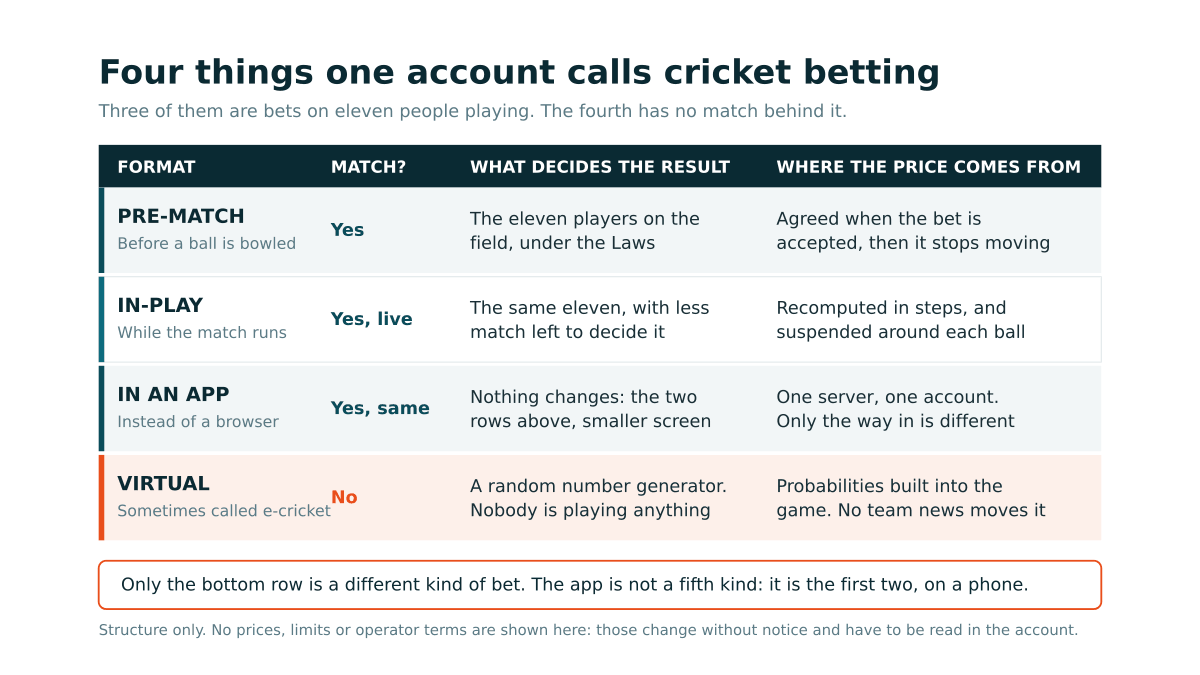
Cricket betting is an agreement about the result of a cricket match at a price fixed the moment the bet is accepted. The reason what is cricket betting is a harder question than it looks is that a single account usually offers four different things under that one name: a bet placed before the match, a bet placed while it is being played, those same two through an app instead of a browser, and virtual cricket, which is a simulation with no match behind it at all. Three of them are bets on eleven people. The fourth is not, and telling them apart is most of what a beginner actually needs.
What is cricket betting, stripped back to the agreement?
Betting in cricket has three parts. You name an outcome, you stake an amount on it, and a price is attached to that pair. If the outcome arrives, the stake returns multiplied by the price. If it does not, the stake is gone. Everything else is detail on top of those three parts.
The part that surprises people first is when the price stops being a moving number. It is fixed at acceptance, not at settlement. The figure on the screen a minute later can be different and it does not follow you: your bet keeps the price it was accepted at. This is why the same market can show two people two different returns on the same outcome, and why nothing that happens afterwards changes what you were quoted.
The other part worth getting straight early is who decides the result. Not the bookmaker. The match is adjudicated under the rules of the game, and the Laws of Cricket are written and maintained by MCC, which publishes each edition in full. The bookmaker reads the official outcome those rules produce and settles against it. Its discretion is in defining the question, not in answering it, which is why an operator's settlement rules are a more useful page than most people assume.
Why do Test, ODI and T20 change what you are betting on?
Because they are three different games wearing the same name, and the betting follows the difference rather than causing it. The ICC publishes a separate set of playing conditions for Tests, ODIs and T20Is, each its own document, and those documents are what the markets are built on top of.
The consequence that matters to a bettor is the draw. A Test can end with neither side winning because the available days ran out, and that is a genuine outcome rather than a failure of the match. So a Test match winner market has three ways to resolve, and the third one answers a different question from the other two: not which side is better, but whether either side has time left to convert that into a win. Days lost to rain and overs lost to a slow rate feed into it as directly as anything either team does on the field. A limited-overs game is built to produce a result inside a fixed number of overs, so its winner market is close to a two-way question. Anyone who learns on T20 and then places a first Test bet the same way has walked past the biggest structural difference between the formats.
What is online cricket betting, and what actually changes online?
The price stops being a quote from a person and becomes a published number you either accept or do not. That sounds like a small shift. It changes the mechanics of the whole transaction.
Placing a bet online is a request, not a handshake. Your phone sends the selection and the stake, the server checks whether the price you were looking at is still the price it is offering, and only then does it accept. When a market has just moved, that check fails and the bet comes back rejected or re-offered at the new number. The delay is not a fault: it is the gap between what your screen was showing and what the book had already done, and on a fast-moving cricket market that gap does real work.
The second change is that the price you were given is written down. The bet slip records the number the bet was accepted at, which is what lets you tell a rejection from a re-offer at a new price, and what turns the fixed price described above into something you can check rather than something you have to take on trust.
What is the difference between pre-match and in-play betting?
Not when you bet. How much is already known when you do.
A pre-match price has absorbed the things that were knowable before play: the surface, the forecast, who is named in the eleven, and the toss, which in cricket carries unusual weight because it can decide who bats while conditions are at their best. Once the match starts, that uncertainty begins converting into fact, one delivery at a time.
In-play pricing follows that conversion, and it does it in steps rather than smoothly. Cricket is a discrete game: nothing happens, then a ball is bowled and something does. A wicket, a boundary or a completed over changes the state of the match in one jump, so the book suspends the market around each event and reopens it with a recomputed price. A market that stayed open through a delivery would be pricing a match state that no longer exists, and that is exactly the moment someone with a faster feed would profit from it.
One consequence of that is easy to miss. If you are watching a stream, you are behind. Video is encoded, buffered and delivered, and the data feed the book prices from is not, so the picture you are reacting to has already been priced in. The ball you just saw hit the boundary was hit before the price you are looking at was calculated. In-play betting off a stream is not a slower version of the same activity, it is a bet on information that is already stale.
What is a cricket betting app, and does it change the bet?
No. It changes the door, not the room.
An app reaches the same account, the same markets and the same settlement rules as the browser site. It is a front end onto a book that already exists, not a second book, so an installation does not open a section that was missing from the browser. 22Bet is the operator this site covers, and its cricket markets sit behind the one account whichever way you reach them.
What does differ is how the app gets onto the phone. On Android, an app distributed outside the Play Store is installed by allowing your phone to accept software from an unknown source, which means switching off a security check that exists for a reason, and the phone will say so. That trade-off is real and it is worth understanding before you accept it rather than after, which is why it is set out on the app page. None of it changes the bet itself, and treating the app as a fifth format is the most common misreading of the four.
What is virtual cricket betting, and is it cricket?
It is a bet on a match that is not happening. No toss, no pitch, no team news, no players, because nobody is playing. A random number generator draws the result and the animation on the screen is a rendering of a number that has already been decided.
The machinery here is not a secret, and one of the clearest public descriptions of it comes from a regulator. The UK Gambling Commission's technical standards put games and virtual events in the same category and require that outcomes be acceptably random, with adaptive behaviour explicitly not permitted: a compensated game, one that adjusts what it produces according to how a player has been doing, is ruled out, and the same guidance asks that outcomes not be predictable and not repeat their sequence. Those standards bind operators licensed in Great Britain and not operators licensed elsewhere, so this is a statement of what the machinery is meant to do rather than a guarantee about any particular product. It is still the most useful thing to know about virtuals.
Read that requirement the right way round and it cuts twice. The game is not supposed to respond to your losses, which is the reassuring half. It also cannot respond to your knowledge, which is the half people skip. Every round is generated independently of the last, so no sequence you noticed, no run of results and no staking pattern alters the chance of the next one. Studying a real team's recent form is at least aimed at something. In a virtual round there is nothing to study, because there is nothing there.
So which of these are you being offered?
Usually all four, in one account, in menus that sit next to each other. Telling them apart takes a few seconds: a real fixture has a date and two named teams, while a simulation starts its next round on a timer regardless of anything.
All of that is structure, not value. Whether any of it is worth doing has an arithmetic answer, worked through in why the margin sits inside every price. Betting is for adults aged 18 and over, the cost is real whether or not a session goes well, and a run of losses is not a reason to keep going. Whether any of this is permitted where you are is a separate question that an operator's foreign licence does not settle, covered in what the law in Bangladesh actually says. How one operator arranges these formats in practice is described in the 22Bet review.
Frequently asked questions
What is cricket gambling, and is it different from cricket betting?
The same activity under a blunter word. Cricket betting sounds like an analytical exercise and cricket gambling sounds like a risk, and the second word is the more honest description of what happens to the money. There is no product difference and no site that offers one and not the other.
What is e cricket in betting?
The label is not standardised, which is the practical answer. Depending on the site it can mean the simulated, computer-generated product described above, or it can mean betting on human players competing in a cricket video game, which is a real contest with real people and real form. Those are genuinely different things sold under similar names, so the market description is what to read, not the section heading.
Can you place a bet after the match has started?
Yes, that is the in-play market, and the practical limit is not the start of the match but the book's willingness to keep pricing it. Individual markets also close at their own points: a first-innings total is settled long before the match winner is. A market disappearing mid-match is normally the book stopping rather than an error, and how each one is defined and voided belongs in the operator's rules, with the questions that come up most collected in the FAQ.