
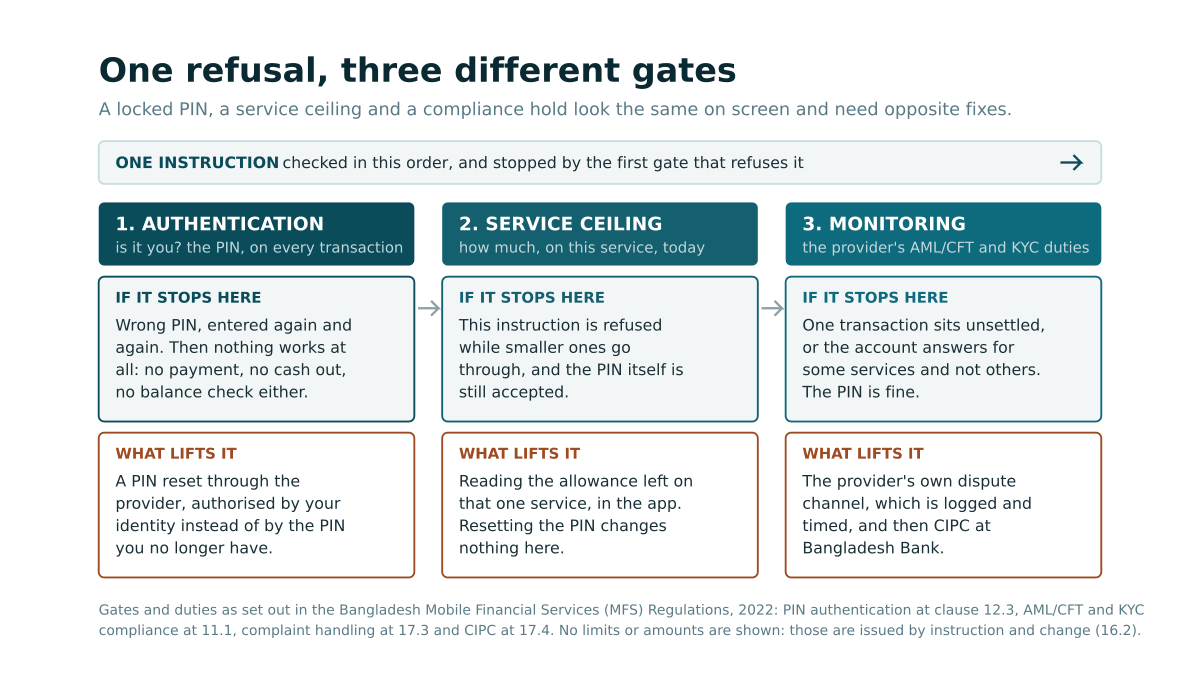
A bKash account locked after repeated wrong PIN entries is a block at the authentication layer, not a freeze on your money. The balance is where it was and nothing has been taken: the wallet has stopped accepting instructions from someone who cannot prove to be the account holder, and the only thing that lifts it is a PIN reset authorised by your identity. That distinction matters because two different failures look almost identical on the screen, a ceiling on the service you were using and a transaction held under the provider's monitoring duties, and neither of those is fixed by resetting anything.
What does a bKash account locked by wrong PIN entries actually stop?
Every instruction, including the ones that do not move money. The Bangladesh Mobile Financial Services (MFS) Regulations, 2022 state at clause 12.3 that all transactions must be authenticated by the account holders using their respective Personal Identification Numbers or similar other secured mechanism, and that providers should ensure proper protection and security features are maintained in issuing and authenticating them. The PIN is therefore not the password of one screen. It is the thing that makes an instruction yours, so a wallet which stops accepting the PIN has stopped accepting instructions, and that is why a lock feels so total: payments, cash out and a simple balance check all fail at the same gate.
The reason a counter exists at all sits one clause earlier. Among the properties clause 12.2 requires of the system is non repudiation, meaning a transaction initiated by a user cannot later be denied by that user. A system obliged to hold that property cannot allow unlimited attempts, because a secret that can be found by trying is no longer proof of anything, and every transaction already authenticated with it would become arguable. The lockout is what protects that property. Most of what is written about locks lists their causes. Underneath every cause is the same mechanism: the wallet stops rather than let a guess succeed.
How do you unlock or recover a bKash account, and why can it not be instant?
By proving who you are to the provider through its own channel, and the wait is the design rather than a queue. A reset cannot be authorised by the credential that is missing, so it has to be authorised by something else, and in a regulated wallet that something else is identity. Clause 11.2 makes the provider responsible for the authenticity and timely updating of its know your customer records, and the regulations define valid identity, for opening an MFS account, as the documents determined under a directive of the Bangladesh Financial Intelligence Unit. Expect to answer things only the account holder could answer, and expect that to take a conversation.
What not to do is take the step list from a search result. Clause 16.2 requires providers to follow rules, regulations, guidelines and instructions issued by Bangladesh Bank from time to time, so a published walkthrough describes the flow as it stood when it was written, and an out of date sequence that still looks authoritative is worse than none. Two of the pages currently on the first screen for this question repeat the same helpline number and the same short list of details to have ready: read that as what those pages say rather than as what the provider requires today, and take both the steps and the number from the app itself.
Forgot my bKash PIN number: is that the same problem as a lock?
Not yet, and the distance between the two is where most locks are made. Forgetting a PIN leaves you with an account in perfect order that you cannot currently instruct. Changing a PIN you still know is an ordinary operation inside the app, authorised by the old PIN exactly as clause 12.3 describes, and because it asks for the current PIN first it is never a way out of a lock. Resetting one you do not know is a different operation with a different authority behind it, which is why it asks more of you.
The mistake in between is trying candidates. Three plausible guesses feel cheaper than a phone call, particularly with a cashier page open and a timer running on it, and each one spends part of the counter. What began as a reset you could have made calmly becomes the same reset plus a lock, and the lock does not shorten the identity checks waiting at the end of it. The moment you are unsure of the PIN rather than mistyping it, the attempt has already stopped being worth its price.
What should you do if the PIN you were issued has expired?
Treat it as an unfinished reset rather than as a new kind of block. A credential handed to you by somebody else to restore access is deliberately short lived, because for as long as it works something other than your own secret can authorise transactions, and clause 12.3 places that authority with the account holder. The window closing puts you back at the start of the reset, not into a second fault needing its own remedy.
So the lesson is about sequence. A reset finished in one sitting, with your own PIN set before you put the phone down, leaves nothing to expire, while one abandoned just after a temporary credential was issued is the state most often mistaken later for a fresh problem and answered with more guessing.
Why is the bKash OTP not received, and how does a missing code end in a lock?
Because the code travels on a different channel from the app, with its own ways of failing. Clause 12.4 asks providers to have a proper process for identifying customers while a service is being enabled or executed, and says that besides the PIN a suitably chosen second authentication factor would be encouraged as additional security. That second factor normally arrives as a message over the mobile network while the app runs on data, so it can fail while the app looks entirely healthy: the registered number sitting in the other slot of a dual SIM handset, no network on that particular SIM, a number on the account that is no longer the number in the phone, or message filtering on the handset.
None of that is a lock, and this is the part worth holding on to: the lock usually arrives afterwards. Waiting for a code that is not coming turns into trying the PIN again, which is the one action that converts a delivery problem into an access problem. Fix the message channel first and leave the PIN alone while you do it. One more thing belongs here, since it is the same layer: a code read out to someone who called you is worth nothing, and impersonation of official bodies is a documented pattern locally rather than a hypothetical, as the alerts published by BGD e-GOV CIRT show, among them one about actors falsely claiming affiliation with CIRT itself.
Is there a bKash live chat, and what is support obliged to do?
Which window or channel is open on a given day belongs to the provider, but the obligations sitting behind it are written down and are the useful part. Clause 17.2 requires providers to put in place processes for prompt handling and redressal of customer complaints, readily accessible through the website and other appropriate information medium. Clause 17.3 requires a call centre receiving and processing disputes twenty four hours a day by telephone, SMS, IVR and mail, says each dispute received must be resolved within ten working days, and requires the provider to be equipped to keep a log of all disputes and review the status of each one.
So a chat box is an access point to a process that is supposed to be recorded and timed, which changes what you should want out of the first contact: a logged complaint with a reference, not reassurance. If that stalls, the escalation is also named. Clause 17.4 states that MFS customers may access the services of the Customers Interest Protection Centre of Bangladesh Bank, and that an aggrieved customer can lodge complaints with it. That is a second door, at the regulator, and almost nothing written about locked wallets mentions that it exists.
The PIN works, so why is the account still refusing?
Because authentication is only the first gate. The second is the ceiling on the particular service you are using, and it refuses in a recognisable way: this instruction fails while smaller ones pass, and the PIN is accepted throughout. Ceilings attach to services rather than to accounts, so the allowance you have left on one says nothing about another, which is set out in which bKash ceiling stops a transaction. No reset touches it.
The third gate is the provider's compliance duty. Clause 11.1 requires MFS providers to comply with the Money Laundering Prevention Act, the Anti Terrorism Act and the instructions and guidelines issued by the Bangladesh Financial Intelligence Unit, and the clause governing the agent channel, 10.1, also requires providers to monitor transaction patterns carefully towards identifying possible unauthorised or suspicious transaction activities. A transaction held under that heading presents as a payment that never settles while everything else behaves, and it is immune to PIN resets by construction. A deposit into a betting cashier does not arrive labelled as one either: it arrives as a payment to whatever merchant stands behind the cashier, so what monitoring sees is a pattern rather than a purpose. Knowing which gate refused you is the point, and retrying until one gives way is not.
What happens to a deposit that was in progress when the PIN locked?
It depends on which side of the authentication it was on when the counter tripped, and that line is cleaner than it feels at the time. An instruction that was never authenticated was never submitted, so nothing left the balance and there is nothing to recover. An instruction authenticated before the lock is already in the provider's records, and a lock that arrives afterwards does not reverse it.
The expensive move is sending it again. A cashier page runs its own clock, a reference can lapse while your wallet is still thinking, and a duplicate payment is far harder to unwind than a late one. The order that keeps you out of trouble is to restore access, read the transaction list, compare it with the cashier history, then raise anything that does not match through the logged channel described above. 22Bet is the operator this site covers, and how deposits and withdrawals work from Bangladesh sets out which wallet appears at which step of its cashier, which is where that reference is shown. A withdrawal caught by the same timing runs the other way: it lands in a wallet you cannot open yet, which is uncomfortable rather than lost.
Whether the activity behind a payment is permitted for you is a separate question from whether the wallet will carry it, and the FAQ covers what the law in Bangladesh says about that. Betting is for adults aged 18 and over, money placed on an uncertain outcome should be money already written off, and an account you cannot open is a reasonable moment to stop rather than a problem to solve at speed.
Frequently asked questions
Can a bKash account lock without me doing anything wrong?
Yes, because the counter cannot see whose fingers are on the keypad. Wrong entries made by anyone who knows your number produce the same lock, and then the lock is a symptom rather than the fault. The reset is identical; what changes is what follows it. Set a PIN with no relationship to the old one, and mention the attempts you did not make when you contact support, since that detail is what turns a reset request into a logged security report.
Does a locked PIN also stop a cash out at an agent counter?
Yes, and the counter cannot work around it. Clause 10.1 allows agents to take part only in cash in, cash out and other transactions approved by Bangladesh Bank, and notes that customers may need to show valid identity to complete one, but authorising a transaction stays with the account holder under clause 12.3, so there is nothing for the agent to accept on your behalf. The cost of the eventual cash out is unchanged by the delay as well, for the structural reason set out in why the cash out charge is a percentage.
Does changing SIM or handset affect a locked PIN?
Not the PIN, which belongs to the account and will meet you unchanged on any phone, lock included. The SIM matters for the other layer: a second factor sent to the registered number reaches whoever is holding that SIM, so a number you have stopped using is a reset waiting to fail. Completing a number change with the wallet provider while you still have access is far easier than proving identity afterwards from a number the account has never seen.