
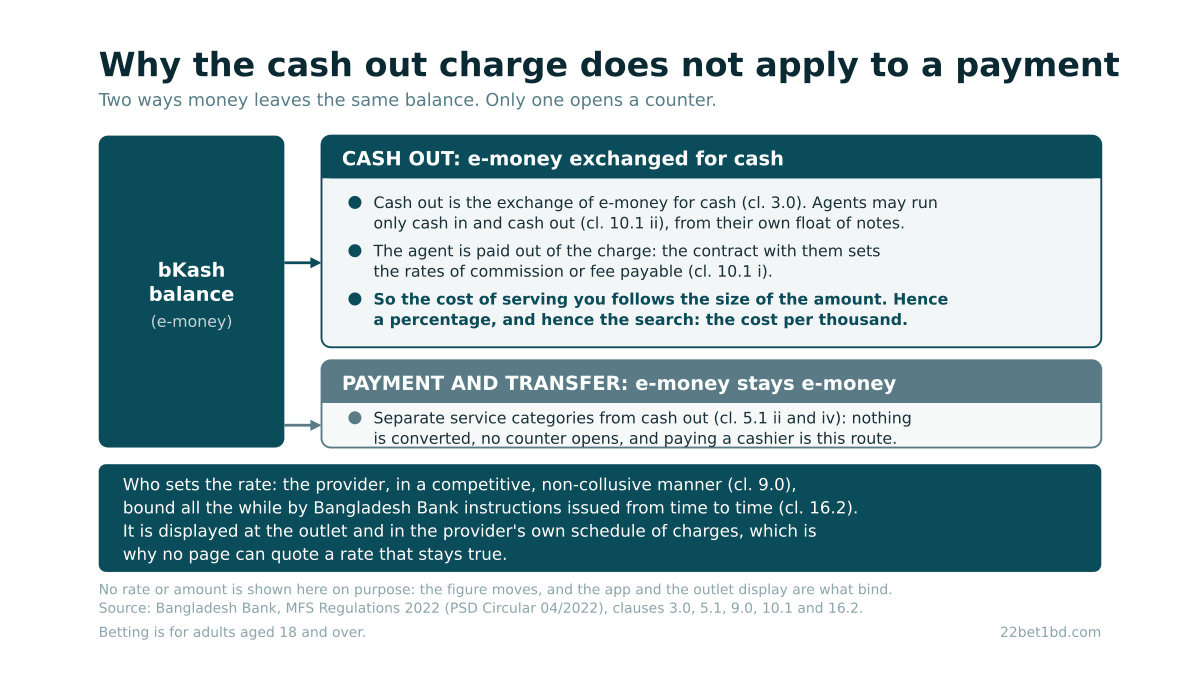
The bKash cash out charge exists because cash out is not a movement of money, it is a conversion: electronic value is exchanged for physical notes, and a person at a counter has to hand those notes over. That person is an agent who gets paid out of the charge, which is also why the fee is a percentage rather than a flat sum, and why it applies to taking money out but not to paying someone from your balance. The rate itself is set by the provider and can be moved by regulator instruction, so no page, including this one, can tell you today's figure.
What is the bKash cash out charge actually paying for?
For the conversion, and for the person who performs it. Bangladesh Bank's Mobile Financial Services (MFS) Regulations, 2022 define the two directions plainly at clause 3.0: cash in is the exchange of cash for electronic value, cash out is the exchange of electronic value for cash. Nothing about a balance changes categories on its own. Somebody stands at a counter with real money and swaps one for the other.
Who that somebody is matters more than most pages let on. The definitions at clause 3.0 make an agent an entity authorised by the provider to carry out transactions on its behalf, and clause 10.1 restricts agents to cash in, cash out and other transactions Bangladesh Bank approves. That same clause requires the contract with them to state the rates of commission or fee payable to agents. So the charge is not a toll the provider invented for the pleasure of it: part of it is the payment to the counter that served you, and the notes that counter hands over are its own working cash, put there in advance and now gone from the till.
That single fact explains the whole shape of the topic. A cash out involves a third party, an inventory of physical money and a location. A transfer inside the system involves none of those.
Why is the bKash cash out rate a percentage and not a flat fee?
Because what it costs to serve you rises with the amount. The agent's float is finite, and a large withdrawal empties more of it than a small one, leaving less for the next customer and forcing an earlier trip to restock. A flat fee would charge the same for a payout that ties up a little of that float and one that ties up most of it.
This is also the answer to the way the question gets asked. Searches like bkash cash out cost per thousand are not asking for something exotic; they are the natural way to read a percentage back into taka, because a percentage is the only kind of rate where a per thousand figure stays constant across amounts. When you see the query phrased that way, the pricing model has already been given away.
There is a practical consequence people discover late. Under a percentage, taking the money out in pieces changes nothing about the total charge, because each piece is charged on its own size and the pieces add back up to the same amount. Splitting is a real technique, but it works against per transaction ceilings, which is a different mechanism entirely, covered in which bKash ceiling stops a transaction. Applied to a percentage fee it just produces more trips to the counter.
Who sets the bKash cash out charge rate, and why does it keep changing?
The provider sets it, and the regulator can move it. Clause 9.0 of the regulations, headed Schedule of Charges, states that the rate of charges realisable from the various financial services offered by MFS providers to their clients shall be set in a competitive, non collusive manner. That is a rule about how the price is arrived at, not a table of prices. Then clause 16.2 requires providers to follow rules, regulations, guidelines and instructions issued by Bangladesh Bank from time to time, which is the door through which a rate can be revised after the fact.
Two things follow, and together they explain almost everything odd about the search results for this topic. First, a rate cut becomes news, because it is an event rather than an amendment to a statute somebody can look up. Second, third party charge calculators exist in the first place because no authoritative page publishes a figure that stays true, so a market opens for pages that publish a snapshot of one.
Clause 9.0 also settles where the binding version lives. It requires providers to display the rates of charges prominently at all their retail agent outlets, and to make information about all products with the schedule of charges available in customer care centres and on their own websites. The rate on the board at the counter and the one in your app are the ones that apply to you. A figure quoted anywhere else is a copy, and copies do not get updated when instructions do.
Why does the charge differ between an agent, an ATM and a merchant point?
Because a different party is doing the work in each case, and each party is paid under a different agreement. An agent outlet is a small business with a cash float and a commission rate written into its contract. A bank ATM belongs to a bank, which has its own arrangement with the provider and its own cost of stocking a machine. An account opened as a merchant account is a different account type altogether, admitted on a different basis and used mainly to receive payments rather than to make them.
So bkash merchant cash out cost is a real question with no shared answer, and the reason is structural rather than commercial. There is no single cash out price because there is no single cash out counter. What you can rely on is the rule from clause 9.0: whichever counter you are standing at has to be showing you its rate, and whichever account you hold has a schedule of charges published for it.
The same logic runs through the other exits from a wallet. Money sent to a bank account is neither an agent cash out nor a merchant payment, and it carries its own charge, its own cap and its own arrival time, which is why a bKash to bank transfer is three variables rather than one.
Does depositing at a betting cashier count as a cash out?
No, and getting this wrong is the most expensive assumption in the whole subject, because it leads people to budget for a fee that is not being charged and to miss the ceiling that is. Clause 5.1 of the regulations lists the categories of payment service separately: cash in and cash out from MFS accounts through agents, branches, ATMs, cards and linked bank accounts is category (i), while person to business payments, the family that includes merchant payments, is category (ii), and person to person transfers are category (iv). Paying an operator's cashier from a balance you already hold is not a conversion into cash. Nothing physical happens and no agent is involved, so the cash out schedule is not what applies.
22Bet is the operator this site covers, and the page on how deposits and withdrawals work from Bangladesh sets out which wallet appears at which step of its cashier, which is where you can see whether you are being asked for a payment or a transfer. That distinction is worth reading before assuming a charge. Betting is for adults aged eighteen and over, money placed on an uncertain outcome should be money already written off, and a licence an operator holds abroad governs that operator rather than settling what is permitted for a player in Bangladesh, a question the FAQ takes up directly.
Cash out becomes relevant one step later, when a balance has to leave the wallet as notes. That is the moment the percentage applies, and it is a separate transaction from anything that happened at a cashier.
What does not reduce the charge?
Splitting the amount, as above. Cashing out through somebody else's wallet is worse than useless: clause 10.1 prohibits transfer transactions involving third party MFS accounts at the sending or the receiving end, and requires providers to monitor transaction patterns for possible unauthorised or suspicious activity, so the arrangement is the exact pattern the monitoring is built to notice.
Nor does moving to a different provider escape the mechanism, only the price list. Bangladesh Bank's own monthly statistics on mobile financial services report cash in, cash out, person to person transfer and merchant payment as separate product lines across the whole industry, which is the regulator confirming in its own accounting that cash out is its own service everywhere, not a quirk of one wallet.
What genuinely changes the cost is choosing the route deliberately: how much has to become physical cash at all, and which counter converts it. Everything else is arithmetic on a percentage.
Frequently asked questions
Is the charge taken out of what I ask for, or added on top?
It depends on which number you type, and the two produce different results. Ask for a round sum and the fee is normally deducted alongside it, so your balance falls by more than the amount you receive. Ask for the amount you want deducted and you receive less than that in notes. The balance has to cover both parts either way, which is why a cash out for exactly the amount showing in the app can fail with money apparently still in it.
Would sending the money to another wallet first and cashing out there be cheaper?
No, and it usually costs more. The cash out still happens at some counter, so its charge still applies, and the transfer step is charged on its own terms before you get there. If the other wallet is not yours, clause 10.1 puts the arrangement into prohibited territory rather than merely inefficient territory.
Why do charge calculator sites disagree with the figure in my app?
Because they publish snapshots of a rate that moves. Nothing in the regulations fixes the number in law: clause 9.0 leaves it to the provider to set competitively, and clause 16.2 keeps it open to instruction from Bangladesh Bank at any time. A page written before the last revision looks exactly like a page written after it. The outlet display and the app are the two places that have to be current.