
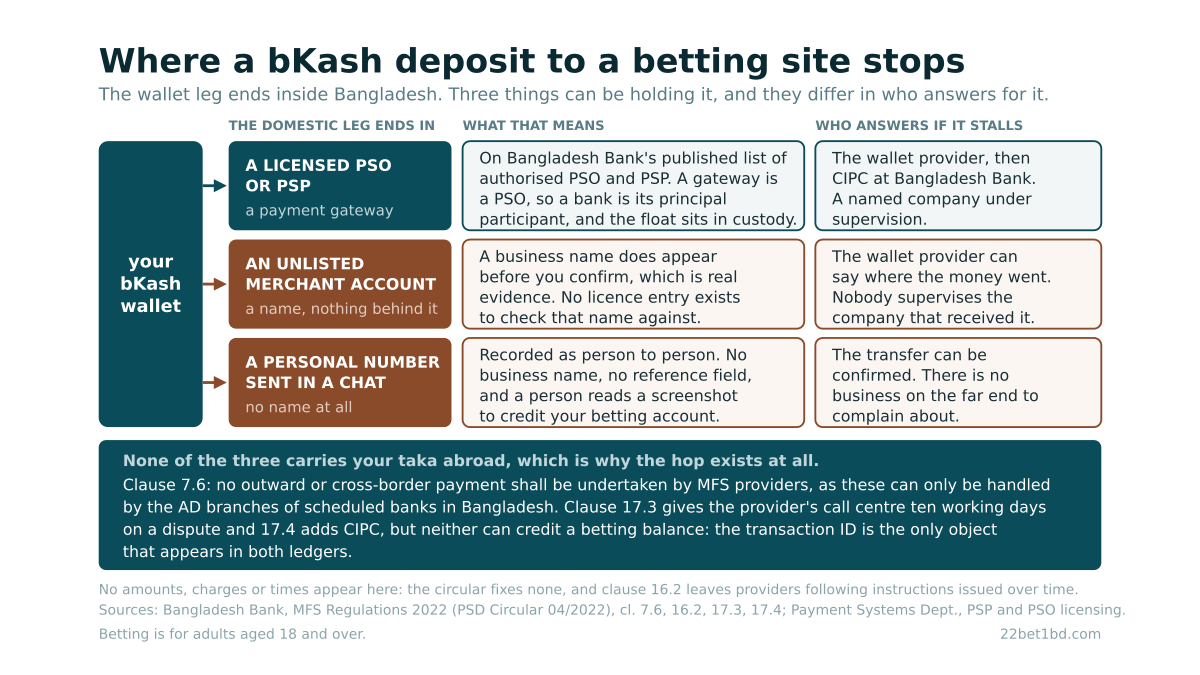
Every bKash betting site in Bangladesh shares one feature that no deposit page mentions: your taka does not leave the country on the wallet rail. It stops at an account inside Bangladesh, and what kind of account that is decides whether anybody can be made to answer when a deposit fails to arrive. That has a checkable answer, which is more than a ranked list of sites offers.
Why can a bKash betting site in Bangladesh not be paid directly?
Because the wallet rail is domestic by law, and a betting operator is not a Bangladeshi company.
Clause 7.6 of the Bangladesh Mobile Financial Services (MFS) Regulations, 2022 settles that in two sentences. The second is the prohibition: no outward or cross-border payment transactions shall be undertaken by MFS providers, as these can only be handled by the AD branches of scheduled banks in Bangladesh. The first allows one inbound route and narrows it just as hard, letting foreign money reach a wallet only as an inward remittance credited through Nostro accounts of scheduled commercial banks, paid out solely in taka. The circular's definitions then read cross-border transactions narrowly, as transfers between related entities operating in different countries, but the prohibition does not rest on that phrase alone: outward stands beside it, whoever the counterparty is.
Read that against an operator incorporated somewhere else and the picture rearranges itself. When you send from your wallet you are not paying that operator. You are paying something domestic, and whatever carries the value onward runs on a rail your app never sees. The hop is not a shortcut somebody chose: it is structural, and every site taking bKash has one.
So the useful version of the question is not which site is best at bKash. It is what is standing in that gap.
What stands in the gap, and what does Bangladesh Bank call it?
The regulator has a vocabulary for it, and a published list of who holds each licence.
Under the Bangladesh Payment and Settlement Systems Regulations 2014, the Payment Systems Department issues two kinds of licence, and explains the split on its own payment systems page. A Payment Service Provider licence goes to a company that facilitates payments directly to customers and settles through a scheduled bank or financial institution, the category an e-wallet sits in: the MFS circular's scope section puts every provider there, stating that an MFS provider will act as a PSP as defined in those 2014 regulations, and bKash is one of them. A Payment System Operator licence goes to a company running a settlement system between participants, of which the principal participant must be a scheduled bank or financial institution, and the examples the regulator gives are a payment gateway and a payment aggregator. That second category is the one standing in the gap on a betting deposit, which is also why searches on this subject keep returning companies selling gateway integration to merchants rather than pages written for bettors.
The same page carries the list of authorised PSOs and PSPs by company name and licence type, and keeps it separate from its list of MFS services, which is where bKash appears. That licence list is the only part of the arrangement a bettor can verify from outside, and two things about it are easy to get wrong. The name to look up is the counterparty's, not bKash's. And a gateway's brand name and its licensed company name are often not the same string, so the check is on the company, not the logo.
The licence buys one more thing. The circular defines a trust cum settlement account as a custody account holding the legal tender stored against issued e-money, or received from the service recipient of the Payment System Operator, and states that its balance shall not be used for any purpose other than the approved ones. Money behind a licensed leg is money that is not supposed to be doing anything else while it sits there. An unlicensed intermediary's account has no such sentence attached to it.
Which of the three is your deposit using?
The deposit screen will not say, but your wallet app shows enough to tell them apart before you confirm.
- A cashier-generated merchant payment to a named company. The counterparty name appears on the confirmation screen, and a reference field on the deposit form ties the payment to your account without a person in the middle. Take that company name to the authorised PSO and PSP list. A match is the strongest signal available from outside.
- A merchant payment to a company that is not on the list. You still get a named counterparty and a merchant record, which is real evidence and better than the third case. The name just has nothing to be checked against, and no supervisor stands behind it.
- A number handed to you in a chat window. Recorded as a transfer between two personal wallets: no business name before you confirm, no reference field, and a person reading a screenshot to credit your balance. Why that transfer and a merchant payment sit in separate categories of the regulations is set out in what "supports bKash" actually means on a betting site.
On a second deposit one signal outranks all three: whether the receiving account is the same as the first time. A counterparty that rotates is the clearest evidence from outside that the domestic leg is improvised rather than contracted. The ceilings also differ by account type, and why a business wallet is measured differently from a personal one is covered in what a bKash merchant account limit is measuring.
Who answers when a bKash deposit does not reach the betting account?
Two parties, each able to establish only half of what you need, and one object that appears in both.
On the wallet side the route is documented and has a clock on it. Clause 17.3 requires the MFS provider to maintain a call centre receiving and processing disputes 24 hours a day by telephone, SMS, IVR and mail, with each dispute resolved within ten working days. Clause 17.4 adds a second step above that: customers may also use the Customers Interest Protection Centre of Bangladesh Bank, where an aggrieved customer can lodge a complaint. Bangladesh Bank publishes how CIPC takes complaints, by hotline, email, online portal or hard copy, and states that the centre covers MFS providers alongside banks and finance companies.
Then the limit, which is the part that surprises people. That route can establish whether a transfer completed and which account received it. It cannot credit a betting balance, because the wallet provider has no view of one. The operator has the opposite problem: it can credit a balance but cannot search for a transfer it cannot identify. The transaction ID is the only object that exists in both ledgers, which is why keeping it matters more than keeping the screenshot.
Clause 17.6 points at the gap directly, requiring that information materials clearly explaining the roles, responsibilities, risks and liabilities of all parties involved in MFS transactions be kept readily accessible to all relevant parties. On a routed deposit, "all parties" includes one the deposit page did not name, and whether you can find out who it is before sending money is the practical test.
Why does the "best bKash betting site" question have no answer worth giving?
Because the thing being ranked is a commercial arrangement nobody outside it can audit, and a list of sites ordered by stars says nothing about which of the three routes your money will take. A page ranking sites on bKash support is ranking a logo.
The answerable version is narrower: does the cashier name its counterparty, is that counterparty on the regulator's list, does the withdrawal screen offer the same wallet the deposit screen accepted, and does the operator's licence claim survive a check on the regulator's own site rather than on a footer badge. The Curacao Gaming Authority publishes warning notices naming sites it has not authorised, some of them for displaying its seal without being entitled to it, which is the kind of source a badge is not: a badge is an image on the page making the claim. 22Bet is the operator this site covers, and its own cashier is where the current list of accepted methods has to be read, since that list changes without notice; the mechanics of each method from Bangladesh are in how deposits and withdrawals work, and what the platform does less well is in the 22Bet review.
Two things stay outside all of this. An operator's foreign licence governs the operator, not the player, and what that means here is a separate question answered in what the law in Bangladesh actually says. And betting is for adults aged 18 and over: money staked on an uncertain outcome should already be written off before it is sent, whatever route it takes to get there.
Frequently asked questions
If the counterparty is a licensed PSO, does that make the betting site itself licensed?
No, and conflating the two is the common mistake here. A PSO licence covers the settlement system that moves the payment, issued on criteria about risk management and settlement rather than about what is being bought. It is evidence that the domestic leg of your deposit has a supervised operator and a bank as its principal participant, and nothing at all about the operator on the far side of that leg, which is regulated, if at all, somewhere else entirely.
Does the betting site see which bKash account the money came from?
Not usually in a form it can act on, and that is the reason verification arrives when it does. A merchant payment credits an account identified by a reference, and the name registered on the wallet is not automatically matched to the name on the betting account at that moment. The match tends to be made later, at withdrawal, which is why a deposit from a relative's wallet works on the way in and causes the problem on the way out.
Can the wallet provider reverse a deposit that went to the wrong place?
Clause 17.3 gives you a resolution within ten working days, not a reversal. The dispute process establishes facts: whether the transfer completed, when, and to which account. What happens next depends on the receiving side, and a merchant account belonging to a supervised company and a personal number belonging to somebody who stopped answering are not in the same position at all. That difference is the whole practical content of the three routes.