
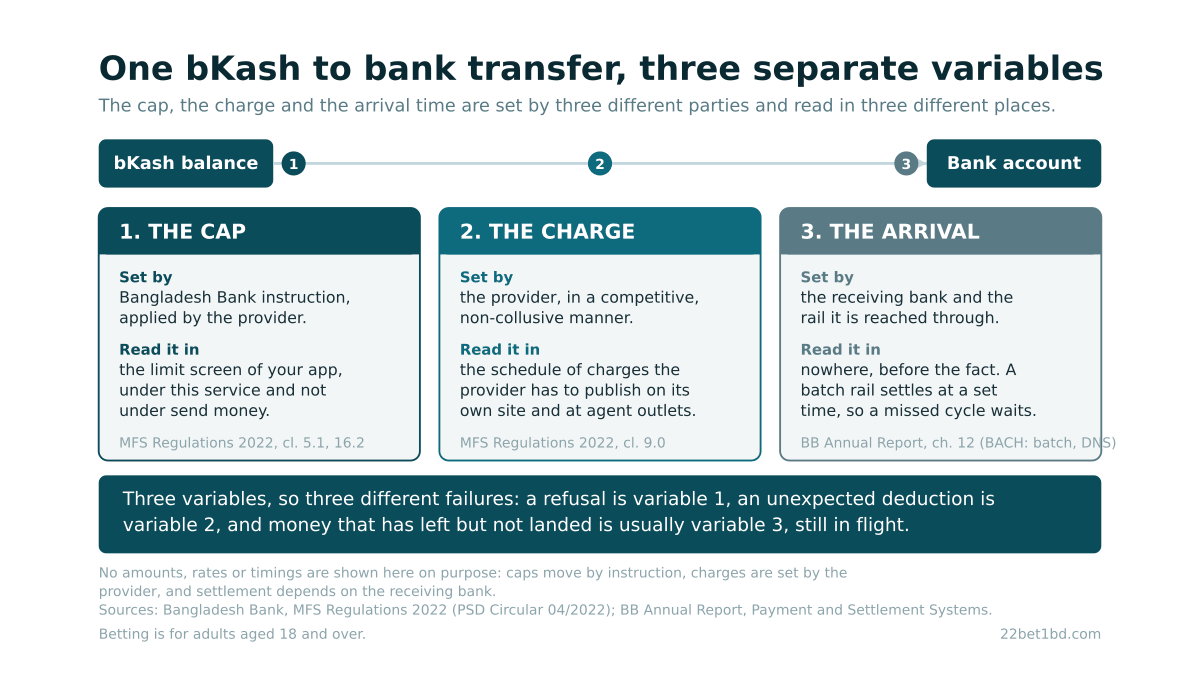
The bKash to bank transfer limit is not the number that decides whether the transfer works. Three separate things govern one instruction: a cap that comes from regulator instruction, a charge the provider sets itself, and an arrival time that belongs to the receiving bank. They are published in three different places, only two of which you can read in advance, and almost every confused question about this transfer comes from treating them as a single figure.
What is the bKash to bank transfer limit, and which of the caps is it?
Moving money from a wallet to a bank account is not a service category of its own. Bangladesh Bank's Bangladesh Mobile Financial Services (MFS) Regulations, 2022, issued as PSD Circular 04/2022, list the permitted payment services at clause 5.1, and this particular movement appears in two of them. Category (iv), person to person, covers one personal account to another at the same or a different provider as well as payments from an MFS account to a bank account and the reverse. Category (i), cash in and cash out, describes how value enters and leaves an account and names linked bank accounts among its channels, alongside agent locations, bank branches, ATMs and cards.
That double placement is the practical problem. The rules leave room for a provider to present the same movement under either heading, so the ceiling that governs it can sit in a row you were not reading, and a cash out allowance you have never touched may be the one being consumed. The limit screen inside the app resolves it, because it shows ceilings per service and for your account rather than for accounts in general.
How those ceilings stack up, per transaction, per day, per month and sometimes per count of transfers, is set out in how the send money caps are structured, and which cell refuses which instruction is covered in the daily limit grid. Worth carrying over from both: clause 16.2 requires providers to follow instructions issued by Bangladesh Bank from time to time, so the figures move without the regulation being amended, and a page quoting a number looks exactly as confident after a revision as before one.
How do you transfer money from bKash to a bank account?
Through an account you have linked, and the linking is deliberate design rather than a convenience. Clause 13.1 requires providers to encourage the linking of MFS accounts with customers' existing or new bank accounts, and clause 13.2 makes the capability compulsory: providers have to design their systems so that every MFS provider can offer fund transfer in a completely interoperable way, which may include payments from a personal MFS account to a bank account at the same bank or another bank and vice versa.
So the question "is a bKash to bank transfer possible" has a firmer answer than most pages give. Clause 7.8 states that MFS account holders are free to mobilise the balances of their MFS accounts to their deposit accounts with scheduled commercial banks, and that providers will act immediately on a customer request to do so. Moving your own balance out to your own bank account is a right written into the regulations. What is left open is where the ceiling sits, which a provider sets inside the instructions clause 16.2 obliges it to follow, along with the charge for it and which banks it has connected.
That last one is the part people meet as a dead end. If a destination account cannot be added at all, the transfer never reaches the stage where a limit could refuse it, and no amount of reading about caps explains the failure.
What is the bKash to bank transfer charge, and is a bKash to bank transfer free?
There is a charge, the provider sets it rather than the regulator, and that is precisely why the answer keeps changing. Clause 9.0 of the same regulations, headed Schedule of Charges, says the rate of charges realisable from the various financial services a provider offers to its clients shall be set in a competitive, non-collusive manner. The regulator fixes the manner, not the number.
The same clause fixes where it has to appear. Providers ensure the rates of charges are prominently displayed in all their retail agent outlets, and information about all products with the schedule of charges should also be available in their customer care centres and on their own websites. That obligation is more useful than it sounds. It means the authoritative figure is published by the party that will actually deduct it, which puts every third-party listing at a permanent disadvantage: not a fresher number against a staler one, but a number against its source.
Two things follow. Pricing set competitively moves with the market, so a fee copied into an article describes a condition on a date rather than a rule. And whether the charge is flat or scales with the amount is part of what the schedule states, and it can differ by destination, which is what makes "is it free" unanswerable in the abstract: the same balance leaving through an agent counter, through a merchant payment and through a transfer to your own bank is three products, priced as three.
How long does a bKash to bank transfer take, and what actually decides that?
Not the app, and not the amount. The receiving bank, and the road taken to reach it.
Bangladesh Bank runs several inter-bank payment systems side by side, and they do not behave alike. Its annual report chapter on payment and settlement systems describes the Bangladesh Automated Clearing House as operating two wings, the cheque processing system and the Bangladesh Electronic Funds Transfer Network, and states that both work in batch processing and Deferred Net Settlement mode: the central system receives instructions from member banks on a 24/7 basis while these are processed and settled at a pre-fixed time. Next to it sits National Payment Switch Bangladesh, introduced on 27 December 2012 to carry interbank payments originating from channels such as ATMs, points of sale and internet banking, and built to act as a mother switch connecting the individual banks' switches.
Those are two different designs sitting side by side, and only one of them is described in timing terms. The batch network is, and that description is the whole explanation of the wait: it accepts your instruction whenever you submit it and settles when the cycle runs, so an instruction given after the last cycle of a working day waits for the next one, and a day that has no cycle produces no settlement at all. The switch is described by what it connects rather than by when it settles, so how long a transfer crossing one takes is a matter between the two institutions rather than something the regulation fixes.
That is why two people making what looks like the same transfer on the same evening report different outcomes, and why neither wallet is at fault. It is also why a time quoted inside an app is an estimate rather than a promise: a provider controls when it releases the instruction, not when another institution posts it.
What is a bKash to bank transfer problem, once you split it in three?
Sorting the symptom into one of the three variables narrows it faster than any support queue.
Refused immediately, balance untouched. That is a cap. Which cap is the open question, and the limit screen answers it in less time than it takes to describe the problem to anyone else. A refused instruction is not a partial transfer, so nothing has moved and nothing has been charged.
It went through, and less arrived than expected. That is the charge, and the comparison to make is against the published schedule for this product, not for a cash out.
It left the balance and has not landed. That is usually the third variable rather than a failure at all. Money debited and not yet credited is sitting between two institutions waiting for a settlement point, and the transaction identifier is the only thing that traces it. Submitting the instruction again is the instinct and the expensive move: a second instruction is a second transfer, consuming cap and charge a second time, and if the first one settles you have moved the money twice.
Where does any of this sit if the money is moving to or from a betting account?
Mostly it does not, and that is the useful correction. A deposit at an operator cashier is a payment to a merchant, category (ii) of clause 5.1, a different service with a ceiling of its own, so the limit described in this article is rarely the one refusing a deposit. 22Bet is the operator this site covers, and the page on how deposits and withdrawals work from Bangladesh sets out which wallet appears at which step of its cashier.
The direction that does run through everything above is the one afterwards. A balance that reaches a wallet and is then moved on to a bank account meets all three variables in order: a cap, a charge, and a settlement window belonging to the receiving bank rather than to the wallet.
Whether the underlying activity is permitted for you is a separate question, and it is not settled by a licence an operator holds abroad. That is taken up in what the law in Bangladesh actually says, and the FAQ gathers the questions asked most often. Betting is for adults aged 18 and over, money placed on an uncertain outcome should be money you had already decided you could lose, and a transfer ceiling is a limit set on a wallet rather than a budget set by you.
Frequently asked questions
Can you transfer from bKash to a bank account belonging to someone else?
The right in clause 7.8 is written narrowly: it covers account holders moving balances to their deposit accounts, meaning their own. A transfer to another person's bank account is not the movement that clause protects, so whether a provider offers it at all is its own product decision. Behind that narrowness sits clause 11.1, which binds providers to the Money Laundering Prevention Act, the Anti Terrorism Act and the instructions the Bangladesh Financial Intelligence Unit issues from time to time. A destination that is not yours is a pattern somebody is obliged to look at rather than a shortcut.
Is a bKash merchant to bank transfer limit the same as a personal one?
No, and the two are not the same product. A merchant account sits on the receiving side of person to business payments under clause 5.1(ii), so moving that accumulated balance to a bank settles takings rather than transferring your own money. It is also admitted differently, since clause 7.4 ties account opening for individuals, businesses and other entities to complete observance of know your customer and customer due diligence drills as prescribed by the competent authority. Planning a personal transfer around a merchant figure compares two account types opened under different rules.
A transfer has been pending overnight. When does it stop being a settlement cycle and become a dispute?
Roughly when a cycle it should have caught has come and gone, which on a batch rail means the next working day rather than the next hour. The escalation route is documented rather than improvised: clause 17.3 requires an MFS provider to maintain a call centre that receives and processes disputes 24 hours a day by telephone, SMS, IVR and mail, and clause 17.1 puts a Bangladesh Bank department over how well providers perform at redressal. Have the transaction identifier ready first, because it is the only thing that identifies the instruction.