
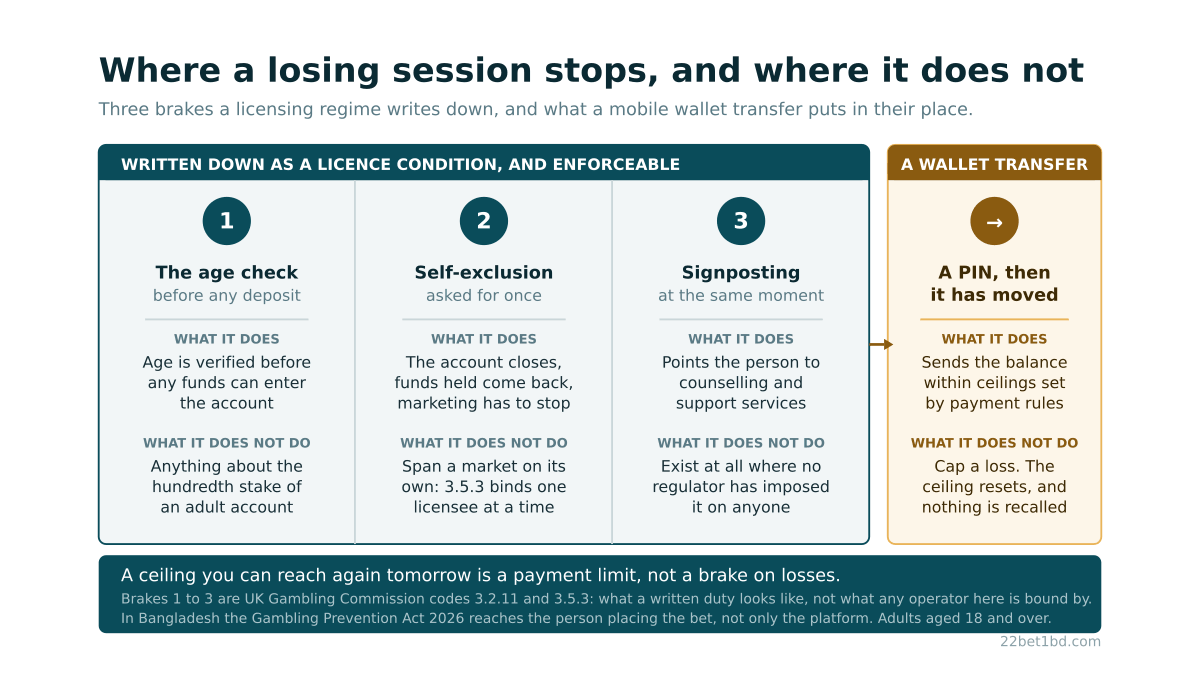
The disadvantages of online gambling named on most pages are the same three everywhere: it can become compulsive, money goes faster than intended, and some sites are fraudulent. All three are true, and all three are written as though the reader could be sitting anywhere. The two that weigh most in Bangladesh are missing from those lists: the law here reaches the person placing the bet and not only the platform, and the payment method almost everyone uses has no brake built into it.
What are the disadvantages of online gambling that the usual lists leave out?
Two, and both of them depend on where the reader is rather than on gambling in general.
The first is legal exposure that sits on the bettor. The second is structural: where a country licenses operators, a set of stopping tools is written into those licences, and Bangladesh licenses nobody. No local register to be excluded from, no authority that can order an account closed, no complaints body with jurisdiction over a site reachable from Dhaka. Nothing announces that absence, which is why a page listing "addiction" and "financial loss" can be entirely accurate and still describe the problem as though the tools for handling it were present.
Why is online gambling more addictive than betting in person?
Because the friction that used to pace a bet has been removed, and the pacing was doing work nobody noticed.
Placing a bet in a physical setting takes a journey, a queue, a counter, and cash that leaves the hand in a visible quantity. The next opportunity is minutes or hours away because somebody has to run the next event. None of that survives on a phone. In-play markets settle while the over is still being bowled, the stake is a number edited with a thumb rather than notes handed over, the balance is an abstraction that does not look like the money it came from, and nothing closes.
The second mechanism is the schedule the returns arrive on. A reward that comes at unpredictable intervals holds attention far longer than one that comes predictably, and a betting market produces that pattern by construction rather than by any operator's design. A run of losses broken by one win is not evidence the run is turning. It is the shape the activity has, and it is the shape that makes stopping feel premature.
Neither mechanism is a flaw in a particular person, which matters because the opposite assumption is what stops people recognising the pattern in themselves.
What are the signs of gambling addiction?
They are behavioural and financial before they are anything else, and none of them is dramatic enough to be unmistakable at the time.
The UK's National Health Service publishes a set of questions used to identify problems with gambling, and the useful thing about the list is how ordinary the items are: betting more than you can afford to lose, needing larger amounts to get the same feeling, trying to win back money you have lost, borrowing money or selling things to get money to gamble, other people criticising your betting, feeling guilty about it, and health problems "including feelings of stress or anxiety".
Two of those move before the others. Needing a larger amount to get the same feeling is the earliest, and it is invisible from outside: nothing has gone wrong yet by any measure a bank statement would show, the sums are simply bigger, the frequency may even be lower, and the person is still winning sometimes.
Chasing losses is the one that changes the scale of the damage, because it turns a bad evening into a bad month. The next stake gets sized by the hole rather than by what the bet is worth, and most of the other signs follow from that one.
Why does a mobile wallet make chasing losses easier?
Because the distance between deciding to recover a loss and the money being gone is a PIN.
A bKash, Nagad or Rocket transfer is a push payment: you send it from your own app to a merchant number, it lands, and nothing in the flow is built to pull it back. A card sits inside a dispute process; a completed wallet send does not. The mechanics of that flow, including the reference field a payment goes missing without, are set out on the deposits page.
The part that misleads people is the limits. Mobile financial services in Bangladesh do carry transaction ceilings, and it is natural to read those as a spending control. They are payment-system rules, set per service and per period, and two of their properties matter here. They reset, so a ceiling reached today is open again tomorrow, which paces a loss without capping it. And they apply service by service, so hitting the limit on one kind of transaction does not close the others: how the ceilings divide up is set out in the piece on daily bKash limits.
That is not a defect in the wallets. They are payment instruments, and a payment instrument does not know what the payment is for. The error is in reading a daily ceiling as a loss limit.
What stops a losing session in a licensed market, and what is missing here?
In a market with licensed operators, the stopping tools sit at the operator and are written into the licence rather than offered as a courtesy.
The UK Gambling Commission's social responsibility code on self-exclusion shows what that looks like in writing. A licensee must take all reasonable steps to refuse service to someone who has self-excluded, close their accounts and return any funds held, stop marketing to them, signpost them to counselling and support services, and make self-exclusion available through an automated remote process as well as through customer services.
The scope of that duty is worth reading precisely. It binds a licensee, one operator at a time, so by itself it would leave open the account started at the next brand the same evening. Britain closes that gap with a separate scheme rather than with this condition, the one the NHS page above points people to, which blocks gambling websites and apps rather than a single brand's, for a period the person picks when signing up. Covering a whole market took a second instrument on top of the licence condition, and neither exists anywhere that issues no licences.
The same rulebook puts the age obligation in the same place, requiring operators to verify a customer's age before any funds can be deposited and to warn customers that underage gambling is an offence. Betting is for adults aged 18 and over, and in a licensed regime that sentence has enforcement behind it.
Bangladesh licenses no online gambling operator, so no authority has imposed any of this on a site reachable from here. An operator may offer limits or exclusion of its own accord, and some do. An option a company chooses to provide and a condition it can lose a licence over are different things, and only one of them survives a change of policy.
What does Bangladeshi law add to the risk?
An exposure the generic lists never have to account for: the person placing the bet is covered, not only the business taking it.
The Gambling Prevention Act 2026 has been in force since 1 July 2026, and participation carries a penalty of its own, separately from operating a platform or promoting one. What the Act covers and who it reaches is set out in what the law actually says about betting in Bangladesh.
The part that belongs to this subject rather than that one is the second-order effect. Someone whose gambling has started causing trouble, in a country where the activity is prohibited, has a reason beyond embarrassment not to tell anyone: not the family, not an employer, not a lender being asked for help. Concealment is already one of the recognised signs, so a legal penalty attached to the activity pushes in the same direction as the problem does, and silence is the condition under which this kind of problem grows rather than resolves.
Is online gambling bad for everyone, or only for some people?
Two different disadvantages get collapsed into that question, and separating them answers it better than either half does alone.
The first applies to everyone and has nothing to do with harm. Odds carry a margin, which is how the business is funded, so the expected outcome over many bets runs against the bettor regardless of discipline or knowledge. That is arithmetic rather than a warning, and it is worked through on whether cricket betting is profitable.
The second is not evenly distributed, and an average taken across everyone who bets says nothing useful about any one of them. The two also surface differently: the arithmetic arrives slowly and evenly, the harm arrives as a change in behaviour, usually noticed by someone else first.
Why take any of this from a site that earns a commission?
Because the incentive belongs on the table before the content is weighed, and here it runs the wrong way.
This site carries affiliate links to 22Bet and earns a commission when somebody registers through one, which the footer of every page declares. That interest points toward more signups, and nothing on this page serves it. Take it as a reason to open the three sources above yourself rather than as a reason to trust the page: they are a health service and a regulator publishing their own words, and neither has anything to sell.
Betting is for adults aged 18 and over, and it should involve only money whose loss would change nothing. Anyone noticing that the amounts have grown to keep the same feeling, or that a stake got sized by a loss rather than by a judgment, is looking at the two signs that move first. Questions readers ask most often about this site and the operator it links to are collected in the frequently asked questions.
Frequently asked questions
Are the signs of a sports betting addiction different from the casino version?
The behaviour is the same, the cover story is better. Sports betting can be described as research and judgment, so hours spent read as analysis and a losing run reads as bad luck on a sound call, which makes both easier not to count. In a game with a random outcome nobody claims skill, so escalation is at least visible as escalation. The markers underneath are identical: larger amounts for the same feeling, stakes sized by the hole, activity kept quiet.
What are the physical signs of gambling addiction?
There are none that identify it, and looking for them costs the time the behavioural signs would have used. The NHS list reaches health only as a consequence, "including feelings of stress or anxiety", which describes an effect rather than a marker anyone can read off a face. What is actually observable is money and pattern: transactions with no account of where they went, borrowing that does not match known spending, hours that have moved to when nobody is watching.
How would you tell whether a partner has a gambling problem?
Not from the gambling, usually, because that part happens on a phone that is face down. It shows up in the money first: wallet activity without an explanation, borrowing out of proportion to anything visible, possessions sold. One thing is worth knowing before raising it in Bangladesh specifically: the person has a legal reason to deny it as well as a personal one, so an opening that starts from a transaction rather than from an accusation leaves them somewhere to stand.