
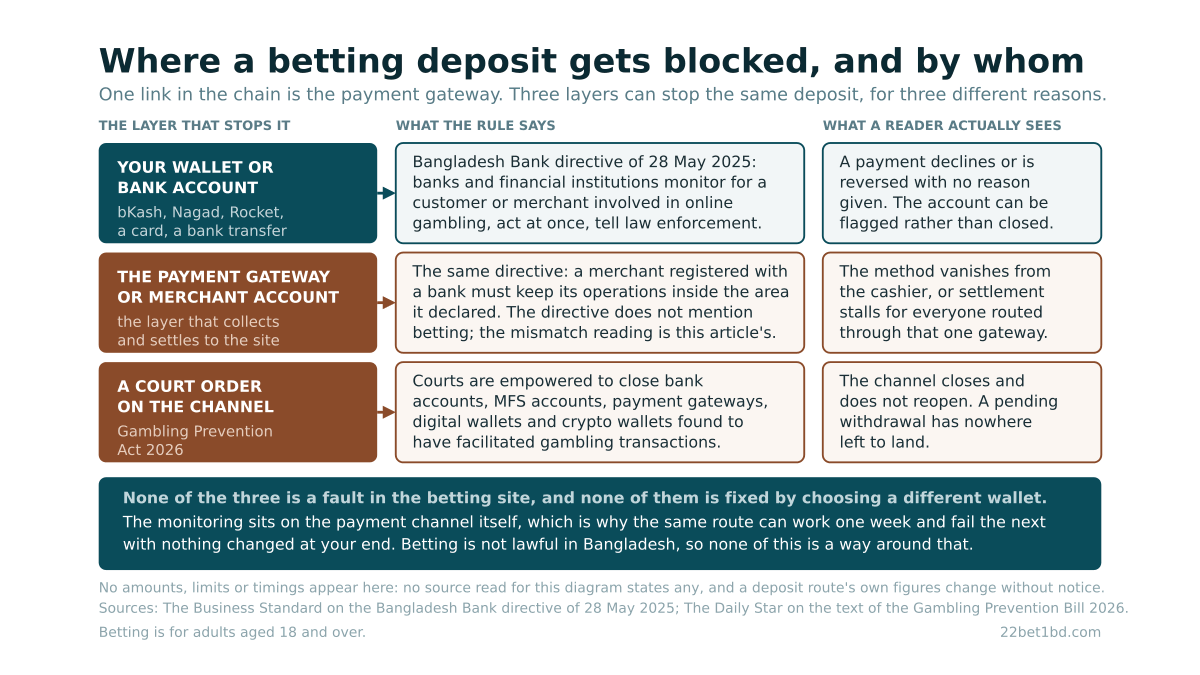
Most people typing gambling payment gateway bangladesh into a search box are not shopping for software to install. They are trying to work out why a payment to a betting site failed, reversed, or quietly stopped being offered at all. The short answer is that the block usually sits on the payment channel rather than on the betting site: Bangladesh Bank has told banks to watch for gambling transactions, and the Gambling Prevention Act 2026, on the published account of its text, lets a court close a payment gateway, an MFS account or a digital wallet found to have carried them.
What is a gambling payment gateway in Bangladesh, and is bKash one?
A payment gateway is the layer between the money and the merchant. It takes an instruction from whatever you are paying with, authorises it, routes it, and hands the merchant a single stream of payments with one set of records, no matter how many different ways the money arrived.
bKash, Nagad and Rocket are mobile financial services. They hold a balance and move it. The two jobs overlap in practice, because a wallet provider also sells merchant payment acceptance, which is why is bKash a payment gateway is a reasonable question with an unsatisfying answer: it is an MFS provider that can appear as one of the methods a gateway exposes, rather than the gateway itself.
That distinction decides who knows what, and it matters the moment something goes wrong. The betting site sees a payment arrive from its gateway or its settlement partner. The wallet provider sees a transfer from you to a merchant account inside Bangladesh. Neither one holds both ends of the chain. Where that leg actually terminates is worked through in where a bKash deposit to a betting site stops.
Why won't my bank allow gambling transactions?
Because the central bank told it to find them and act, and told it what to look for.
On 28 May 2025 the Payment Systems Department of Bangladesh Bank directed all banks and financial institutions to increase surveillance on transactions related to online gambling, to monitor regularly for any merchant or customer involved in it, and to take immediate action and notify law enforcement where involvement is suspected. The directive suggested using artificial intelligence for the monitoring itself.
One clause in it bears directly on deposits. A merchant registered with a bank, having given business information for a specific area, must keep its operations inside that declared area. The directive does not say how that applies to a betting payment, so what follows is a reading of it rather than its text: a betting deposit does not arrive labelled as one, so it travels through a merchant account registered for something else, and a system told to flag a merchant operating outside what it declared is pointed at that kind of mismatch.
This is why a block tends to look arbitrary from where you are standing. The directive names customers as well as merchants, but it is the account on the receiving end that carries everybody's traffic, so the same method can work one week and fail the next with nothing changed at your end, and everyone routed through that account is affected at once when it trips. What a merchant account is, and why its ceilings work differently from a personal wallet's, is covered in bKash merchant account limits.
Who can order a payment gateway closed, and on what authority?
A court, and the power names payment gateways specifically.
Reporting on the text of the Gambling Prevention Bill 2026 as it was placed before Parliament describes courts empowered to order the closure of bank accounts, mobile financial service accounts, payment gateways, digital wallets and cryptocurrency wallets where an account is found to have facilitated gambling transactions. The same report describes a national digital blacklist under Chapter 4, Section 39, compiling NID details, SIM cards, MFS accounts, bank accounts, wallets, devices, domains, IP addresses and applications linked to suspected offences, and, under Chapter 4, Section 43, powers to use AI based monitoring, deep packet inspection, risk scoring and transaction monitoring against gambling related flows.
The Act has been in force since 1 July 2026. The section numbering above comes from reporting on the bill text as it went to Parliament, which is the most detailed public account of those provisions, and it is cited here as that rather than as the final statute.
Two things follow. The first is that "payment gateway" has stopped being purely a technical term in this market and has become a category of thing the law can switch off. The second is that the target is infrastructure rather than individuals one at a time, which is why the effect arrives as a method disappearing rather than as a letter addressed to anybody. Whether betting itself is lawful here is a separate question with a short answer, and it has its own page.
Why does the list of deposit methods in a cashier keep changing?
Because the cashier is a status readout of the channel layer, not a menu curated for taste.
A betting site serving Bangladesh does not hold one payment route. It holds several, through different gateways, aggregators and merchant accounts. When one of them is closed, flagged, or simply stops settling, the method it powered disappears for everybody at the same moment, and a new method appears when a new counterparty is arranged. From outside it looks like the site changing its mind about a wallet. From inside it is the site losing and replacing a counterparty.
The same mechanism explains the asymmetry people notice between paying in and taking money out. A deposit needs a route that works in one direction at the second you press the button. A withdrawal needs a route that works in the other direction at the moment the site processes it, which can be days later, and the two legs are not required to use the same channel. A withdrawal sitting pending is sometimes a verification queue and sometimes a return channel that is not currently open.
What happens to money that is already moving when a channel closes?
It depends which of three places it is in, and each one has a different party to talk to.
If the payment never left your wallet or account, it fails cleanly. Nothing was credited anywhere and there is nothing to chase.
If it left your account but was never credited to your betting balance, it is a payment dispute, and it belongs to the wallet provider or the bank rather than to the betting site. The transaction ID is the only object that exists in both ledgers, which is what makes it the thing to keep.
If it was credited, it is a balance rather than a purchase, so getting it back means withdrawing it, which depends on a working return channel. That is the case a closed channel makes most expensive, because the money is neither in your hands nor recoverable by complaining to a party that never received it.
Does any of this make one payment method safer than another?
No, and being plain about that is more useful than a ranking. The monitoring runs on the channel, and the list of channels a court is reported to be able to close covers the lot: bank accounts, MFS accounts, payment gateways, digital wallets, cryptocurrency wallets. Nothing a reader could switch to sits outside it.
The law also treats attempts to get around the monitoring as an offence in its own right rather than as a workaround. The reported bill text covers fake SIM cards, fraudulent mobile financial service accounts and false identities, including misuse of biometric or national identity data.
Which methods a site currently offers is visible only in its own cashier, because it moves with the channels behind it. For 22Bet that list sits in the cashier after login, and how the domestic leg of a payment works, whichever method happens to be showing, is set out on the deposits page.
Betting is for adults aged 18 and over, it is not lawful in Bangladesh, and over any meaningful period it costs money rather than making it. None of the above is a route around any of that. It is an explanation of why a payment behaves the way it does.
Frequently asked questions
What is the difference between a payment gateway and a payment aggregator?
A gateway authorises and routes one merchant's payments into that merchant's own account. An aggregator collects payments for many merchants into a pooled account and settles onwards to each of them afterwards. For a payment that goes wrong the difference is traceability: with a gateway the receiving account belongs to the business you paid, while with an aggregator it belongs to the aggregator, and your transaction has to be matched to you inside a pool before anyone can follow it. That extra step is one of the places a stalled payment can sit.
Can I block gambling sites from my own bank account?
Not through anything described here. The monitoring on this page is a supervisory tool pointed at merchant traffic by banks and the central bank, not a setting handed to a customer, and no customer facing gambling block is documented in the sources read for this article. If the aim is to stop playing rather than to understand a failed payment, the controls built for that purpose sit inside a betting account under its responsible gambling settings, not at the bank.
Does paying in cryptocurrency avoid any of this?
No, because crypto is named rather than overlooked. The reported bill text defines cryptocurrencies alongside VPNs, proxy services, mirror sites and ghost SIM cards, puts cryptocurrency wallets in the list of accounts a court can order closed, and treats gambling related money laundering and crypto based gambling as predicate offences under the Money Laundering Prevention Act 2012. A channel that is harder for a bank to see is not a channel the law failed to consider.