
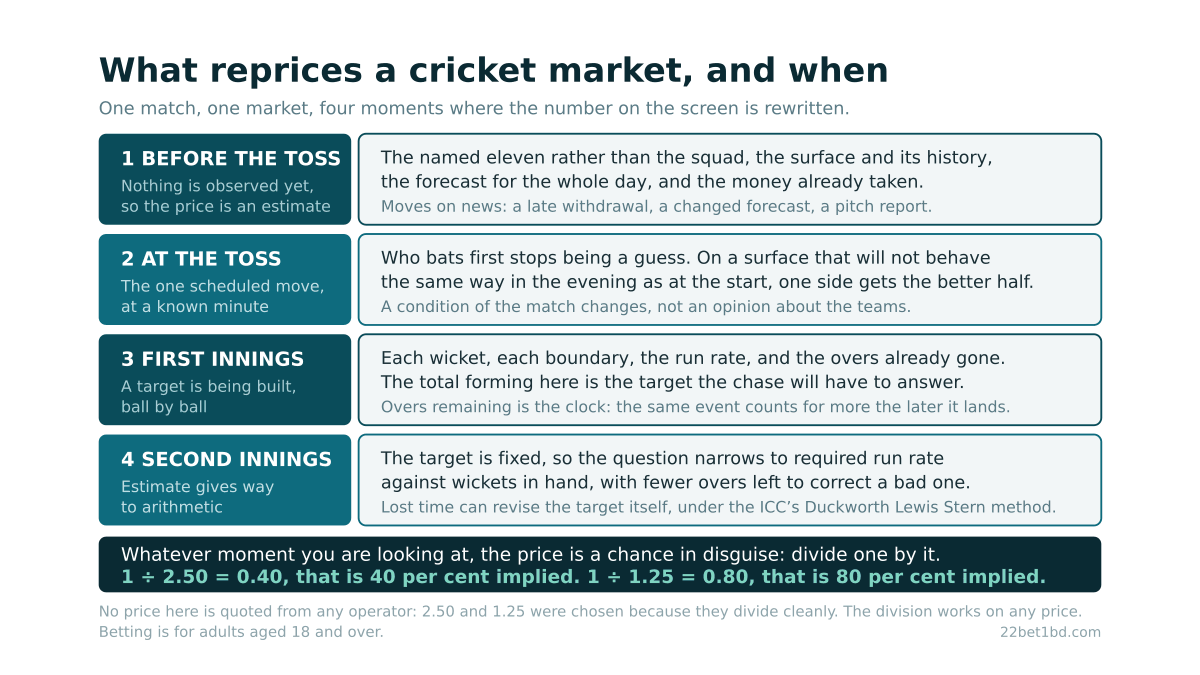
A cricket price is a probability wearing a multiplier: divide one by the number on the screen and you have the chance the market is pricing. How does cricket betting odds work is really two questions, though, and the second one is where most of the confusion lives. The number is not set once. It is rewritten continuously, at the toss, at every wicket and as the overs run out, because each of those changes what the match actually is.
How do you read cricket betting odds on the screen?
A decimal price is the total return on one unit of stake, the stake included. At 2.50, one unit returns two and a half if the bet wins, which is one and a half of profit plus the unit back.
That same number is also a statement of probability. Divide one by the price and you have the implied chance: one divided by 2.50 is 0.40, which is 40 per cent, and one divided by 1.25 is 0.80, which is 80 per cent. The division is the whole conversion and it works on any price on any screen, which is worth doing rather than assuming, because the figures above were picked for dividing cleanly and not quoted from anywhere.
Two other notations show the same thing. A fractional price of 6/4 is the profit against the stake, so it returns 2.50 in decimal terms. An American price states how much you stake to win one hundred, or how much one hundred wins. Switching the display changes nothing about the bet: most sites let you pick the format in account settings, and the implied chance underneath is identical in all three.
What does match odds mean in cricket betting?
Match odds is the market on who wins the match itself, as opposed to the markets on a quantity or on a player. It is the baseline price, and in cricket it has a complication the equivalent football market does not.
In a limited overs match it normally has two sides, because the format is built to produce a winner. In a Test it usually has three, because the draw is a genuine outcome rather than a rare one, and a Test can be headed for a draw while one side is clearly on top. That third option is why a Test match odds screen can look strange to someone arriving from twenty over cricket: three prices, and the one that moves most on the final afternoon is often the draw.
Then there is the tie, which is not the draw. A tie is a limited overs match that finishes level on runs, and what happens next depends on the competition rather than on the bookmaker: some go to a super over, some share the result. Whether the super over counts towards match odds settlement is written in each site's own rules, and the answer is not the same everywhere. The formats these markets sit on top of are covered in what cricket betting is, format by format.
Where does the opening price come from before a ball is bowled?
From an estimate, then from a margin, then from money. Somebody models the two sides and produces a chance for each, the margin is added so the published prices total more than one whole, and the price then starts reacting to the stakes that arrive.
The estimate uses the named eleven rather than the squad, which is why a late withdrawal can move a price that the squad announcement weeks earlier did not. It uses the surface, because grounds behave differently and the same ground behaves differently in April than in October. It uses the forecast for the whole day, not just the start.
What the market is pricing is a contest with a published rulebook, and the rulebook is not one document. The Laws of Cricket are drafted and interpreted by MCC, which has held that custodianship since the club was formed in 1787, while international matches are played under ICC playing conditions published separately for Tests, ODIs and T20Is and those conditions can differ from the Laws. A price is an opinion about an outcome. The outcome itself is decided by those documents, so when a result is disputed the question is usually which of them applied.
Why does the toss move a cricket price more than it would in most sports?
Because the toss changes a condition of the match rather than an opinion about the teams, and it does so at a known minute. Nothing else in the pre-match period is both scheduled and material in that way.
Batting first and chasing are not the same job. A surface that offers the bowlers something early can punish whoever bats first, and a surface that breaks up can punish whoever bats last. In a day-night match, dew arriving in the evening can make the ball harder to grip, which changes the price of a chase independently of who is doing the chasing. None of that is known until a coin lands, and all of it is priced the second it does.
So the market is not reacting to new analysis when the toss lands. It is reacting to a condition of play that was genuinely unknown a minute earlier and is now fixed for the rest of the match.
What moves the price once the match is under way?
Three things, and they do not move it equally. Wickets move it in steps, runs move it continuously, and the overs remaining decide how much either of those is worth.
A wicket is discrete and large, because it removes a specific player and brings in a different one, and because a side has only ten of them. A boundary is small and frequent. The run rate sits between the two: it is the summary the market updates ball by ball, and it moves most when a passage of play runs against the rate the market expected.
The overs remaining are the part people underestimate. They work as a denominator. Early in an innings there is time to recover from a bad over, so the price absorbs it. Late in the same innings the identical over is unrecoverable, so the identical event produces a much larger move. That is the shape of cricket's in-play market in one sentence: the same news is worth more the later it arrives.
Why does the second innings price move faster than the first?
Because the target stops being an estimate. In the first innings the market is guessing what total will be enough. In the second it knows, and the question narrows to arithmetic that both sides of the market can do.
Required run rate is the runs still needed divided by the overs still available, and it rises every time an over passes without enough runs. Wickets in hand are the capacity to attack that rate, since a side with batting left can take risks and a side without cannot. Both numbers shrink as the innings goes on, and the price is essentially tracking the gap between them.
That is why a chase can look comfortable and then reprice violently in two overs. Nothing unusual happened. The denominator got small enough that a single bad over moved the required rate beyond what the remaining batters can realistically take on.
What does rain do to a price that was already moving?
It can move it without a ball being bowled, and it can change what the bet is about. When time is lost, international limited overs cricket does not simply shorten the chase and keep the same target. The ICC adopted the Duckworth Lewis Stern method, a formula it describes as a way to decide the result fairly when weather interrupts a match, including recalculating totals when time is lost.
So a forecast is itself an input. A market can shorten on one side simply because rain is expected later, since a revised target under a shortened chase is not the same task as the original one. That is the cricket specific case worth knowing: in most sports weather either stops play or does not, while here it can rewrite the target and leave the match running.
A match cut short can still produce an official result on a revised target. A match abandoned before the minimum play has been completed can produce no result at all, and bets are handled differently in those two cases.
Why does the market disappear for a few seconds at a time?
Because the alternative is leaving a price up that is already wrong. Between deliveries, during a review, and through an interruption, the in-play market is suspended rather than updated, and bets are not accepted until it reopens.
The reason is latency. The feed reaching the trading screen is ahead of the picture reaching most viewers, and the gap between the two is a window in which somebody who already knows the outcome of a delivery could take a price that no longer reflects it. Suspending the market closes the window. It is a defensive mechanism, not a technical fault, and it is why the price you see after a wicket is frequently the first price of a new market rather than a changed version of the old one.
Where each of those lines falls is set out in an operator's own betting rules rather than in the sport's. 22Bet is the operator this site covers, and how its cricket markets are organised is described in the 22Bet review.
So what are you actually accepting when you take a price?
The implied chance, plus the margin that was folded into it before a ball was bowled. Converting both sides of a two way market and adding them together gives more than one whole, and the excess is the part that does not belong to either outcome. That arithmetic, and what it means over time, is worked through in whether cricket betting is profitable.
Knowing why a price moves is not the same as being able to predict the move. The mechanism above is visible to the market before it is visible to you, which is why the price has usually already absorbed the news by the time you have read it.
Betting is for adults aged 18 and over, and a session should be treated as spending rather than as a way to make money. A run of losses is not a reason to continue. Whether any of this is permitted where you are is a separate question with a separate answer, and the common ones are collected in the FAQ.
Frequently asked questions
If a price shortens, has that team actually become more likely to win?
Not necessarily. Two different inputs move a price: new information about the match, and the weight of money already staked. A book that has taken heavily on one side will shorten it to balance regardless of what happened on the field. From the price alone you cannot tell which input moved it, but a move with no corresponding event in the match is usually the second one.
Why does the app sometimes show a different price from the one I tapped?
Because the price on your screen is a copy of one held on a server, and the server updates first. Most sites handle this with a setting that decides what happens when the price changes during acceptance: accept any change, accept only moves in your favour, or reject the bet. With rejection selected, a shifting market means bets that simply do not go through, which surprises people more than the price change itself.
Can a wicket move the price in a direction you would not expect?
Yes, and the Test draw is the clearest case. A wicket late in a match that was heading nowhere can shorten the draw rather than either win price, because it makes a declaration less likely and burns time. In a chase, a wicket that removes a batter who had stopped scoring can shorten the chasing side, since the replacement may be better suited to the required rate. The market prices the situation, not the event.