
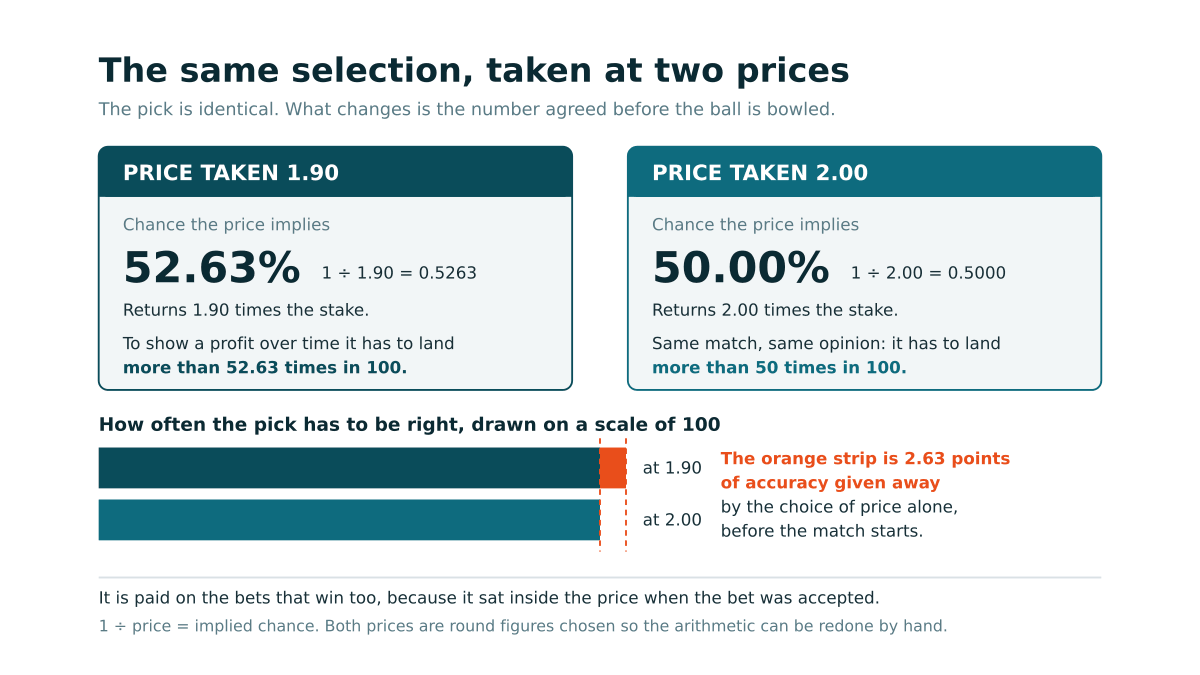
There is a condition, and it is arithmetic rather than advice. How to make money betting on cricket comes down to being more accurate than the published price by more than the margin folded inside it, on average, across enough bets that luck has stopped deciding the total. Tips, staking plans and profit calculators all sit on top of that condition, and none of them removes it.
How to make money betting on cricket: what is the condition underneath every method?
Every price a bookmaker publishes already contains its charge. Convert the prices in one market into the chances they imply, add them up, and the total comes to more than one whole. That excess is the margin, and the full derivation is set out in why cricket betting is not reliably profitable. This article starts where that one ends, because the margin is the ceiling every method below has to clear.
Clearing it means something specific. It is not picking more winners than losers, which any run of short prices produces on its own. It is that your own estimate of a result has to be closer to the truth than the price by a wider gap than the margin, repeatedly. The margin is charged on the bets that win as well as the ones that lose, because it was inside the price when the bet was accepted.
The sample matters as much as the edge. A month of profit is compatible with a method that loses in the long run, and a month of losses with one that does not, which is why the condition has to be read off the prices rather than off last month's total.
Which parts of this can a bettor actually control?
Three, and the list is shorter than most guides suggest: which price you accept, how much you stake, and whether you keep an honest record of both.
What you do not control is the result of any single bet, the news that moves a price after you have taken it, whether a tipster's claimed record is real, or how much an operator will let you stake once it has formed a view about your account. Separating the two lists is worth the minute it takes, because almost everything sold as a way to earn money from cricket betting is sold as control over the second one.
Why does the price you take matter more than the pick you make?
Because the price is a decision you make with full information, and the result is not.
Take the same selection at 1.90 and at 2.00, two round figures used here so the arithmetic can be redone by hand. One divided by 1.90 is 0.5263, so that price needs the bet to come in more than 52.63 times in 100 to show a profit. One divided by 2.00 is 0.5000, so the same opinion on the same match now needs it more than 50 times in 100. The 2.63 points between them were handed over at the moment the bet was placed, on the winners as well as the losers.
That gap is the reason experienced bettors compare prices before staking rather than after reading a preview. It is also the only part of the process where a bettor can gain ground on the condition without being a better judge of cricket than anyone else.
There is a further use for the price, and it is the closest thing to a scoreboard for a method. Record the price you took and the price the same selection reached at the start of play. If the prices you take shorten more often than they drift, your estimate was arriving ahead of the market, which is the shape an edge takes. If they drift, the method is not beating the price, whatever the win column says that week.
What does a cricket betting profit calculator actually calculate?
It multiplies a stake by a price and shows what the bet would return. That is useful arithmetic and it is the whole of it.
What it does not calculate is income, because the number that decides income is the one the calculator asks you to supply. Type in a win rate and it will report a profit for any win rate you type, including one nobody has achieved. Searches for cricket betting income and cricket betting revenue treat the output as the unknown, when the unknown sits on the input side: how often you will actually be right, at the prices you will actually be able to take. A calculator cannot measure that, and neither can a preview.
What is a limit in cricket betting, and why does it arrive after a good run?
A limit is a ceiling on what the operator will accept or pay. There are usually two kinds: a maximum stake for a given market, and a maximum payout per bet or per day, both published in the operator's own rules. Separately, an operator can reduce the maximum stake on an individual account.
The mechanism is worth understanding because it closes the loop on this whole question. A bookmaker balances money across a market rather than predicting results, so an account that repeatedly takes prices just before they shorten is a liability rather than a customer, and the standard response is to cut what that account can stake. The condition for making money and the condition for being limited are close to the same condition, which is why sustained profit is structurally harder than the arithmetic alone suggests.
Where those ceilings sit is set by each operator rather than by any general rule. 22Bet is the operator this site covers, and how its cricket markets work and what an account has to clear before a withdrawal is released are set out in the 22Bet review. The ceilings themselves are not reproduced there, because they change: they are read in the operator's own rules, which is worth doing before the bet rather than after a capped one.
How do you read a claimed win rate?
A win rate on its own says nothing about profit, because it is missing the price. Winning most bets at prices shorter than the win rate justifies still loses money, and winning a minority of bets at long prices can still clear the margin. Any seller quoting a fixed percentage of winners without the prices those bets were struck at has quoted the half of the record that cannot be checked.
Two things make a claimed record readable: whether it covers every bet or only the ones the seller chose to publish, and whether each entry carries a timestamp and the price available at that moment rather than the best price found afterwards. A record that begins at the start of a winning run is a selection, not a measurement.
Does virtual cricket change any of this?
It removes the part people think they are good at. A virtual match is produced by software, so there is no toss, no surface and no team news to read: the result comes from a random number generator, and the animation renders a number already drawn.
The clearest written statement of what that has to mean is the UK Gambling Commission's technical standard on the generation of random outcomes, which applies to betting on virtual events: it requires the results to be acceptably random and states that adaptive behaviour, meaning a game that compensates for previous results, is not permitted. That standard binds operators licensed in Britain rather than every site reachable from Bangladesh, but it describes what a virtual event has to do to be fair anywhere. Where it holds, nothing in the sequence of past rounds carries information about the next one, so no staking pattern and no reading of recent results changes what a round is about to produce.
What happens to the record when a match ends without a result?
Rain, bad light and the clock end cricket matches before they finish, and whether a shortened match still has an official result is decided by the competition's playing conditions rather than by the bookmaker. The ICC publishes the playing conditions for Tests, ODIs and T20Is, alongside the Duckworth Lewis Stern method that sets revised targets when a match is shortened. A match cut short can still produce a result that way. A match abandoned before the minimum play required produces no result at all, and what happens to a bet on it is then decided by the operator's own settlement rules, which normally void the bet and return the stake.
For anyone keeping a record, void bets need their own column. Counting them as neither wins nor losses is correct for the money and misleading for the win rate, since the bet never got the chance to be wrong. It is a small piece of bookkeeping that quietly flatters a method when it is done carelessly.
So what is left?
A narrow and unglamorous list: take the best price you can find rather than the first one, keep stakes at a size that does not change after a loss, write down every bet with the price and the time, and measure the result against the prices rather than against the wins. None of that makes betting profitable. It makes the arithmetic visible, which is the difference between a cost you have chosen and one you have not noticed. The vocabulary behind it, markets, decimal prices, settled and void bets, is explained from the beginning in what cricket betting is and how it works, and the questions that come up most often about accounts and payments are collected in the FAQ.
Betting is for adults aged 18 and over, and the arithmetic above runs against the bettor by default, so the sensible frame is entertainment with a price on it rather than a source of income. If a session stops being something you would choose to pay for, that is the point to stop, and a run of losses is not a reason to continue. Whether any of this is permitted where you are is a separate question, answered in what the law in Bangladesh actually says, and an operator's foreign licence does not settle it.
Frequently asked questions
Is a betting exchange different, since no bookmaker is setting the price?
The cost changes shape rather than disappearing. On an exchange the price is offered by another user and the platform charges commission, usually on net winnings, so the charge arrives after the result instead of sitting inside the price beforehand. The condition is unchanged: your estimate has to beat the available price by more than the cost of transacting. Cricket markets outside the largest fixtures also tend to be thin, and a price nobody is offering is not a price you can take.
Does betting only on cricket I follow closely change the condition?
Only if that knowledge disagrees with the price. The published price already contains the team news, the forecast and, once it has happened, the toss, so following a league closely mostly reproduces the market's own view at a slower speed. Familiarity becomes an edge at the point where it produces a different number, not at the point where it produces confidence.
Does a bigger bankroll make the arithmetic work?
No. Its size changes how long you survive the swings, not the expected result of any individual bet, since each bet is priced the same whoever places it. The same applies to raising stakes after losses, which changes the size of the eventual loss rather than its likelihood. That is why flat staking is described as discipline rather than as a way to win.