Searching how to report a betting site from Bangladesh runs into a problem the search results do not mention: there is no Bangladeshi body that receives that report. Every page ranking for this question belongs to a country that licenses gambling at home, so it can send you to a national regulator or an ombudsman. Bangladesh licenses nobody, because the Gambling Prevention Act 2026 prohibits rather than regulates. What is left is a different route, and it is worth understanding before you spend a week writing to the wrong address: the complaints machinery attached to the operator's own foreign licence.
How to report a betting site from Bangladesh, and what reporting can achieve
Start by splitting one word into two, because they go to different places and produce different outcomes.
Reporting means telling an authority that a company has done something wrong. The outcome is supervisory: an investigation, a warning notice, in the worst cases a licence action. It does not hand your money back, and it is not meant to.
Complaining means telling the operator that it owes you something and asking it to fix that. The outcome is money, or a reasoned refusal. This is almost always what someone means when a withdrawal has not arrived.
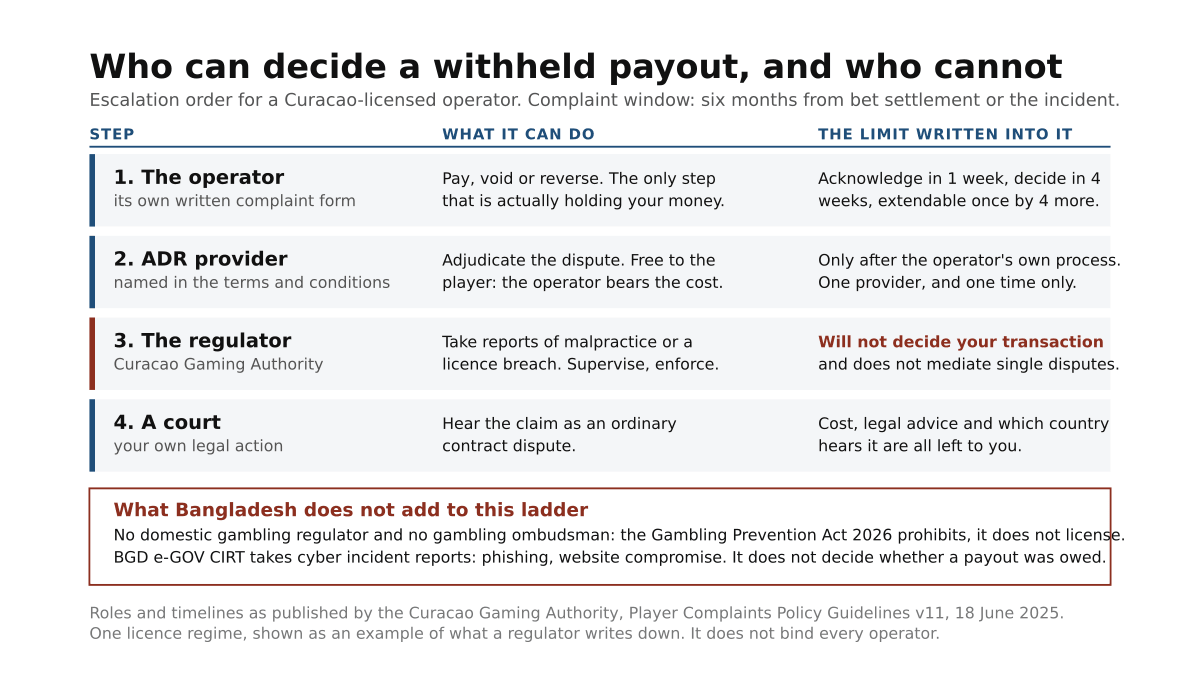
In Bangladesh the reporting half has exactly one domestic address, and it is narrower than people expect. BGD e-GOV CIRT, the national computer incident response team at the Bangladesh Computer Council, takes incident reports from individuals as well as organisations, and the categories on its own form show the shape of what it handles: phishing, malware, unauthorised access, website compromise, data breaches. A cloned or phishing domain wearing a bookmaker's name fits that list. A licensed operator that held your withdrawal for identity checks does not: that is a dispute about a contract, not a cyber incident, and filing it in the wrong place mainly loses time.
The complaining half runs entirely through whichever regulator licensed the operator, which for most sites reachable from Bangladesh means Curacao. That regime is examined in the operator review on this site, and the practical consequence is the subject of the rest of this page.
Is there a betting ombudsman, and who is the gambling ombudsman?
For a Bangladeshi bettor, no. There is no gambling ombudsman with jurisdiction here, because an ombudsman is created by the state that licenses the industry, and no such licensing exists in Bangladesh.
The word itself is a British and European habit. In those systems the body people call the betting ombudsman is formally an Alternative Dispute Resolution provider, or ADR: an independent organisation that reads both sides and decides. The UK regulator sets out how taking a complaint to an ADR provider works, and three details in it travel well beyond the UK. You cannot go to ADR before exhausting the operator's own complaints procedure. The service is free to the player. And the operator is expected to tell you which provider to use, sometimes in a letter confirming the internal process is over, called a deadlock letter.
A Curacao-licensed operator has the equivalent, and it is written down. Under the online gaming framework the Curacao Gaming Authority publishes, its Player Complaints Policy Guidelines require every licensed operator to offer independent ADR, to name the provider in its terms and conditions, and to carry the cost of the process itself. Two limits in the same document matter as much as the right: once an ADR process has finished it cannot be restarted with a different provider, and a player who walks away from a process already under way is not expected to raise the dispute again later. You get one run at it, which is an argument for assembling the evidence first.
Above ADR there is only a court, and the same document is careful about it: the operator must not restrict a player's own right to take legal action, except where that has been agreed in the terms of the ADR process. The UK guidance points the same way, naming the small claims court as the step available after a final adjudication and advising independent legal advice before taking it. For a bettor in Bangladesh that rung is open in principle and heavy in practice, since the cost, the advice and the question of which country would hear a claim against a company licensed in Curacao all fall on the person bringing it.
How do you complain to a gambling commission when the operator is licensed abroad?
By not starting there. A gambling commission is a supervisor of companies, not a judge of your transaction, and both of the regulators quoted on this page say so in their own words.
The UK Gambling Commission opens its guidance on complaining about a gambling business with the line that it does not resolve or make decisions on complaints regarding gambling-related transactions, and tells the reader to complain to the business first. The Curacao complaints policy says the same thing about its own authority: it will not resolve or decide player complaints about transactions on an operator's website, and it does not mediate individual disputes. What it does instead is keep the information and use it for supervision and enforcement, and it forbids operators from blocking a player who wants to contact the authority directly about malpractice or a breach of licence conditions.
That is the honest shape of it. Writing to a regulator about a withheld payout is a vote recorded against the operator's record, not a step that gets you paid.
The operator's own process is where a decision can be made, and the Curacao policy puts deadlines on it. A complaint can be lodged free of charge up to six months after the bet was settled or the incident happened. The operator must confirm receipt in writing within a week and explain how the complaint will be handled. It then has four weeks to assess and respond, extendable once by another four weeks with written notice. Complaints about responsible gambling are treated faster, with a target of five business days. The final answer must come in writing, either as a reasoned assessment or as detailed reasons for not handling the complaint, and if you are still unsatisfied the operator has to tell you that you may escalate to an independent ADR entity.
Those dates are the useful part. A complaint that has been outstanding for five weeks with no written acknowledgement is not merely slow: it is outside what the licence framework describes, and saying so in your next message changes the conversation.
Can a betting site refuse to pay, and what happens when betting companies are not paying out?
Yes, in defined circumstances, and establishing which circumstance you are in comes first, because it decides which of the four steps is worth your time at all.
A bet is a commercial contract between two parties. The UK regulator's ADR guidance states plainly that a gambling business is free to decide who it accepts bets from and on what terms, and that an ADR provider will not take a complaint about a refusal to accept a bet or a refusal of your custom. The same logic covers a bet voided under a term that gave the operator that power, and an account closed under a rule the terms set out. Disliking a term is not a dispute. Being treated against a term is.
What a complaint procedure does cover is wider than most readers assume. The Curacao policy lists the grounds a player may complain about, and they include withdrawal issues, deposit issues, treatment of player balances, identity verification, account closures and restrictions, alleged errors or unfairness in game outcomes, and unfair terms. A withdrawal sitting in pending while verification documents are reviewed is squarely inside that list, which means it is a complaint with a deadline attached rather than a matter of waiting politely.
Before escalating, separate the two common causes, because they look identical from the account page. One is verification: the operator is checking identity or the source of funds and will release the money when it is satisfied. The other is a payment route that failed somewhere between the operator and a mobile wallet. How those transfers actually move, and where they get stuck, is set out on the deposits page. A complaint that names the transaction reference, the date and the exact amount requested is answerable. One that says the money has not arrived is not.
How do you report a betting company for misconduct rather than complain about money?
Through the licensing authority, and the report is only as good as what you attach to it.
Reporting is the right channel when the issue is conduct rather than a balance: a site operating under a licence number that does not belong to it, terms changed after a bet was settled, marketing aimed at someone who had self-excluded, an operator refusing to supply its ADR details at all. The Curacao authority publishes warning notices about names operating without authorisation, and it says explicitly that the information it receives feeds its supervisory and enforcement work even though it will not adjudicate your case.
Assemble the evidence before writing, because a report without it is difficult for anyone to act on: the exact domain character by character, since a lookalike domain is a common cause of a site "not paying"; the account identifier; the dates of the bet, the withdrawal request and every reply; screenshots of the terms as they stood on the day rather than as they read now; and transaction references from the wallet side as well as the operator side. The same list is what makes a CIRT report usable if the site turns out to be fraudulent rather than merely slow, and the checks that would have flagged a fake site earlier are collected in the piece on how to check a betting site before trusting it.
One point specific to Bangladesh deserves saying plainly. Making a report of this kind does not place a bettor outside the Gambling Prevention Act 2026, which covers participation as well as operation and promotion. Nothing on this page changes the legal position, which is set out on its own terms in what the law actually says about betting in Bangladesh.
Can you get your money back from betting sites if you have a gambling problem?
Ordinary losses, no. A settled bet that lost is a contract that completed, and no complaints procedure, ADR provider or regulator reverses it. The pages that answer this question optimistically are usually describing a refund scheme that exists in one country's consumer law and not here.
There is one situation that the rules do treat differently, and it is worth knowing precisely. The Curacao complaints policy singles out responsible gambling complaints for the fastest handling, and it names the admission of a self-excluded person as a matter to be taken seriously regardless of how small the amount involved is. That is a complaint about the operator breaking its own obligation, not a request to undo a loss, and the distinction is the whole reason one can succeed where the other cannot.
The payment side is harsher here than in the countries writing the top search results. A mobile wallet transfer is a push payment: you send it, it arrives, and there is no card chargeback mechanism standing behind it to pull it back because the recipient behaved badly. Anyone whose spending has moved past what they intended should treat that as the signal it is and stop, rather than treat a complaint as a recovery plan. Betting is for adults aged 18 and over, the risk of harm is not spread evenly across people, and a licensed site can host exactly the same problem as an unlicensed one. What that harm looks like in practice is covered in the disadvantages of online gambling.
A dispute that reaches the complaint stage often began as a verification request left unanswered, which makes knowing what an operator asks for, before it asks, the cheapest prevention available. Those questions, and the account and payment ones that follow them, are collected in the frequently asked questions.
Frequently asked questions
Is gambling a mental illness?
It is treated as a health condition, which is a separate question from anything a betting site decides. The NHS in England runs specialist gambling treatment clinics staffed by teams of psychiatrists and psychologists, and the national centre they sit under is named for behavioural addictions. The relevance to a complaint is narrow but real: harm linked to a self-exclusion failure is the one category that licence rules push to the front of the queue, while harm on its own is a matter for support services and not for a dispute process.
Can you post gambling content on Facebook?
A platform report and a regulatory report are different channels with different outcomes, and conflating them wastes both. Social platforms run their own permission systems for gambling advertising and their own in-post reporting tools, and the most a successful report achieves there is removal of the content or the account. No platform decides whether a payout was owed. In Bangladesh there is a second consideration that does not apply to the countries ranking for this query: the Gambling Prevention Act 2026 reaches promotion, including advertising, sponsorship and affiliate marketing, so posting promotional gambling material carries its own exposure separate from anything the platform does.
Does a licence number in the footer mean an ADR route exists?
Not by itself. The obligation to offer ADR attaches to a current licence, and a number printed in a footer is a claim the site is making about itself until it resolves in the authority's own register. The useful test is to look for the ADR provider's name in the terms and conditions, because a licensed operator is required to put it there and to include contact details. Terms that describe a complaints procedure but never name an independent provider are the clearest sign that the second rung of the ladder is missing, and that is worth knowing before a deposit rather than after a dispute. 22Bet, the operator this site carries affiliate links to, names a Curacao licence, so 22Bet can be put through exactly that test like any other name.