
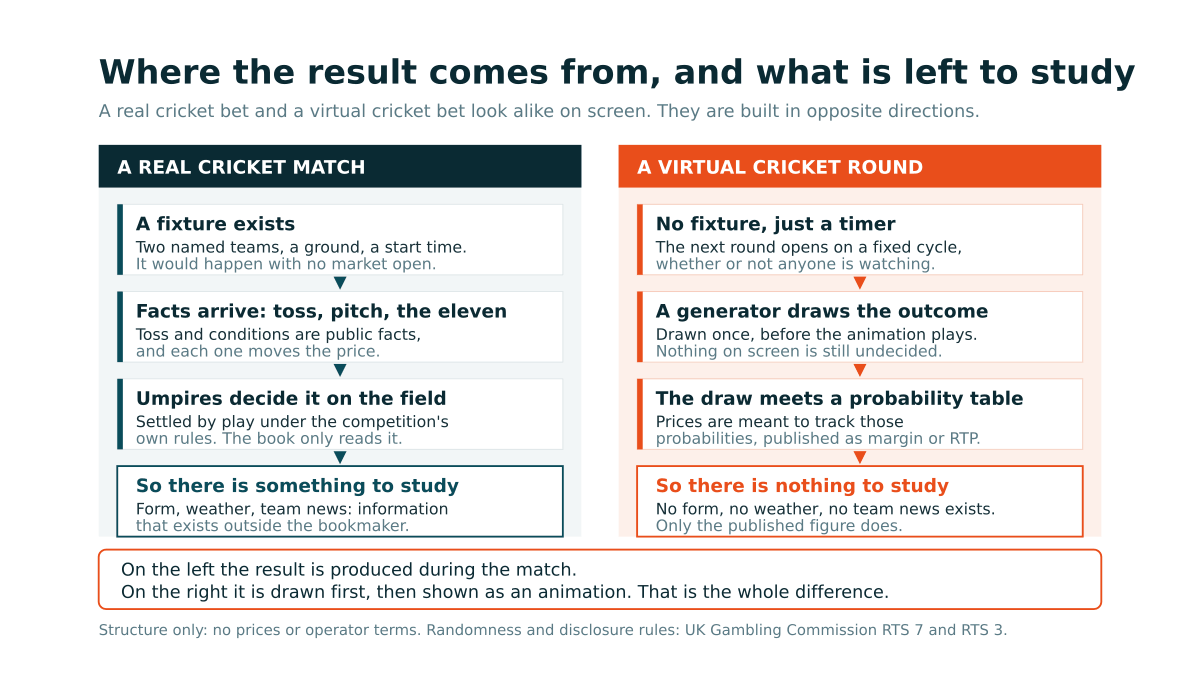
Virtual cricket betting is betting on a cricket match that is not being played. Asking what is virtual cricket betting usually gets an answer about graphics, and the graphics are the least important part: a program draws the result, the screen then plays an animation of the result it already drew, and the bet settles against that. No toss, no ground, no eleven players, no weather. By the time the first ball appears on screen, nothing about that round is undecided.
What is virtual cricket betting, and what are you actually betting on?
On a number, dressed as a match. The three parts of the bet are the ones described in what cricket betting is: you name an outcome, you stake an amount, a price is attached to the pair. What changes is the thing on the other side of the agreement.
The clearest evidence of how different that is comes from the way regulators file it. The UK Gambling Commission's technical standards on random outcomes apply to gaming, lotteries and betting on virtual events in one breath, a scope line that does not mention betting on real sport at all. Virtual cricket is not filed alongside cricket. It is filed alongside bingo and slots, and everything awkward about it follows from that single fact.
So the honest description is not "cricket, simulated". It is a game of chance that borrows the vocabulary of cricket, in the same way a slot borrows the vocabulary of fruit.
How does virtual sports betting work, from the timer to the settled bet?
As a cycle that repeats, not as a calendar that fills up. A round opens, a betting window stays open for a short time, the window closes, the outcome is generated, the animation plays, bets settle, and the next round opens behind it. The cycle length is a product decision made by whoever built the engine, which is why the schedule never has a rain day, an off season or a gap between tours.
That difference does more work than it looks. A real fixture imposes waiting: a Test runs for days, and even a T20 leaves hours of nothing. Virtual rounds remove the waiting, so nothing in the product marks the point where a session should end, because no match ever ends. The stopping point real sport provides for free has to be imposed from outside here, decided before starting rather than during. Betting is for adults aged 18 and over, and money staked on a virtual round is gone exactly as money staked on a real one is.
Is virtual sports betting rigged?
That question has two halves, and most answers only give the first one.
The first half is what the software is supposed to do. The standards cited above require that outcomes be "acceptably random", demonstrable through statistical testing, and they explicitly prohibit adaptive behaviour, meaning a game that adjusts what it produces in response to how a player has been doing. The guidance adds that outcomes should be unpredictable, that the generator should not reproduce the same output stream, and that seeding should not introduce predictability. A separate requirement bans near-miss design: an event may not substitute one losing outcome for a different losing outcome to make the loss look closer than it was, and a simulation of a real device has to carry the real probabilities of that device.
The second half is who enforces any of it on the account you actually hold. Those standards bind operators licensed in Great Britain, and an operator licensed elsewhere is outside them, so the list above describes what the machinery is meant to do rather than guaranteeing what any particular product does. Many betting sites reachable from Bangladesh are licensed in Curacao instead, and the Curacao Gaming Authority states plainly that it does not handle individual complaints against operators, that resolving player disputes is not within its mandate, and that it is not a civil court and cannot order an operator to compensate anyone. Complaints still matter to it as evidence of possible breaches, but that is supervision of the operator, not a remedy for you.
Read the two halves together and "is it rigged" is the wrong first worry. The practical exposure is not a secretly tilted generator, it is that the settlement rules written by the operator are, in most cases, the whole of the dispute process, which makes what an operator publishes and how it presents it a real difference between accounts. That is what the 22Bet review sets out.
What does "in-play" mean if the result already exists?
Not what it means on a real match, and this is where the two products stop resembling each other. In a live game, in-play pricing tracks uncertainty converting into fact one delivery at a time, which is why a market suspends around each wicket and reopens with a recomputed number. The information genuinely does not exist yet.
In a virtual round it already does. The outcome was drawn before the first frame rendered, so the animation is playback, not play. Any price quoted while it runs is a price on something that has already been decided, and the only thing that changes second by second is how much of the result the viewer has been shown. Whether a given product takes bets once the round is running, and against what, is therefore the first thing to establish in its rules, and it is a question that does not even arise on a real match.
The same logic disposes of a habit imported from real cricket: watching closely gains nothing, because a render is not evidence about anything except a number that was fixed before it started.
How do you win in virtual cricket betting?
No method changes the odds of a drawn outcome, and that is not caution, it is the design. Each round is generated independently of the last, and the guidance behind that standard asks that the next outcome be unpredictable without complete knowledge of both the algorithm and its seed value, which is the same thing as saying that the results already shown tell you nothing about the next draw. A run of results you noticed is a pattern in numbers that were meant to have no pattern. The ban on adaptive behaviour cuts the same way from the other side: the game is not responding to your losing streak, which is reassuring, and it is equally not going to become "due", which is the belief that streak actually feeds.
There is one number worth looking for, though, and it is the one part of a virtual product that is meant to be disclosed. The same technical standards require that, before a customer commits to gamble, information enabling an informed decision about the chance of winning be easily available for each virtual event: the house edge or margin, the return to player percentage, or the probability of the winning events, with the guidance adding that displayed odds should reflect the probability of each outcome as closely as possible. A real cricket match has no such figure, because nobody knows the true probability of a team winning. A virtual event does, because somebody wrote it. Finding it in the game rules is the only research in virtuals that is research rather than superstition, and what that figure means once you have it is the arithmetic worked through in why the margin sits inside every price.
Do virtual cricket betting apps and sites change anything?
No. An app is a door onto an account, not a different product behind it, and a virtual round reached through a phone is the same cycle reached through a browser. 22Bet is the operator this site covers, and whatever any sportsbook files under a "virtual" heading is defined in that market's rules inside the account, not by the name of the menu it sits in.
Searches for a virtual cricket betting app do mix two unrelated things: real-money virtual events inside a sportsbook, and free cricket simulator games that stake nothing and are distributed like any other app. They look alike in a store listing, so the test is whether the thing takes a deposit, not whether the screenshots show a scorecard.
Frequently asked questions
What is virtual betting, and is virtual football betting any different?
The machinery is identical and only the artwork changes, which is why virtual football, virtual racing and virtual cricket all answer to the explanation above: a drawn outcome, a fixed cycle, a rendered result. The reliable way to tell a virtual event from a real one is not the section it sits in but whether the fixture exists outside the betting site at all. A real match has two named teams and a date confirmable on a governing body's calendar. A virtual one exists nowhere except on the screen showing it, and starts again because the timer says so.
If the probabilities are fixed, why do the prices change from one round to the next?
Because each round has its own line-up, and the prices belong to that line-up. The standards prohibit changing the rules, payouts or outcome probabilities of a virtual event while it is available for gambling, except as the rules themselves provide, and the guidance gives the specific example of virtual racing products where the odds differ from event to event depending on the virtual runners. So varying prices between rounds are the composition of each round, not the book reacting to money, news or anything you did.
Does a simulated match change the legal position in Bangladesh?
No. The absence of a real fixture is a product detail, not a legal distinction, and an operator's foreign licence regulates the operator rather than the person placing the bet. What the law in Bangladesh says, and what a Curacao licence does and does not cover, is set out in the article on the legal position.