
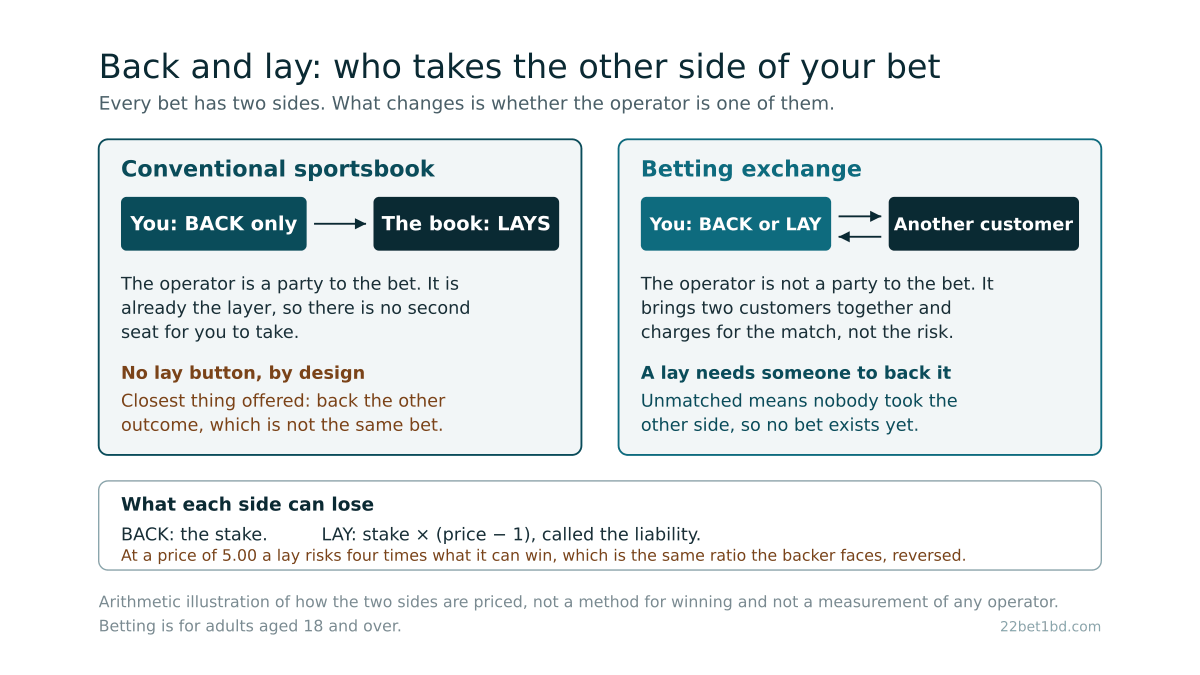
To back an outcome is to stake money on it happening. To lay the same outcome is to take the other end of that bet, collecting the stake if the outcome fails and paying the winnings if it arrives. The part most guides skip, and the reason what is back and lay in cricket betting is a more confusing question than it looks, is that only one of those two sides is on sale to an ordinary customer at a conventional bookmaker. A sportsbook sells you the back side and keeps the lay side for itself, so the lay button those guides describe is not missing from your account by oversight. It belongs to a different kind of operator.
What is back and lay in cricket betting, stripped to the mechanics?
A back bet is the familiar one. You name an outcome, you stake an amount, a price is attached, and if the outcome arrives the stake comes back multiplied by that price.
A lay bet is the same contract read from the other end. You accept somebody else's back bet. Their stake becomes what you stand to win, and their potential winnings become what you stand to pay. Laying "Bangladesh to win" is not a prediction that Bangladesh loses in a vague sense: it is an undertaking to pay a specific person a specific amount if Bangladesh does win.
Put those together and the pair stops being two products. Every matched bet in existence has a backer and a layer, always, with no exception. The only question any given market answers is who is allowed to sit in each seat.
What does back and lay mean in sports betting rather than in cricket specifically?
The same thing, because the vocabulary is not cricket vocabulary at all. Back and lay come from betting exchanges and are used identically for football, tennis and horse racing. The sport does not change the mechanic. It changes how many ways the bet can finish, and that is where cricket trips people who learned the terms somewhere else.
In a two-way market, laying an outcome and backing its opposite feel interchangeable. Cricket often has a third result, and then they are plainly different bets. Under the Laws of Cricket, a match is a Tie when all innings have been completed and the scores are equal, which is clause 16.5.1, and a Draw when the result is not determined in any of the ways the preceding clauses set out, clause 16.5.2. So laying one side covers two destinations, the other side winning and nobody winning, while backing the opponent covers only one of them. Anyone who treats the two as the same bet has quietly dropped a whole outcome.
What counts as a result in an international match is narrower still, because the playing conditions sit on top of the Laws and the ICC publishes a separate set for Tests, ODIs and T20Is. A limited-overs competition can carry its own tie-breaking procedure that a Test cannot. The practical rule that follows is boring and worth more than any tip: read how the market defines its result before assuming that laying one team is the same as backing the other.
Why is there no lay button in your betting account?
Because the bookmaker is already laying. Every price it publishes is an offer to take the other side of your bet, with its own money, at its own risk. The lay seat in a sportsbook is occupied before you arrive.
An exchange is a different business, and where the two are licensed separately the difference is written into the licence itself. The UK Gambling Commission's remote betting intermediary licence allows the holder to bring two or more betting parties together online "in circumstances where you do not have liability for their bets", and the Commission notes that such an intermediary is commonly known as a betting exchange. That phrase about liability is the whole distinction. A bookmaker is a party to your bet and carries the risk of it. An exchange is not a party to anything: it finds another customer who will be, and charges for the matching rather than for the risk. Those rules bind operators licensed in Great Britain and not operators licensed elsewhere, so this describes the two business models, not any particular account.
Two consequences follow for someone reading an exchange guide with a sportsbook open in the other tab. A lay facility is not a feature a bookmaker can switch on, because taking lay orders from customers would make it the other kind of operator. And the closest thing a sportsbook offers is not equivalent: a cash out figure is the book pricing a buyback of your own bet, a number you accept or decline, whereas a lay on an exchange is a price you set and another customer has to come and take.
What does laying a bet actually put at risk?
More than the stake, and the arithmetic is worth doing once because it surprises people. The layer's exposure is the stake multiplied by the price minus one, which is the amount the backer would win. Lay an outcome at a price of 5.00 to win one unit and four units are at risk. At 11.00 it is ten. The backer's position is the mirror image, risking one to win four, and neither side is more or less sound than the other: they are the same bet, priced once, seen from opposite ends.
That asymmetry is why laying longshots feels comfortable and occasionally is not. Most of the time the unlikely thing does not happen and the layer keeps a small stake, and when it does happen the loss is many times larger than any single win. This is the bookmaker's own risk profile in miniature: not a better side of the bet, a differently shaped one. Where those prices come from in the first place, and what the operator takes out of them, is set out in how cricket betting odds work.
Two more mechanics matter on an exchange and have no counterpart at a sportsbook. A lay order only becomes a bet when somebody backs it, so an unmatched order is not a position, it is a request, and thin markets leave requests sitting there. And the exchange deducts commission from net winnings rather than building a margin into the price, which is why its prices can look better than a bookmaker's before the deduction and less so after it.
What is the meaning of 2Up in sports betting, and why does it appear next to back and lay?
2Up is a name for early settlement, and it comes from football: a bet is settled as a winner the moment the team backed goes two goals ahead, whatever the final score turns out to be. It is not a market and not a bet type. It is a concession an operator chooses to apply to certain bets, and which bets, which competitions and which conditions qualify differ from one operator to the next and change without notice, so the only reliable source is the rules of the account in question. This page does not list any operator's terms for exactly that reason.
It turns up in back and lay discussions because it breaks the symmetry the whole mechanic rests on. Back one side and lay the same side elsewhere and the two positions normally cancel, give or take the gap between the prices. If one of them has been settled early while the other is still live, they no longer cancel, and that asymmetry is the thing people are describing when they talk about pairing a bookmaker bet with an exchange lay. Whether anything is left over once the price gap and the commission are paid is arithmetic to do case by case, not a property of the method.
Cricket has no state that corresponds to being two goals ahead, so the football version does not transfer. Any early payout rule in a cricket market is defined by the operator that wrote it, and it is written in that operator's settlement rules rather than in the Laws of the game.
So which product are you actually looking at?
This is checkable in a few seconds and decides whether any back and lay guide applies to you. An exchange shows two prices for the same outcome, one to back and one to lay, usually in adjacent columns with amounts next to them showing how much is available. A sportsbook shows one price per outcome, because there is only one side being sold. 22Bet is the operator this site covers, and how its cricket markets are arranged is described in the 22Bet review.
Everything above is structure. None of it says whether a bet is worth placing, and the formats these markets are built on are a separate question answered in what cricket betting actually is. Betting is for adults aged 18 and over, the money is at risk whichever side of a bet you take, and a run of losses is not a reason to keep going. Whether any of this is permitted where you live is not settled by an operator's foreign licence, and it is covered in what the law in Bangladesh says.
Frequently asked questions
Is lay betting legal?
Legality does not attach to the side of the bet. Laying is placing a bet like any other, so the question is not whether laying is permitted but whether betting is, and that is decided by the law where the person is rather than by the product a particular operator happens to sell.
Can you back and lay the same selection?
Yes, and the result is a position defined by the two prices rather than by the match. If the lay price you get is higher than the back price you took, the pair closes at a loss even when the selection wins, and commission on the exchange side is charged on top of that gap. The case people have in mind, where the two prices are close enough to leave the outcome irrelevant, is the exception rather than the normal state of a market. The awkward middle is worse than either: if the lay goes unmatched you are left holding one side only, exposed to exactly the result you were trying to neutralise.
What happens to a lay bet if the match is abandoned?
Whatever the market's own settlement rule says, and in cricket that is a routine case rather than an edge one. If the market is voided, both sides are returned: the backer gets the stake back and the layer's liability is released. If it settles on a revised target instead, the bet stands and the layer pays or collects on that result. Which of the two applies is decided by the market definition, not by the fact that play stopped, and how a shortened cricket match settles goes through the distinction.