
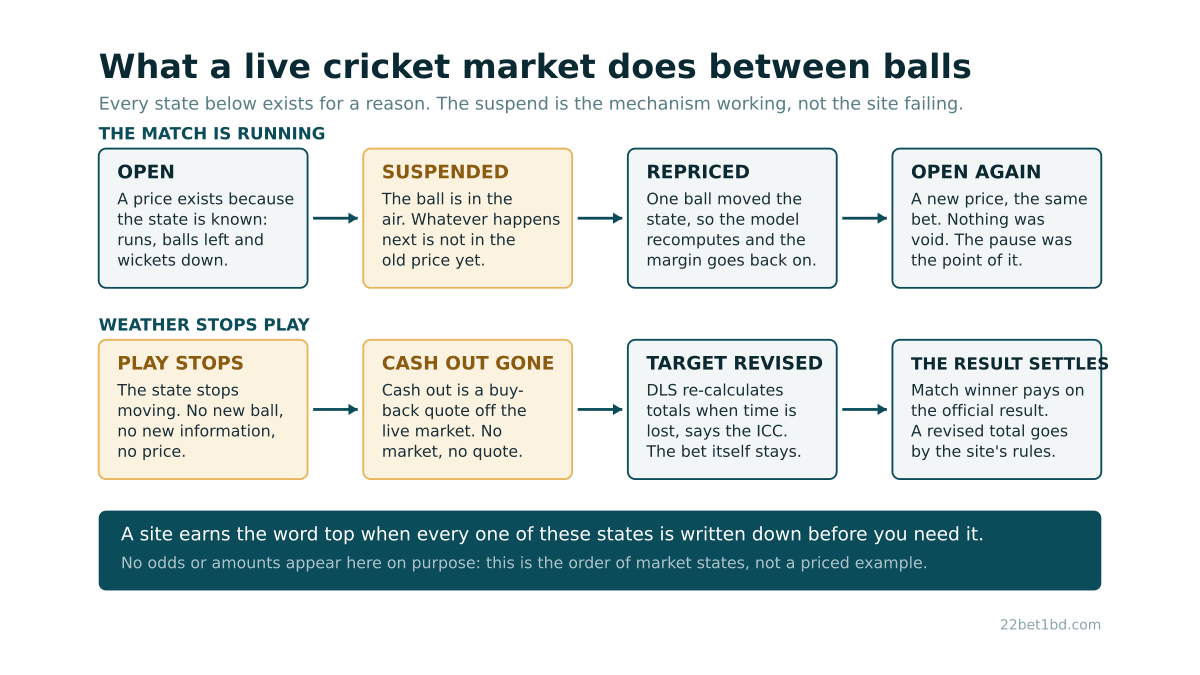
There is no top betting site in Bangladesh in the sense the phrase promises, because nobody has published the test that would establish one. What does exist is a narrower question with a checkable answer. During live cricket, which is when most money here is actually at risk, a site either tells you in advance how it handles a suspended market, a revised target and a withdrawn cash out, or it leaves you to find out while a bet is running. That difference is readable before you deposit, and it is the only part of "top" that anyone outside the company can verify.
Is there a top betting site in Bangladesh, or only the top of somebody's list?
Only the top of somebody's list, and the list is almost always an advertisement.
Most of the pages competing for this query and its near variants are ranked tables, and the publisher of a ranked table is normally paid when a reader opens an account through one of its links, often by more than one of the names in the table at once. This site earns the same way, on a single operator, which is what its footer discloses. The variants people actually type make the shape obvious. "Best betting site in Bangladesh 2026" puts a year in the title, which records when the page was edited rather than when anything was examined. "Top 10 best betting site Bangladesh" fixes the answer at ten before the question is asked. Neither the year nor the number is a finding. The deeper problem with "which betting site is best in Bangladesh" is that it has no answer for a stranger: best at what, on which sport, paid out through which wallet. The licensing side of this, and the three dated records that do exist outside every ranking, are covered separately in why a ranked list cannot establish trust.
How many betting sites in Bangladesh are there, and why does nobody have the number?
Nobody has it, and the reason is structural rather than lazy: there is no domestic register of these sites to count.
Operators reachable from here hold licences issued elsewhere, each under the rules of whichever authority issued them, and no authority maintains a roster of which of them accept Bangladeshi customers. A count would need a list kept by someone with standing over the sites themselves, and for this market that list does not exist. Even a count of domains would overstate things, because one brand commonly runs several mirror addresses at once, which is also why a domain spelled one character off the one you know is such a common problem. The separate question of where the law puts the person placing the bet is not settled by any licence and is treated on its own terms in what the law says about betting here.
Why do live cricket odds freeze the second a wicket falls?
Because an in-play price is a function of the match state, and for a moment after each delivery the state the model is holding is out of date.
A live price is computed from runs scored, balls remaining, wickets in hand and the model's standing view of the two sides. A wicket moves several of those inputs at once, and a boundary moves two of them. In the interval between the event happening at the ground and the model taking it in, any price still on the screen is a price for a match that no longer exists. Suspending the market is how an operator avoids accepting bets at a figure that is already known to be wrong. The video feed compounds it from the other side, because what a viewer watches runs behind the ground, so even a price that looks live is describing a slightly older match than the one the operator is pricing.
So the freeze is the mechanism working. What varies between sites, and what is worth reading before you need it, is how long the suspension lasts, whether bets keyed in during it are accepted or returned, and whether any of that is written down.
What happens to a bet when DLS revises the target mid-match?
The bet stays where it is. The match it was priced against does not.
The International Cricket Council describes the Duckworth Lewis Stern method on its own page for the method as "a formula to fairly calculate the winning side when inclement weather intervenes and the match is interrupted, which includes re-calculating totals when time is lost in the match". A bet on the match winner survives that intact, because it settles on the official result and a revision still produces one. Markets built on a quantity are the awkward case: a total, a player's runs, the number of overs. The revision can shrink or remove the thing those markets were counting, and what happens next is decided by the operator's settlement rules, not by cricket's.
Two published documents sit behind the result itself, and they are not the same document. The ICC issues playing conditions for each format separately, dated and revised, with Test, one day international and Twenty20 international versions listed on their own for both the men's and women's games. The Laws of Cricket are a different text, kept by MCC, which describes its custodianship of the Laws as a role it has carried out since the club's formation in 1787. A result is declared under the competition's playing conditions, and those are what a settlement eventually refers to. The question for a site is therefore specific: does it name the competition rules it follows, and does it say what becomes of the markets a revision emptied out.
Why does cash out disappear during a rain delay?
Because cash out is a price, and during a stoppage there is no market to take a price from.
Cash out is an offer to buy your bet back at a figure derived from where the market stands right now. When play stops, the state stops advancing: no ball is bowled, no information arrives, and there is nothing new to compute a figure from. A stoppage is also the moment when the eventual outcome is least knowable, since whether play resumes at all is still open, so an operator quoting through one would be quoting blind on both sides. Withdrawing the offer is the conservative choice, and it costs you nothing you held: the original bet stands at the price you took it.
The grievance worth having is not that the button went grey. It is whether the site stated, before you placed anything, that this is a situation in which the button goes grey.
What should a cricket betting site in Bangladesh be judged on, then?
Four documents, all of which can be read without an account and most of which never appear in a ranked list.
The first is the cricket settlement section specifically: abandoned matches, DLS revisions, reduced-over matches, bets on an innings that was never played. The second is the suspension rule, covering the window described above. The third is the cash out rule, and in particular the conditions under which the offer can be withdrawn. The fourth has nothing to do with cricket and is the payment and withdrawal terms, because a mobile wallet transfer is a push payment with no chargeback behind it, which is why how deposits and withdrawals actually move deserves its own reading.
A site that keeps all four in a generic "sports rules" page has told you something by that choice alone. This site carries affiliate links to a single operator, so it has no ordering to defend and nothing to rank; what it can do is stay with one name and show the working, which is what the operator review sets out, with everything said about 22Bet kept to what its own published documents and outside records state. The four readings above remain yours to do, on the operator's own rules pages, and the point of naming them is that you can do them before you deposit rather than after.
What does none of this change?
Four things, and they survive every check above.
The margin is the first. Prices are set so the book holds an edge across many bets, and a site with impeccable settlement rules is still priced that way, which is the arithmetic laid out in why cricket betting rarely pays over time. The second is that none of these documents are promises about your individual outcome. The third is your own position under Bangladeshi law, which is about you rather than about the company and which no foreign licence addresses. The fourth is harm: betting is for adults aged 18 and over, it is habit forming, and a site that handles a DLS revision perfectly can cause exactly the same damage as one that does not.
Frequently asked questions
Is a popular betting site in Bangladesh the same as a good one?
Popularity measures how many people arrived, which is largely a measure of how much was spent on advertising and affiliate commission. It is a real quantity, and anyone can approximate it by looking at how often a brand's name is searched directly rather than through a category term. What it cannot be read off is settlement conduct, because nothing about how an operator treats an abandoned match is visible in its traffic. A brand can be the most searched name in the country and still have the vaguest rules page in it.
Does a general sports betting site in Bangladesh handle cricket worse than a cricket-only one?
Not by virtue of being general. The difference that shows up in practice is coverage depth: whether domestic and franchise fixtures carry in-play markets at all or only the internationals do, and whether the cricket settlement rules are written out separately or folded into a paragraph covering every sport at once. The folded version is the warning sign, because interruptions, revised targets and reduced-over matches have no equivalent in most other sports, so a generic rule has nothing useful to say about them.
Does any of this apply to virtual cricket?
None of it does, and that is the cleanest way to see what separates the two. Virtual outcomes are produced by a random number generator rather than by a match, so there is no ground, no weather, no suspension around a delivery and no DLS to revise anything. Everything this page treats as a test simply has no counterpart there, which is covered in what virtual cricket betting actually is.