
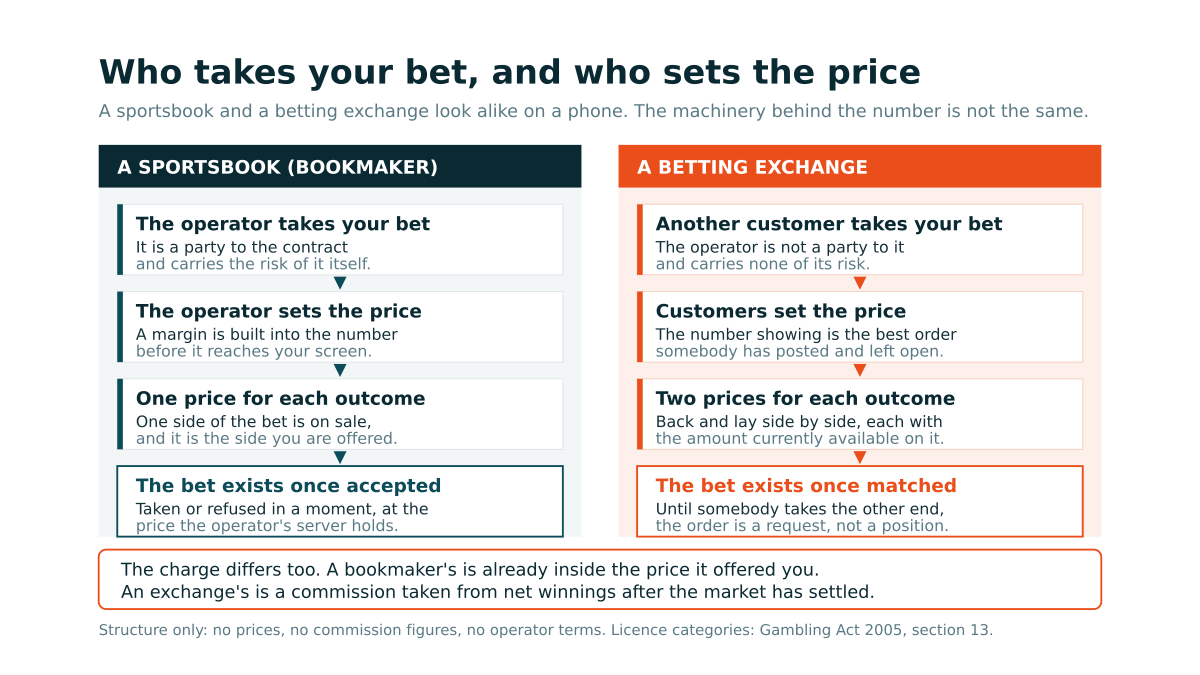
A cricket betting exchange is a marketplace rather than a shop. Instead of an operator quoting you a price and taking the other side of your bet with its own money, an exchange puts two customers in front of each other and charges for the introduction. That one structural difference is what produces everything else people notice: two prices for each outcome instead of one, bets that sit waiting until somebody takes them, and a charge that arrives after the market settles rather than hidden inside the number you accepted.
What is a cricket betting exchange, in plain mechanics?
It is a venue where the bets are between customers and the operator is not a party to any of them. The business has a name in law. The Gambling Act 2005 defines a betting intermediary as a person who provides a service designed to facilitate the making or acceptance of bets between others, which is section 13, and the regulator attaches that definition to the product directly: the UK Gambling Commission's remote betting intermediary licence permits a holder to bring two or more betting parties together online "in circumstances where you do not have liability for their bets", and notes that such an intermediary is commonly known as a betting exchange.
Read the phrase about liability slowly, because the rest of the article is a consequence of it. A bookmaker is on the other end of your bet and loses when you win. An exchange is on neither end: it finds the person who will be, holds the stakes while the match is played, and takes a cut of the winnings for running the matching. Those rules bind operators licensed in Great Britain and not operators licensed anywhere else, so what they describe is the shape of two businesses, not the status of any particular account.
Who sets the price on an exchange, if not the operator?
The customers do, by leaving orders open. Every number on an exchange screen is somebody's unaccepted offer: a price one person is willing to take and an amount they are willing to risk at it. Nothing published it, and nobody modelled it in the sense a trading room models a sportsbook price.
That is why each outcome carries two numbers rather than one. The back price is the best offer currently available to somebody who wants to stake on the outcome happening. The lay price is the best offer available to somebody who wants to take the opposite end of that bet. The two sides of a bet and the reason an ordinary betting account only shows you one of them are worked through in back and lay in cricket betting; what matters here is that the gap between those two numbers is not a fee. It is the distance between what one group of customers will pay and what another will accept, the same gap a market in anything has, and it widens when few people are interested.
What does "rate" mean on a cricket betting screen?
The word does two different jobs, and the confusion is worth clearing because both appear in the same app. In the match, a rate is runs per over: the run rate scored and the required rate still to be achieved. In the market, "rate" is used loosely for the quoted price, and exchange style layouts often label their back and lay columns that way.
Telling them apart is a matter of where the number sits, not of the number itself, because the two ranges overlap: a required rate of six and a price of six are the same digits. A price sits in a market row beside an outcome and a field for your stake, it has a second number next to it on an exchange, and it changes when people bet. A rate sits with the score and the overs, usually labelled current or required, and it changes when a ball is bowled. One shortcut holds in one direction only: a number below one is never a price, because a decimal price under one would return less than the stake. Once you know you are reading a price, dividing one by it gives the chance the market is implying: one divided by 2.50 is 0.40, a forty per cent chance. What that implied chance includes, and what it leaves out, is set out in how cricket betting odds work.
Why does a bet on an exchange sometimes just sit there?
Because an order is not a bet until somebody takes the other end of it, and on a quiet market nobody may. This is the mechanic that most surprises people arriving from a sportsbook, where a bet is accepted or refused within a second and there is no third state.
Three things follow. An unmatched order is a request and carries no position, so a reader who places one and closes the app has not backed anything. An order can be matched in part, leaving you staked for less than you intended and still queuing for the rest. And the amount shown next to a price is finite: taking more than is available means taking the rest at the next price along, which is worse.
Cricket makes this sharper than most sports because interest is so unevenly spread. A major international fixture carries enough orders that the two sides of the market sit close together. A domestic match in a league nobody is watching may have one customer on each side, and then the best available price is not a market view at all. It is whatever that one person typed.
Why do exchange prices and bookmaker prices for the same match differ?
Because the charge enters in two different places. A bookmaker's margin is folded into the price before it reaches you, so every number on the screen is already net of the operator's cut. An exchange leaves the price alone and takes a commission out of net winnings after the market settles.
The visible consequence is that an exchange's headline price on the same outcome tends to look longer than a bookmaker's, and the comparison is incomplete until the commission is applied to the winning case. Whether the exchange is actually cheaper for a given bet is arithmetic to do with the two real numbers in front of you, not a property of the product. Commission rates differ between operators and change, so no figure is quoted here.
There is a second reason the two can diverge, and it has nothing to do with charges. A bookmaker's price is one company's opinion, adjusted for how much money it has already taken. An exchange price is whatever one customer is currently offering and another has not yet taken. When those drift apart it usually means the exchange is thin rather than that somebody has found an error.
How can you tell whether a platform is an exchange or a bookmaker?
By looking at four things, none of which require an account. Does each outcome show two prices with an amount available beside each, or one price on its own? Does a bet wait to be matched, or is it accepted outright? Is the charge described as commission on winnings, or is nothing mentioned because it is already inside the price? And which licence does the operator hold, since the categories are not interchangeable: the Commission issues the betting intermediary licence above for exchanges and a separate remote general betting licence for providing betting facilities on real events, which is the bookmaker's category.
This is the useful way to answer "is this named site an exchange", because the answer changes as companies change products and a list of names goes stale the month after it is written. The four checks do not.
Why does a search for a cricket betting exchange return live score apps?
Because the word "exchange" is in the brand name of several cricket apps that are not exchanges, and search results group by words. A live score app shows the ball by ball picture, commentary and sometimes the prices being quoted elsewhere. It holds no money, matches no orders and is not a party or an intermediary to anything, whatever its name suggests.
The same applies to the APK mirrors that appear alongside them. Downloading an installer from a mirror site means turning off an Android safety check so the phone will accept software that did not come from its store, and the file you get is not guaranteed to be the one the developer built. That tradeoff is worth understanding separately in what cricket betting actually is and where it happens.
So which kind of platform is in front of you?
If the screen shows one price per outcome, with the operator on the other end of the bet and the margin already inside the number, it is the fixed odds kind. 22Bet is the operator this site covers and works that way, and how its cricket markets are arranged is described in the 22Bet review. Knowing which structure you are using tells you which guides apply to you and which are describing a product you do not have.
None of this is advice to use either one. Betting is for adults aged 18 and over, the money is at risk on both sides of every matched bet, and a run of losses is not a reason to continue. Whether any of it is permitted where you are is a separate question, decided by the law where the person is rather than by where an operator holds a licence, and it is covered in what the law in Bangladesh says.
Frequently asked questions
What happens to an unmatched order when the match starts?
It depends on the market, and the two behaviours are opposite. Markets that stay open in play usually carry the order through, and it can be matched after the first ball at a price that no longer means what it did. Markets that close at the start cancel what is unmatched and return the money. The risk worth knowing is the partial match: if half the order was taken and half was cancelled, you are left holding a position half the size you planned, which is a different bet from the one you intended and from no bet at all.
Is an exchange cheaper than a bookmaker?
Only if the price difference on the bet you are actually placing is larger than the commission charged on it, and that is a sum with two inputs rather than a rule. The comparison also changes by market: the gap tends to be widest on heavily traded ones and can reverse on quiet cricket fixtures, where a thin exchange price can be worse than the bookmaker's even before commission.
Can a matched bet be cancelled?
Not by either customer, because at that point it is a contract between the two of them and cancelling it would mean letting one side walk away from a bet that has started going wrong. It can still be voided, but only by the market's own settlement rules, which is what happens when a fixture is abandoned or a market is ruled invalid. Until a bet is matched, by contrast, you can pull the order back whenever you like.