
Fancy betting in cricket is betting on a piece of the match instead of its result: the runs scored in the next over, the total at the end of a named block of overs, the score a single batter finishes on. The market is quoted as a figure with a price on either side of it, and the figure is re-struck after every valid ball, which means the quote on the screen has a life measured in seconds rather than hours. That speed, and the fact that one delivery can decide the whole bet, is what separates these markets from a bet on who wins.
What is fancy betting in cricket, in plain terms?
It is the subcontinent's name for a family of in-play markets on parts of a match, and "session betting" is the same family under a different label. The vocabulary is local rather than official: the Laws of the game define the ball, the over and the innings, and name no betting market at all. "Fancy" is a tab on an operator's cricket page, and what sits inside the tab is decided by that operator.
What gets priced is some quantity that the match is about to produce. Runs in an over. Runs across a block of overs. The total a named batter reaches. Whether a particular event occurs inside a stated span of play. The common thread is that the bet is settled long before the match is, and that it is settled on a count rather than on a winner.
One practical consequence worth knowing before you search the term: "fancy" is also a popular brand word among betting companies, so a search for it returns company names more often than explanations. The term itself belongs to no company.
What is session in cricket betting, and who decides where a session ends?
The operator does. A session in a betting market is simply the block of play the market definition names, and that definition is written by whoever offers the market rather than by the sport. Cricket's own units are the ball, the over and the innings, and a market borrows whichever of them it likes.
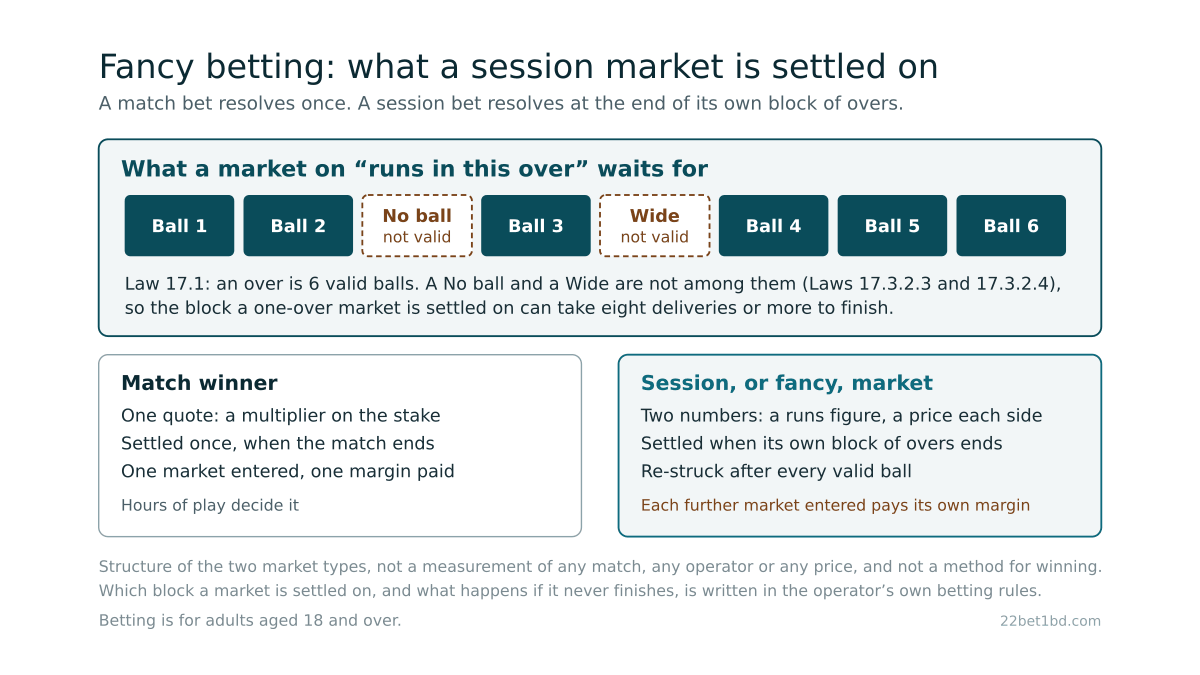
The over is where this gets concrete, because an over is not six deliveries. Under the Laws of Cricket the ball is bowled in overs of 6 valid balls, which is Law 17.1, and Law 17.3 lists what is not a valid ball: a No ball is not one of the six under 17.3.2.3, a Wide is not one of the six under 17.3.2.4, and 17.3.3 states that only valid balls count towards the six. A market on "runs in this over" therefore waits for six valid balls, not six deliveries, and an over containing two of those calls runs to eight deliveries before anything settles. Every one of the extra deliveries is live play that can produce runs.
Blocks longer than an over bring a second complication. How many overs an innings contains is set by the playing conditions for the format, which the ICC publishes separately for Tests, ODIs and T20Is and revises, so a shortened match can leave a block of overs that never arrives. What happens to the bet then is a question for the operator's settlement rule, not for the scorecard.
How do you read betting odds in cricket when the market is a session market?
Expect two numbers where a match market shows one. A match price is a multiplier: divide one by it and you have the chance being priced, which is the arithmetic set out in how cricket betting odds work. A session quote instead names a quantity of runs and attaches a price to each side of it, one for the total finishing above the figure and one for it finishing below.
That changes what movement means. In a match market the price moves and the outcome stays the same. In a session market the figure itself moves, so a quote taken a minute ago and the quote on screen now are not two prices for one bet: they are two different bets. Your own bet stays struck on the figure you were given, which is why it is worth reading the confirmation rather than the screen you tapped.
The two sides of the figure also exist at every moment, because somebody has to hold each end of any bet. That symmetry, and who is allowed to sit on which side of it, is covered in back and lay in cricket betting.
What is cricket gambling on a session, compared with backing a winner?
Three differences, and all three work against the person placing the bet.
The first is horizon. A match bet is decided by hours of play, so a single delivery rarely settles it. A one-over market is decided by a handful of balls, where one boundary or one wicket is the whole result. Shorter horizon means the outcome depends far more on chance and far less on anything a reader could study in advance.
The second is how often the margin is paid. The operator's cut is built into the price of every market it offers, so entering one market pays it once and entering twenty session markets in one match pays it twenty times. A bettor who is right slightly more often than the price implies can still finish behind, and the arithmetic of that is worked through in is cricket betting profitable.
The third is settlement. A match bet usually survives an interruption, because the match itself gets a revised target and still produces a winner. A session bet needs its own block to finish, and the shortened and abandoned cases are frequent in this sport rather than exotic.
Why does a fancy rate move after every ball?
Because what is being priced is only the part of the block still to come, and that shrinks with every delivery. A wicket, a bowling change, a new batter at the crease or the end of a fielding restriction each rewrite the remaining span, and with it the figure.
Two mechanical consequences follow, and neither is a fault. In-play markets typically suspend between deliveries rather than reprice straight through them, and the reason is latency: the picture reaching a viewer lags the feed reaching the trading screen, and a market left open across that gap could be taken by somebody who already knows what happened to the ball. And because of that same lag, a bet request can be accepted at a different figure from the one displayed, or declined outright. The rule deciding which happens is in the operator's betting rules.
Is match betting illegal, and where does fixing come into it?
Those are two separate questions that the phrase runs together.
The first is whether a person may place the bet at all, and that is answered by the law where that person is, not by the operator's licence. In Bangladesh the Gambling Prevention Act 2026 has been in force since 1 July 2026 and makes taking part in gambling punishable, alongside advertising and promoting it. A licence granted somewhere else does not change that: the Curaçao framework, reformed by the National Ordinance on Games of Chance in December 2024, regulates the companies it licenses, and it says nothing about the person placing a bet in another country. What the law in Bangladesh actually says is set out in is betting legal in Bangladesh.
The second question is fixing, and session markets sit at the centre of it. The ICC's Anti-Corruption Unit states that corruption exists because of the ability to profit by betting on the result of a match or a specific part of the match when the outcome has been predetermined, and notes that betting occurs on unregulated markets "predominantly in the sub-continent where betting is a crime". A specific part of the match is exactly what a fancy market prices, which is why a bowler conceding an agreed number of runs in an agreed over is the classic form of this offence. What the unit polices is conduct inside the game: the risk it names is that attempts will be made to involve participants in such practices, not that somebody placed a bet. So this is not a rule about the customer. It is a warning about the market: a quantity that one player can control is a quantity one player can be paid to control.
What should you read before a session bet, and what cannot be known from here?
The settlement rule, first, because it decides the cases that actually arise: what happens if the block is never completed, whether the innings ending mid-block voids the bet or settles it on the runs so far, whether extras count towards the figure, and what becomes of a bet on a batter who never faces a ball. None of that is in the Laws of the game. It is in the betting rules of the account, it differs between operators, and it changes. 22Bet is the operator this site covers, and how its cricket markets are arranged is described in the 22Bet review.
Second, the acceptance rule, since it governs the gap between the figure you tapped and the figure you got.
What this page cannot give you is an edge. Understanding why a figure moves explains the market, it does not predict the next ball, and no reading of a session quote changes the fact that the operator's margin sits inside it. Betting is for adults aged 18 and over, the money staked is at risk, and a run of losses is a reason to stop rather than a reason to raise the stake.
Frequently asked questions
What is a 7 bet called?
A slip with seven selections that must all win is a sevenfold accumulator, and the full cover version of the same seven, which stakes every combination of two or more rather than only the seven together, is usually sold as a Super Heinz. Full cover is where the name matters: seven selections produce 120 such combinations, so that is 120 stakes rather than one, and a slip funded in the usual way costs 120 times the unit you typed. These are bookmakers' trade names rather than rules of cricket, so the authority is the bet type printed on the slip.
Who bet $100 to win 1.7 million?
That question comes from stories about long multiples in other sports, and which particular bet it refers to is not something this site can verify, so it is not repeated here as fact. The part worth keeping is the arithmetic. A stake returning seventeen thousand times itself is priced at odds of 17,000.0, which implies a chance of roughly one in seventeen thousand. Published stories are drawn from the slips that came in, and the ones that did not are not news, which is the whole reason this shape of bet looks more attractive in a headline than in a ledger.
Is fancy bet in cricket available in an app, and does it work the same way?
The markets come from the same trading feed as the website, so the quotes are the same ones. What can differ is latency and how the app handles a figure that moves while a bet is being placed: some clients ask again, some decline. That behaviour belongs to the operator's rules rather than to the device.
What is the best fancy bet in cricket?
There is no answer to this that would survive contact with the next match, and anyone presenting one is describing a preference rather than a measurement. What can be compared between two session markets is structural: how wide the two sides of the figure sit, how clearly the block is defined, and what the rule says when the block does not finish. Those are the things that are knowable before a ball is bowled.